
Shimadzu launches MultiNA II Microchip Electrophoresis System for DNA and RNA analysis
It is ideal for use in private and commercial testing laboratories, as well as academia including medical, agricultural, pharmaceutical, science and engineering research applications
23 Oct 2026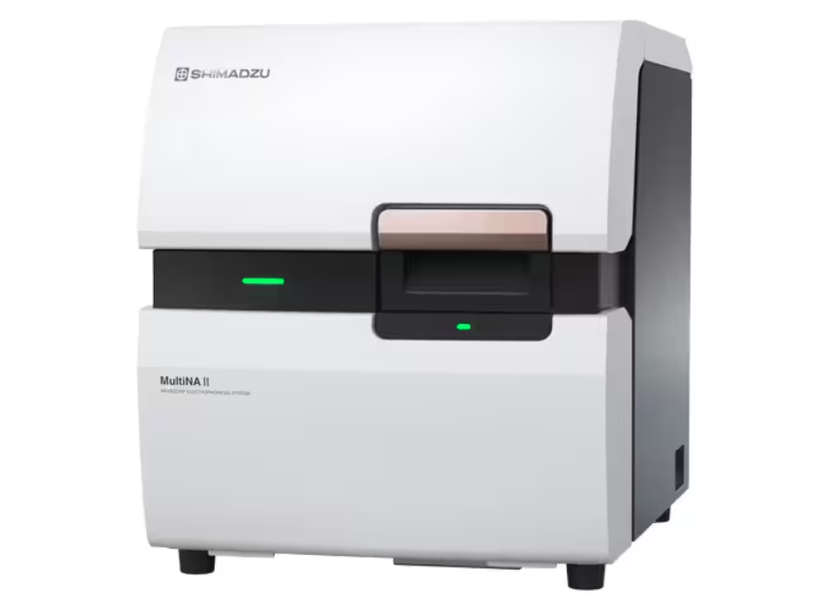
MultiNA II MCE-301 Microchip Electrophoresis System
Shimadzu Scientific Instruments has introduced the MultiNA II MCE-301 Microchip Electrophoresis System designed for the size analysis of DNA and RNA.
The system reflects growing analytical demands driven by next-generation sequencing (NGS), genome editing and RNA-based workflows that require diverse analysis functions and high-sensitivity detection.
The system supports the calculation of RNA degradation indictors and is compatible with Shimadzu’s newly released high-sensitivity detection kit (DNA-HS12000 Kit). It is ideal for use in private and commercial testing laboratories, as well as academia including medical, agricultural, pharmaceutical, science and engineering research applications.
Smart, simplified workflow design
The MultiNA II MCE-301 Microchip Electrophoresis System enables efficient, reliable analysis using simple operations. The intuitive software provides clear-cut procedures for automatic analysis, significantly increasing laboratory productivity.
Operators can automatically dilute samples with purified water to ensure the concentration is within the quantitative concentration range. In addition, users can pause the system during an analysis to add up to 120 samples.
Gel images can be rearranged into any order, regardless of the actual sample analysis order. Past data can be displayed next to current data for easy comparison. In addition, it is easy to display size prediction values as red-line size guides within gel images or electropherograms.
The removable sample rack holds up to 96 plates, and up to two types of reagent kits can be loaded in a mixed arrangement.
Enhanced analysis functions
Because extracted RNA continues to decompose as time elapses, the MultiNA II MCE-301 Microchip Electrophoresis System can calculate RNA Integrity Index (RII) values as an independent method of evaluation. The RNA integrity values align with those produced by non-Shimadzu platforms, with a 0.95 or higher correlation.
For DNA fingerprinting analysis with a positive control, the system automatically determines the presence or absence of each DNA fragment. After analysis, results can be collectively listed or shown grouped with other samples of the same type.
Expandable application range
The MultiNA II MCE-301 Microchip Electrophoresis System provides grouping analysis and molar concentration ratio analysis to support screening genome-edited samples. Electrophoresis of heteroduplex DNA can be used to determine the presence or absence of mutations and the genotype.
The system automatically detects grouping analysis discrimination between homo and hetero types and between mutation types and displays it as a single list. The system can also calculate molar concentration ratios of peaks within a user-defined size range.
Next-generation sequencers
With the high-sensitivity kit, smear analysis functionality and RNA integrity index calculation, MultiNA II system can easily evaluate the quality of NGS samples. The smear analysis functionality can be used to calculate the average size and concentration values. Used in combination with a high-sensitivity kit, library data can be evaluated for concentrations down to 5 pg/µL.
Platform enables full drug/vaccine characterization
Lipid nanoparticles (LNP) and adeno-associated virus (AAV) vectors are new therapeutic solutions that require characterization and Shimadzu offers a full solution. Use the Centrifugal Field-Flow Fractionation (CF3) system for LNP and AAV size characterization, extract mRNA and single strand DNA and run them seamlessly on the MultiNA II for size confirmation.
Energy savings
Compared with previous models, the MultiNA II system uses 30% less power and has a 27% smaller footprint, making it well suited for laboratories with limited space. The system also requires more than 40% less purified water for rinsing, helping reduce liquid waste and overall environmental impact.
Want the latest science news straight to your inbox? Become a SelectScience member for free today>>
Links
Tags
Frequently asked questions
Show frequently asked questions
What is the Shimadzu MultiNA II MCE-301 Microchip Electrophoresis System used for?
The MultiNA II MCE-301 performs DNA and RNA size analysis for applications including next-generation sequencing (NGS), genome editing, DNA fingerprinting, mutation detection, and RNA-based research. It also supports high-sensitivity detection, smear analysis, grouping analysis, molar concentration ratio analysis, and RNA Integrity Index calculation.
How does the MultiNA II evaluate RNA integrity and NGS sample quality?
The MultiNA II calculates RNA Integrity Index (RII) values, which correlate at 0.95 or higher with values from non-Shimadzu platforms. Its smear analysis calculates average size and concentration. When paired with the DNA-HS12000 high-sensitivity kit, it can evaluate NGS library concentrations down to 5 pg/µL.
How does the MultiNA II improve laboratory productivity and sustainability?
The MultiNA II offers automatic analysis, sample dilution, comparison of past and current data, and the ability to add up to 120 samples during paused analysis. Its removable rack holds up to 96 plates. Compared with previous models, it uses 30% less power, occupies 27% less space, and requires over 40% less purified rinsing water.