
Applying model-informed drug development moves dosing beyond escalation
Evotec experts explain how timely evidence, integrated modeling, and cross-functional collaboration can support better-informed dose optimization decisions
27 Oct 2026
Across drug development, there is increasing emphasis on identifying doses that balance efficacy, safety and tolerability, rather than relying primarily on traditional dose-escalation approaches. This shift is particularly evident in oncology, but successful dose optimization requires more than sophisticated modeling. Clinical teams must bring together safety, pharmacokinetic, biomarker, and efficacy data while trials are still running, ensuring critical dose decisions are informed by the right evidence at the right time.

(Left) Andrea Nizzardo, Clinical Biometry Manager, Evotec and (right) Dr. Cristina Costantin, Vice President of Clinical Operations, Evotec
For decades, oncology dose finding has focused on identifying the maximum tolerated dose (MTD). The U.S. Food and Drug Administration (FDA)’s Project Optimus is shifting that approach towards identifying doses that balance efficacy with safety and tolerability, with its 2024 guidance on oncology dosage optimization setting out recommendations for dose selection during clinical development.
More broadly , the International Council for Harmonization (ICH) M15 guideline adds a framework for model-informed drug development (MIDD), establishing shared principles for how model-informed evidence should be planned, evaluated, and reported.
Together, these developments are increasing the importance of integrating different sources of clinical evidence to support dose selection. Yet generating that evidence is only part of the challenge. It must also be available, reliable and ready for interpretation when decisions need to be made.
At Evotec in Verona, Italy, Dr. Cristina Costantin, Vice President of Clinical Operations, and Andrea Nizzardo, Clinical Biometry Manager, work across both sides of this challenge: designing and conducting early clinical studies and transforming the resulting data into evidence that can guide development decisions.
In an earlier SelectScience® interview, Evotec experts explored how integrated expertise can help identify development risks before a candidate enters the clinic. Here, Costantin and Nizzardo discuss what happens once a trial begins, and why successful dose optimization depends as much on operational readiness and effective governance as it does on quantitative modeling.
Why dose optimization is replacing the maximum tolerated dose
The MTD paradigm rested on an assumption that held for cytotoxic chemotherapy: more drug, more effect. In targeted therapies, immunotherapies, antibodies, and gene therapies, the relationship between exposure and response is far more complex.
"As a consequence, the highest tolerated dose is not necessarily the best dose," Nizzardo explains, citing Project Optimus as reinforcing the move away from MTD.
Instead, dose optimization requires a broader assessment of how much drug patients receive, how their bodies respond, and whether increasing exposure delivers additional therapeutic benefit.
This is where model-informed drug development becomes particularly valuable. By combining quantitative models and analyses with clinical and biological evidence, development teams can better understand relationships between dose, exposure, response, and tolerability.
"Instead of asking if a particular dose is safe, we can ask what level of exposure is driving the biological effect that we want. That is quite a different question," Nizzardo says.
Rather than relying on individual results in isolation, this approach can help teams evaluate competing signals and identify doses that offer a more appropriate benefit-risk balance.
Instead of asking if a particular dose is safe, we can ask what level of exposure is driving the biological effect that we want. That is quite a different question.
Andrea Nizzardo Clinical Biometry Manager, Evotec
How dose optimization is reshaping clinical operations
Although dose optimization is often discussed in terms of modeling and statistics, its success also depends on how clinical studies are designed and executed.
Clinical operations have traditionally made sure a study runs to protocol and follows Good Clinical Practice (GCP) while delivering clean data at agreed milestones. When a study must support dose and cohort decisions, the job changes, and in Costantin's view, clinical operations "becomes an active enabler of timely, evidence-based decision-making."
Safety assessments, laboratory results, PK samples, biomarker data, and data cleaning have to be scheduled around decision milestones rather than conventional ones. Investigative sites also need to enter data promptly, resolve decision-critical queries within agreed timelines, and maintain communication with the wider development team.
A delay in laboratory reporting or data transfer can affect more than the availability of an individual result. It can postpone the next dose decision, slowing the progress of the trial. For biotechnology companies entering clinical development, this makes operational planning an essential component of a successful dose optimization strategy.
Planning clinical trial data around dose decisions
Operational readiness for dose decisions begins, in Costantin's experience, before the site initiation visit. The first step is to name each decision expected during the trial and the critical data it requires, then work backwards to set collection schedules, delivery timelines, review processes, and governance. Every function needs to know its responsibilities and timelines from day one.
The pathway that needs most attention runs from sample logistics through laboratory turnaround and data transfer to centralized review. Because the steps are sequential, one delayed dataset can postpone an entire dose review meeting. "Decision readiness is an operational design principle, not an activity that is performed only on demand," she says.
Turning separate data streams into one dose decision
Most early studies already generate plenty of data. "Having data available is not the same thing as having information available," Nizzardo points out. Data must arrive in the agreed format and quality, with traceability maintained across systems.
Nizzardo sees the same need for upfront planning on the data side, with standards, transfer specifications, internal timelines, and decision milestones established before the study begins.
A single dataset rarely tells the whole story. Lower-than-expected exposure in PK data might favor escalation, but biomarker evidence could simultaneously show that the desired biological effect has already plateaued, while laboratory results point to emerging safety concerns. Viewed together, those signals could lead to a very different dose decision. That fuller picture is only valuable if the data arrives in time to be considered together.
Governance turns clinical evidence into action
Clinical trials generate new information as they progress, but that information is only valuable if teams are ready to act on it. Costantin argues for bringing operational, medical, quantitative, and translational teams together with sponsor leadership when important decisions need to be made, with clear responsibilities agreed from the start.
“Good governance reduces the delay between learning something new and acting on it appropriately,” she says. Planning reviews around these key decision points helps teams respond to emerging evidence when it matters, rather than waiting for the next scheduled meeting.
How early integrated evidence shapes later-stage clinical development
Dose selection is only one output of a model-informed approach, which Nizzardo calls "a decision tool that can transform data into knowledge." He sees more value in what it reveals about how a compound behaves in patients, including what drives variability between them. Sponsors can use that knowledge to refine patient selection and choose endpoints more likely to meet a study's primary objective in Phase II and Phase III trials.
"One of the most expensive situations in drug development is when you discover at a late stage that one of your critical assumptions was wrong," Nizzardo says. Testing assumptions early lets major investment follow evidence and avoids costly protocol amendments later.
What biotech leaders should look for in clinical development partners
Biotech companies entering the clinic often outsource most of their early development activities. Technical capability remains important, but Costantin advises judging partners above all on whether they can work together to support fast, informed decisions. She looks for proven early-phase experience within cross-functional governance and the flexibility to adapt as evidence reshapes the program.
Governance with every partner, down to escalation pathways, should be agreed from the outset. "In early development, the best partners are not those who generate the most data, but those who help transform data into better decisions," she says.
Evotec’s clinical development and translational medicine offering brings Phase I and Phase II study management, clinical data management, biostatistics, PK/PD, and pharmacometrics into the same organization, reducing the hand-offs between generating evidence and using it to inform dose decisions. For Costantin and Nizzardo, the opportunity is to build this integration into development from the very beginning, so that teams are ready not simply to generate data, but to turn it into better-informed decisions.
In early development, the best partners are not those who generate the most data, but those who help transform data into better decisions.
Dr. Cristina Costantin Vice President of Clinical Operations, Evotec
Explore model-informed dose optimization in practice
The conversation does not end here. On October 30, Costantin and Nizzardo will join SelectScience for an exclusive webinar exploring how model-informed drug development strategies can be planned from the outset to support smarter decisions as a program progresses.
Register for free: From dose escalation to dose optimization through Model-Informed Drug Development.
Related products
Request Quote for All Products
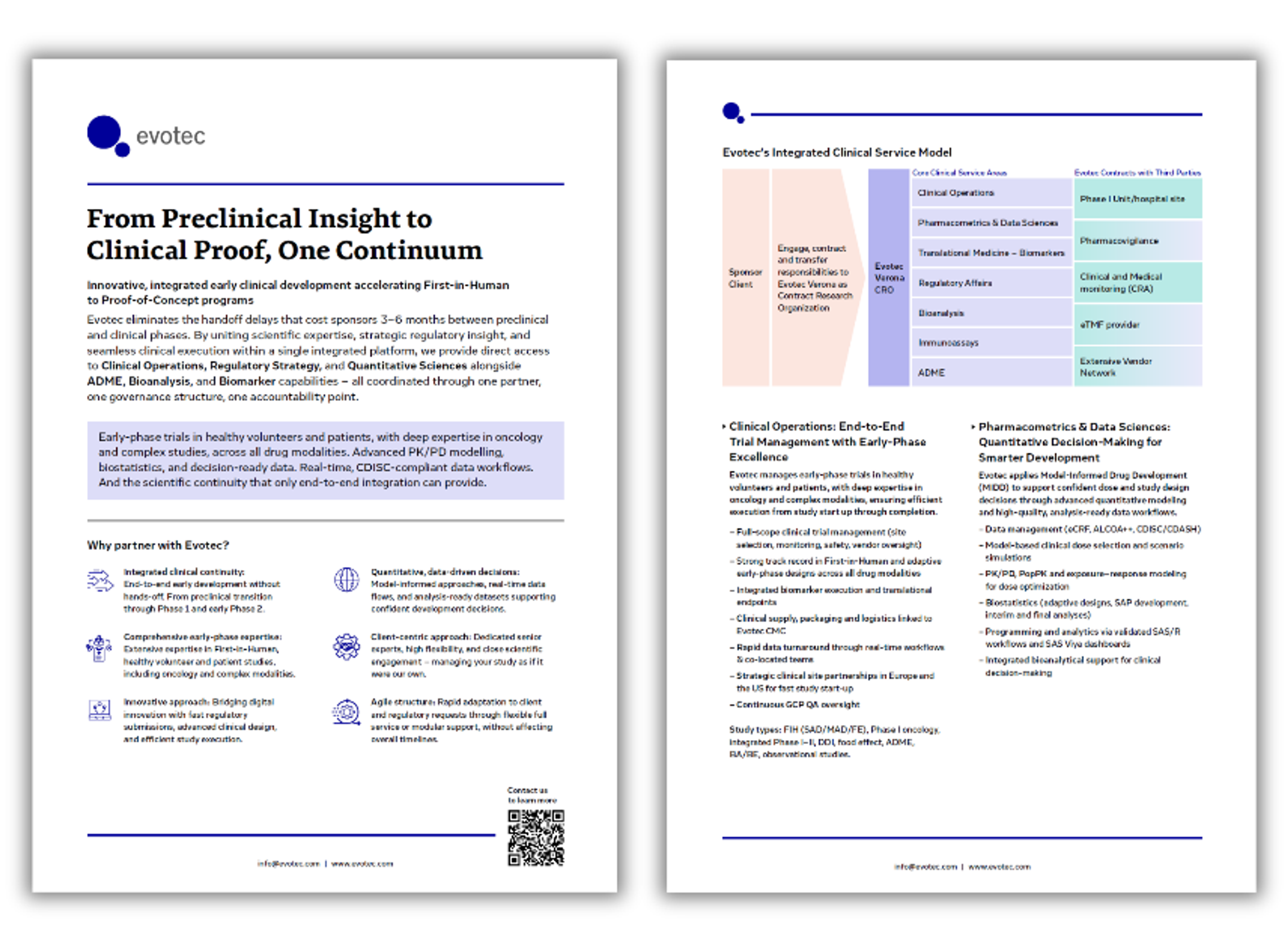
Early-Phase Clinical Development & Translational Medicine Services
EvotecEnd-to-end early clinical development, from first-in-human and proof-of-concept trials to regulatory submissions, biomarker translation, bioanalysis and clinical supply, delivered by one senior team with a single point of contact.
Links
Related content

Tags
Frequently asked questions
Show frequently asked questions
Why is dose optimization replacing the maximum tolerated dose in oncology?
The FDA’s Project Optimus encourages oncology drug development teams to select doses that balance efficacy, safety, and tolerability. Unlike cytotoxic chemotherapy, targeted therapies, immunotherapies, antibodies, and gene therapies may not produce greater benefits at the highest tolerated dose.
How does model-informed drug development support dose selection?
Model-informed drug development (MIDD) combines quantitative models with pharmacokinetic, biomarker, efficacy, safety, and biological evidence. Guided by frameworks such as ICH M15, it helps clinical teams understand dose-exposure-response relationships and identify doses with an appropriate benefit-risk balance.
Why are clinical operations and governance essential for oncology dose optimization?
Clinical operations must align sample logistics, laboratory reporting, data transfers, cleaning, and reviews with dose-decision milestones. Clear cross-functional governance enables operational, medical, quantitative, translational, and sponsor teams to interpret integrated evidence promptly and act without avoidable trial delays.