
De-Risk Early or Pay Later: The power of comprehensive de-risking, from NAMs to beyond
Evotec experts explain why early de-risking is more than avoiding failure, it is about helping the right drug candidates succeed
16 Sept 2026
It is well understood in drug development that failures get more expensive the later they happen. Yet many candidates are not evaluated early enough to inform critical go/no-go decisions or reveal risks that could derail development later. A safety signal missed until a Good Laboratory Practice (GLP) toxicology study, or worse, until the clinic, costs far more to address than the same signal caught before a candidate is ever committed to development. That gap, between a liability caught early and one caught too late, is the starting point for Marina Galvani, VP, Scientific Strategy Leader at Evotec in Verona, and Paul Walker, VP, Head of Toxicology and Innovation Efficiency at Cyprotex, an Evotec company.

Marina Galvani, VP, Scientific Strategy Leader, Evotec and Paul Walker, VP, Head of Toxicology and Innovation Efficiency, Cyprotex
In this exclusive SelectScience interview, they unpack why de-risking drug development early, backed by new approach methodologies (NAMs), is one of the most valuable decisions a team can make before investigational new drug (IND)-enabling work begins.
Where the cost of a missed liability really escalates
The cost of failure rises at every clinical phase, Galvani explains, so a Phase 3 failure is the costliest outcome of all. That is why comprehensive de-risking and a translational strategy are worth building before Phase 1 or Phase 2, before bigger investments are made and when problems are easier to fix.
The same principle applies even earlier in development than many teams realize. "With this small investment before, you could avoid a major expenditure for failure later," Galvani adds. A failure at the IND-enabling stage can often be avoided if predictive testing has already identified the underlying risk. For teams advancing a small number of lead candidates, that early visibility is not just about avoiding setbacks; it is about recognizing which candidates have the strongest chance of success and focusing resources accordingly.
Critically, Galvani notes that a robust evidence package can also increase investor confidence by demonstrating not only that a candidate has promise, but that it has a credible path through drug development.
With this small investment before, you could avoid a major expenditure for failure later
Marina Galvani ,VP, Scientific Strategy Leader, Evotec
How integrated de-risking strengthens drug candidate selection
Drug candidates can fail for many reasons, including toxicology concerns, drug metabolism pharmacokinetic (DMPK) challenges, and chemistry, manufacturing and controls (CMC) or developability issues. True de-risking requires a balanced assessment of all these factors, supported by expertise across each discipline. However, Galvani argues that the real advantage lies in integration. By connecting these specialist areas, teams can better understand how risks interact and avoid the blind spots that often arise from a fragmented, multi-vendor approach.
"You cannot fully elucidate the toxicology or the efficacy if you have not solved the problem of exposure," she explains, pointing to how bioavailability and formulation are bound up with DMPK and metabolism. A single framework helps teams prioritize and address the issue with a multidisciplinary approach, so when a project throws up an unexpected result, the right expertise is already at the table to interpret it and determine the most appropriate path forward.
On Walker's own integrated projects, he notes that chemists, DMPK experts, and toxicologists meet regularly alongside the client team, so decisions draw on "a shared voice and a collective opinion." That collective view allows teams to interpret findings through multiple expert lenses, helping ensure no critical consideration is assessed in isolation.
Galvani takes this further than cross-discipline integration alone. Evotec's environment brings discovery and development expertise around a candidate much earlier than would traditionally be possible, enabling teams to assess developability, safety, and translational potential in parallel rather than in sequence. She describes this as a "discovery-to-development continuum", an approach she says improves both the quality and speed of candidate evaluation.
The overlooked risks that derail promising drug candidates
Efficacy and safety tend to get the attention they deserve, Galvani says, since they are the clearest evidence of a drug's value. What is underestimated more often is CMC, with complex active pharmaceutical ingredients needing deeper synthesis work, or unresolved formulation and solid-state problems.
While CMC issues rarely end a program outright, they do cause delays and added costs that catch teams off guard, primarily because it is the area most likely to have gone unexamined until development is already underway.
How predictive safety tools and NAMs are transforming early assessment
A broad range of NAMs are now deployed earlier in discovery, Walker says, to triage and select the strongest compounds. Advances in AI and machine learning have made in silico prediction from structure alone far more capable, drawing on much larger reference data sets covering a wide range of mechanistic assays.
As candidates progress, more sophisticated in vitro NAMs come into play, including micro-physiological systems, often combined with iPSC-derived cell models. Evotec has also built a large transcriptomics data set spanning hundreds of reference compounds, letting the team develop AI and machine learning models that translate mechanistic responses into predicted clinical outcomes.
Moving beyond risk flags in predictive safety assessment
A weight-of-evidence approach still underpins fast, early decision-making, Walker explains. Simpler assays such as mitochondrial assessment or Bile Salt Export Pump (BSEP) inhibition remain valuable because hundreds of reference molecules have shown what a combination of flags reliably predicts. A cholestatic risk signal alongside mitochondrial effects, for example, carries a strong likelihood of drug-induced liver injury (DILI).
Evotec has since moved beyond flag-counting, building XGBoost-based interpretation tools that combine a broad panel of NAM data into a single risk assessment against exposure. Understanding the mechanism behind a toxicity, not just flagging that one exists, is what lets a team determine whether a risk can be managed, mitigated, or is significant enough to halt progression.
Where the industry still has work to do
Galvani and Walker are equally candid about where current tools fall short. In vitro systems cannot yet fully recapitulate a living organism, from the complexity of tissue vasculature to the diversity of cell types working together, and iPSC-derived organ models, while promising, cannot yet reproduce a complete tissue system.
"There's a clear gap," Walker points out, when it comes to translating preclinical findings to humans, a challenge that continues to influence candidate selection and development decisions across the industry. Galvani adds that no predictive tool replaces sound study design: evidence generated early informs how later studies are built, from species selection to dosing regimen and study readouts, producing more reliable, more defensible data, while the final answer still comes from seeing a compound's behavior in the human body.
A clearer path to IND through early de-risking
When comprehensive de-risking and predictive safety converge into a single pathway toward IND, Galvani describes a discovery-to-development continuum where the line between discovery and development starts to disappear.
Development scientists can weigh in on a preclinical program early, and clinical scientists can be brought into discovery discussions, so every discipline needed at a given moment is available at the same table rather than coordinated across separate providers.
A growing evidence base backs this up further down the pipeline, with Walker stating that published research suggests a comprehensive NAM-based de-risking approach can reduce failures at the costly GLP stage, in step with a wider industry shift toward using NAMs earlier and more broadly across drug development.
For Evotec, early de-risking is not simply about preventing failure, it is about helping the right drug candidates succeed and define a more data-informed plan to IND. After repeatedly seeing promising programs held back or delayed by risks that could have been identified much earlier, Evotec developed INDiGO Select to assess candidate readiness before critical development decisions are made. Bringing together expertise across chemistry, formulation, DMPK, and safety, the approach helps teams identify high-potential candidates sooner, build confidence in development decisions, and give the most promising programs the strongest possible chance of success.
Related products
Request Quote for All Products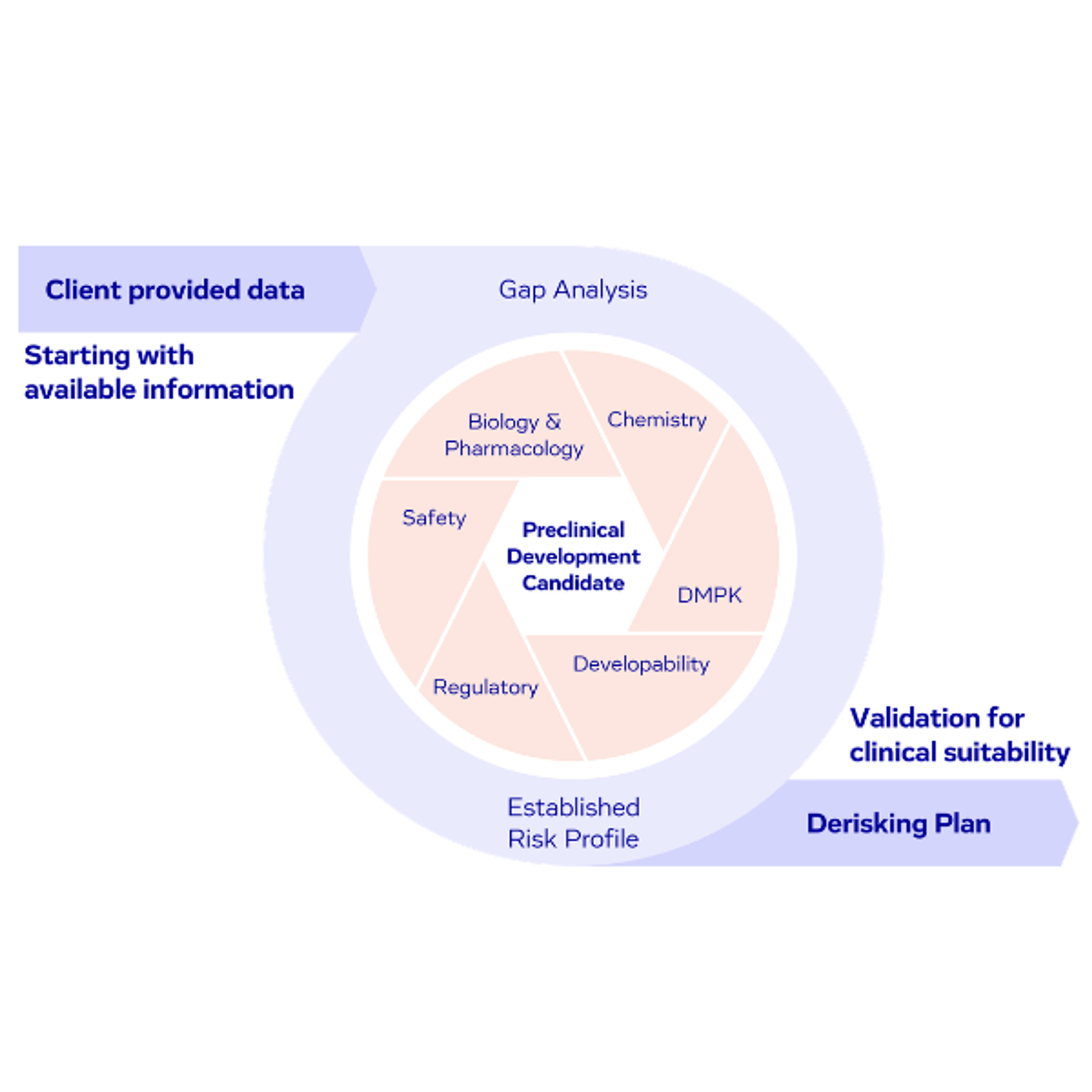
INDiGO Select
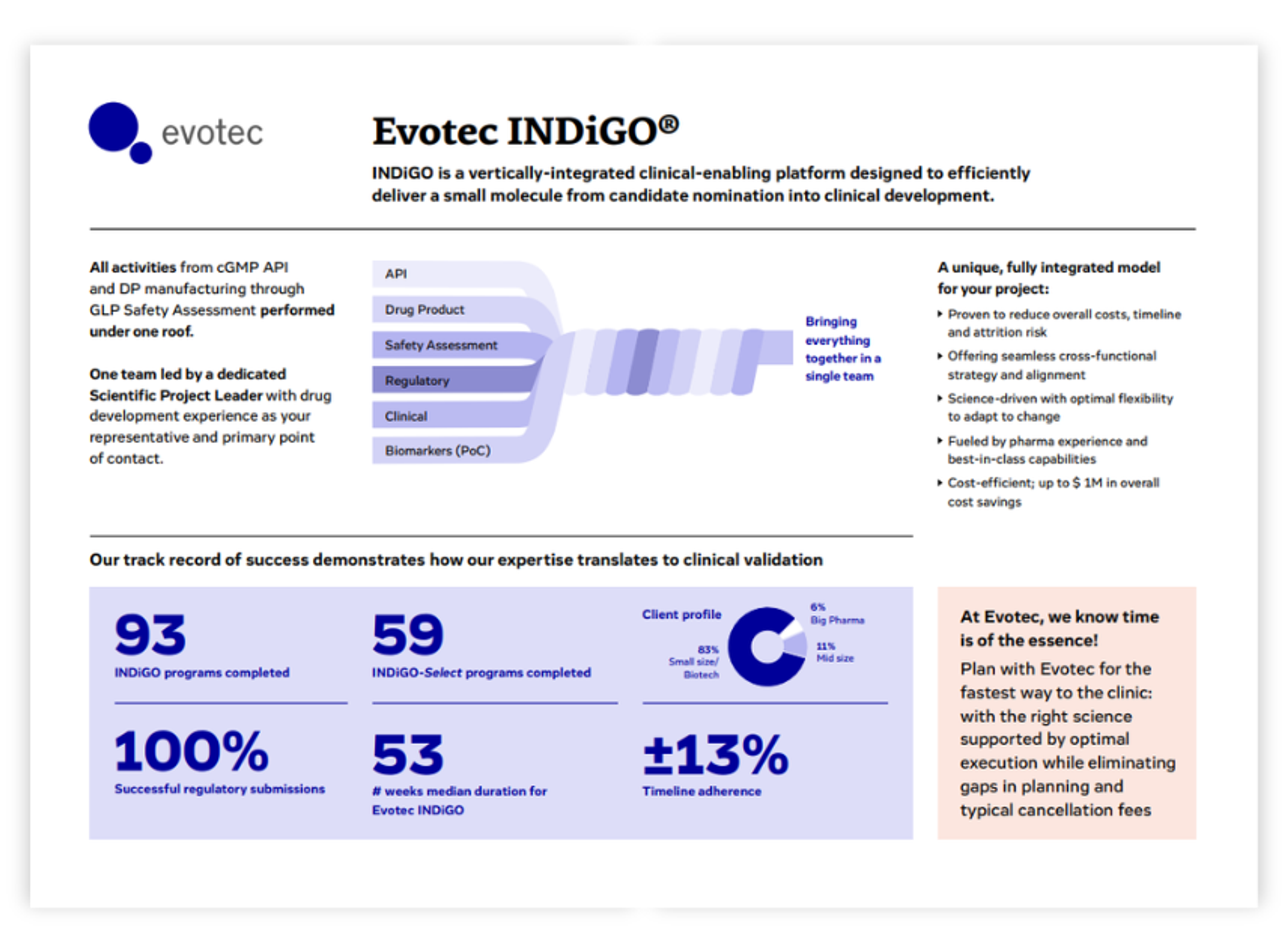
EvotecAn integrated candidate de-risking package that helps early-stage teams choose the right molecule to take forward, and reach IND faster. It brings the critical early developability, safety and DMPK questions into one coordinated workstream, so you can make a confident go/no-go decision before committing to a full IND-enabling programme.
Links
Related content
Tags
Frequently asked questions
Show frequently asked questions
How does early de-risking reduce costly failures in drug development?
Early predictive testing can identify safety, toxicology, DMPK, CMC, formulation, and developability risks before IND-enabling studies or clinical trials. According to Marina Galvani, addressing liabilities early helps teams avoid expensive late-stage failures, prioritize stronger drug candidates, focus resources, and build investor confidence.
How are new approach methodologies transforming predictive safety assessment?
New approach methodologies (NAMs) combine in silico prediction, AI, machine learning, mechanistic assays, micro-physiological systems, iPSC-derived models, and transcriptomics data. Paul Walker explains that these tools support weight-of-evidence decisions, predict risks such as drug-induced liver injury, and help determine whether toxicity can be managed, mitigated, or should halt development.
What is Evotec’s INDiGO Select approach to drug candidate readiness?
INDiGO Select assesses candidate readiness before critical development decisions. Evotec integrates chemistry, formulation, DMPK, and safety expertise within a discovery-to-development continuum. This multidisciplinary approach helps identify high-potential candidates sooner, strengthen development decisions, reduce potential GLP-stage failures, and create a more data-informed path toward an investigational new drug (IND).