
Agilent introduces the 9500 Triple Quadrupole ICP-MS – Redefining trace element analysis
Next-generation triple quadrupole ICP-MS delivers faster acquisition, simplified interference removal, and improved workflow efficiency
2 Jun 2026
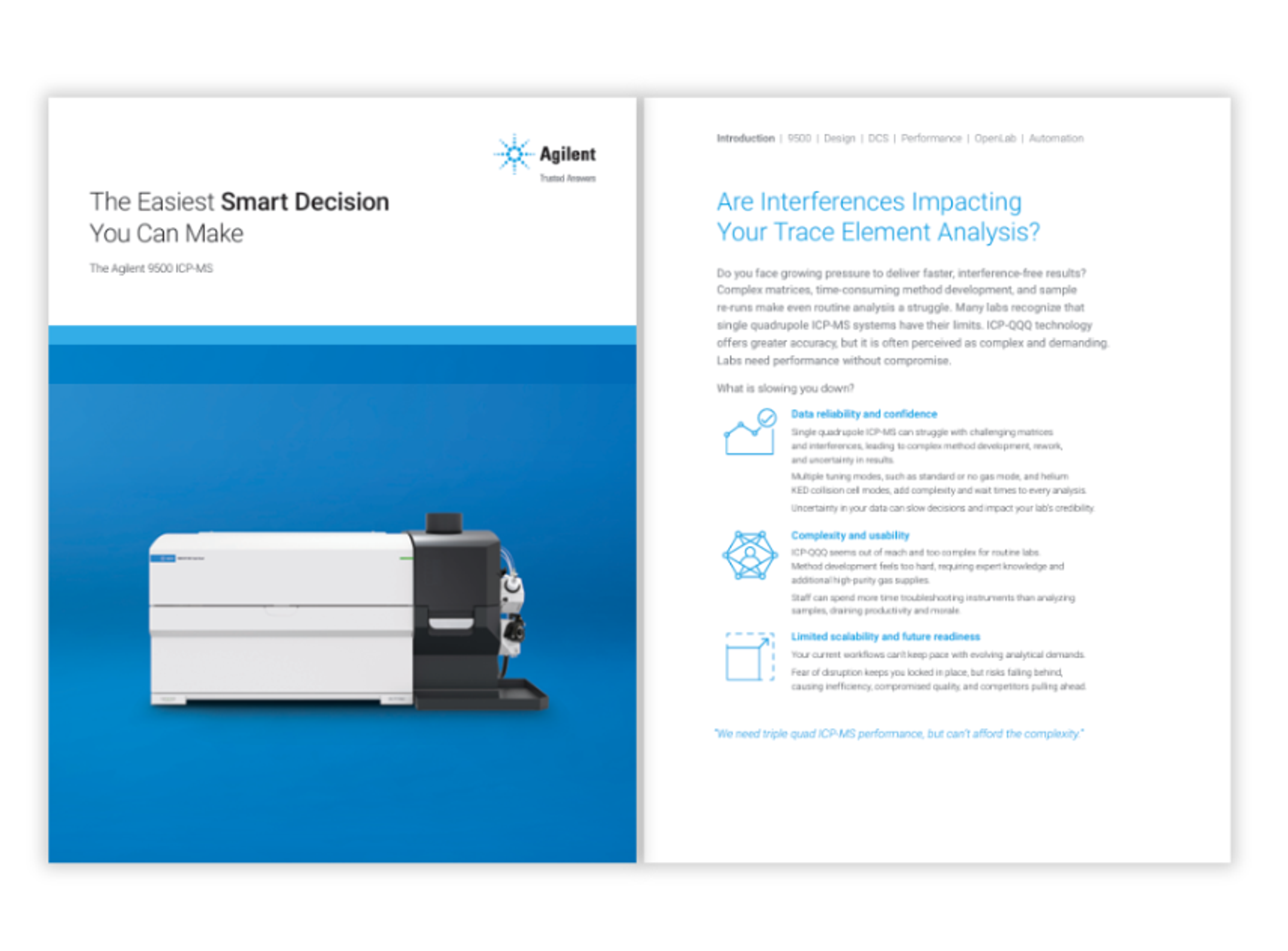
Agilent Technologies Inc. has launched the Agilent 9500 Triple Quadrupole ICP-MS, a next-generation inductively coupled plasma mass spectrometry system. Designed to help laboratories using single quadrupole ICP-MS transition to triple quadrupole ICP-MS, the Agilent 9500 ICP-MS enables faster, interference-free trace elemental analysis while reducing operational complexity and supporting higher-quality data across environmental, food, pharmaceutical, fine and specialty chemical, advanced materials, and contract testing applications.
Next-generation triple quadrupole ICP-MS for evolving testing demands
As testing requirements become more complex and skilled analytical resources remain limited, laboratories are under pressure to deliver rapid, accurate trace element measurements without increasing workload. The Agilent 9500 ICP-MS addresses these needs by improving productivity, simplifying advanced interference removal, and enabling laboratories to generate high-quality data with greater confidence.
The system is specifically designed to support laboratories that currently rely on single quadrupole ICP-MS, providing a practical pathway to adopt triple quadrupole technology for both routine and advanced elemental analysis.
Key innovations: Air Cell, Advanced Helium Mode, and Dual-Cell System
The Agilent 9500 ICP-MS introduces several new technologies to enhance interference control and streamline workflows. These include Air Cell and Advanced Helium Mode (AHM), both enabled by Agilent’s proprietary Dual-Cell System (DCS). Together with intelligent OpenLab ICP-MS software, these capabilities help redefine traditional single quadrupole workflows.
By combining Air Cell, AHM, and DCS, the 9500 ICP-MS supports faster data acquisition, reduced rework, and easier adoption of triple quadrupole ICP-MS methods. Laboratories can maintain familiar workflows while accessing more advanced interference removal strategies to handle challenging sample matrices.
Simplified transition from single quadrupole to triple quadrupole ICP-MS
The Agilent 9500 ICP-MS is built on established Agilent workflows and is supported by OpenLab ICP-MS software to enable straightforward and confident adoption of triple quadrupole technology. Routine users can migrate existing single quadrupole methods with minimal disruption, while gaining the analytical depth needed to address increasingly complex samples.
Faster measurements and improved interference removal
The Agilent 9500 ICP-MS delivers a typical reduction of more than 33% in acquisition time, helping laboratories increase sample throughput and reduce the analysis cost per sample. This performance improvement supports laboratories facing growing sample volumes and tighter turnaround times.
Advanced interference removal, including the ability to use ambient laboratory air for triple quadrupole reactions, reduces method complexity and minimizes reliance on oxygen cylinders. This capability supports more efficient and sustainable laboratory operations by simplifying gas supply requirements and reducing associated costs and logistics.
Enhanced data quality and confidence in complex matrices
By enhancing interference removal, sensitivity, and productivity, the Agilent 9500 ICP-MS helps laboratories reduce reruns and improve confidence in reported results. The system is designed to handle increasingly complex sample matrices encountered in environmental monitoring, food safety testing, pharmaceutical quality control, fine and specialty chemical production, advanced materials research, and contract testing services.
With workflows that feel familiar and intuitive to existing ICP-MS users, the 9500 ICP-MS delivers the confidence and performance of triple quadrupole analysis without adding unnecessary complexity. Laboratories can take on more demanding applications while maintaining reliable, reproducible results.
“With the Agilent 9500, we are fundamentally changing how laboratories adopt and use triple quadrupole ICP‑MS,” said Geoff Winkett, vice president and general manager of Agilent’s Spectroscopy and Vacuum Division. “By making advanced capability straightforward and easily accessible, the 9500 enables customers to migrate their existing single quadrupole methods while benefiting from improved productivity, lower cost of ownership, and the highest data quality.”
Want the latest science news straight to your inbox? Become a SelectScience member for free today>>
Links
Related content
Tags
Frequently asked questions
Show frequently asked questions
How does the Agilent 9500 Triple Quadrupole ICP-MS improve trace elemental analysis for laboratories transitioning from single quadrupole ICP-MS?
The Agilent 9500 Triple Quadrupole ICP-MS is specifically designed to help laboratories that currently rely on single quadrupole ICP-MS adopt triple quadrupole technology for both routine and advanced elemental analysis. It improves trace elemental analysis by enabling faster, interference-free measurements while reducing operational complexity.
Built on established Agilent workflows and supported by OpenLab ICP-MS software, it allows routine users to migrate existing single quadrupole methods with minimal disruption. This combination helps laboratories increase productivity, handle more complex samples, and generate higher-quality data with greater confidence.
What key technologies in the Agilent 9500 ICP-MS enhance interference removal and support high-quality data in complex matrices?
The Agilent 9500 ICP-MS introduces several interference control technologies, including the Air Cell, Advanced Helium Mode (AHM), and Agilent’s proprietary Dual-Cell System (DCS). These features, together with intelligent OpenLab ICP-MS software, redefine traditional single quadrupole workflows by enabling advanced interference removal strategies.
The system can use ambient laboratory air for triple quadrupole reactions, reducing method complexity and minimizing reliance on oxygen cylinders. By enhancing interference removal, sensitivity, and productivity, the 9500 ICP-MS supports high-quality, reliable data even in challenging sample matrices encountered in environmental monitoring, food safety testing, pharmaceutical quality control, fine and specialty chemical production, advanced materials research, and contract testing services.
In what ways does the Agilent 9500 Triple Quadrupole ICP-MS address evolving testing demands and operational pressures in environmental, food, and pharmaceutical laboratories?
The Agilent 9500 Triple Quadrupole ICP-MS addresses evolving testing demands by delivering a typical reduction of more than 33% in acquisition time, which increases sample throughput and helps reduce the analysis cost per sample. This is particularly important for laboratories facing growing sample volumes and tighter turnaround times in sectors such as environmental monitoring, food safety, and pharmaceutical quality control.
The system simplifies advanced interference removal, reduces rework, and supports more efficient and sustainable operations by enabling the use of ambient air for reactions and reducing dependence on oxygen cylinders. According to Geoff Winkett, vice president and general manager of Agilent’s Spectroscopy and Vacuum Division, this approach makes advanced triple quadrupole capability straightforward and accessible, allowing laboratories to improve productivity, lower cost of ownership, and maintain familiar operational practices while meeting more complex regulatory and analytical requirements.