
ADME/DDI challenges and strategies for emerging modalities including a PROTAC case study
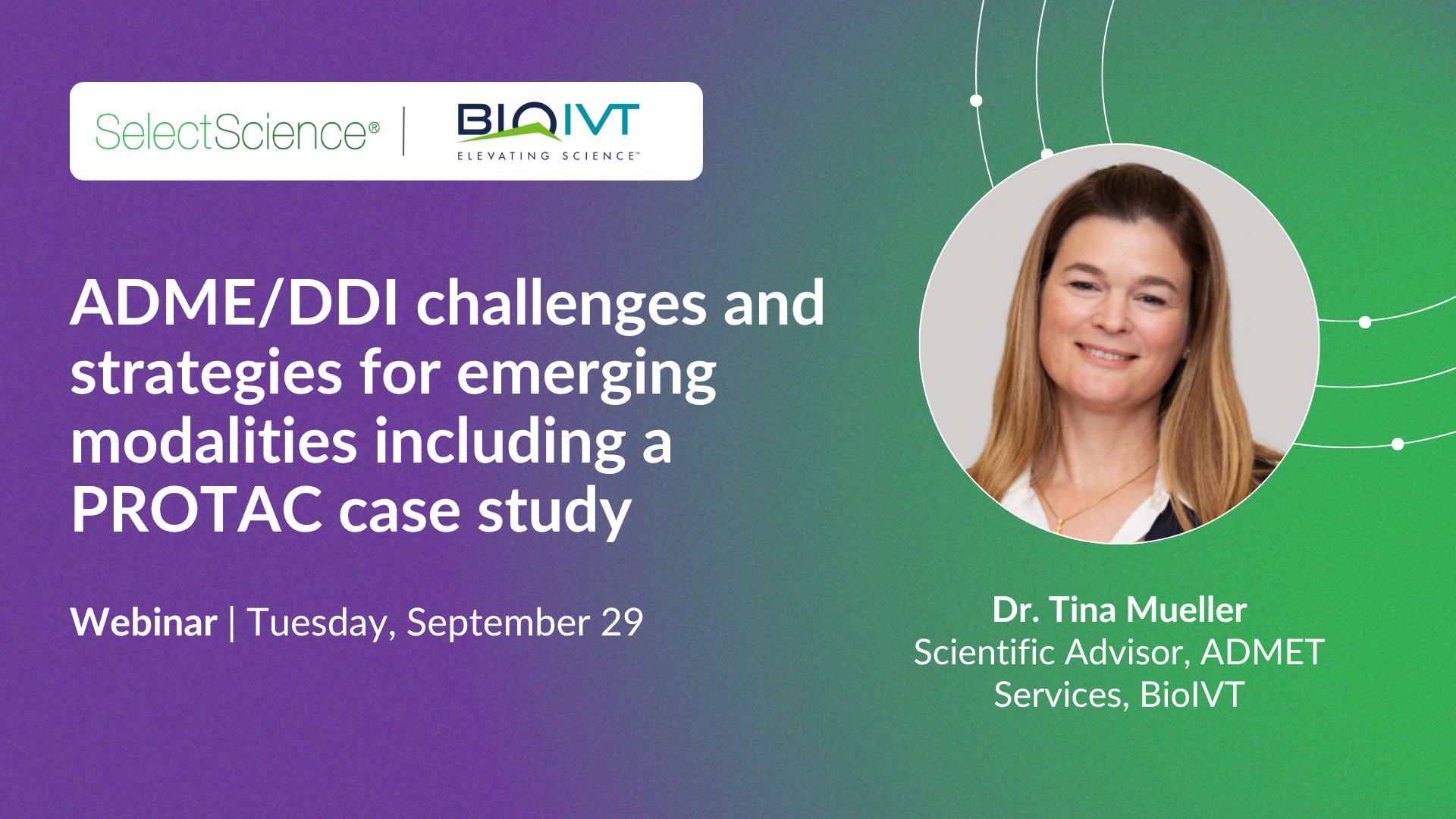
Tuesday, September 29 at 16:00 BST | 17:00 CEST | 11:00 EDT | 08:00 PDT
Not all drug candidates behave like traditional small molecules. As modalities such as PROTACs, oligonucleotides, antibody-drug conjugates (ADCs), and peptides gain momentum, researchers are increasingly challenged to apply established absorption, distribution, metabolism, and excretion (ADME) and drug-drug interaction (DDI) approaches in new ways.
In vitro ADME and DDI studies are critical tools for identifying safety and potential interaction risks in early development. When applied appropriately, they can also help address the unique challenges associated with emerging modalities, including PROTACs and other protein degraders.
In this SelectScience webinar, discover how adapting test conditions and using complementary in vitro systems can improve understanding of metabolic clearance, biotransformation pathways, and DDI risk assessment. Dr. Tina Mueller, Scientific Advisor for ADME-Tox Services at BioIVT, will demonstrate applying these concepts with a case study using BioIVT-generated data from evaluating two commercially available PROTACs, ARV-825 and JNJ-1013. She will also discuss practical strategies for navigating common development challenges and generating data that supports informed decision-making and regulatory alignment.
Certificate of attendance
If you attend the live webinar, you will automatically receive a certificate of attendance, including a learning outcomes summary, for continuing education purposes.
If you view the on-demand webinar, you can request a certificate of attendance by emailing editor@selectscience.net.
Webinar details
Cost: Free to attend
Location: Online
Duration: 60 minutes
Registration is required to secure your place. If you register but can’t attend live, you will receive a link to the on‑demand recording once it becomes available.
Speakers


Who should attend?
- ADME-Tox scientists
- Study directors
- Research program leaders
Featured products
Request Quote for All Products
In Vitro ADME-Tox Test Systems
BioIVTBioIVT is the leading provider of quality, highly characterized, ethically procured ADME research products, featuring custom preparation or extensive ready-to-ship inventory, large lot sizes and expert support.
In Vitro ADME/DMPK Studies
BioIVTWith decades of drug metabolism, drug-drug interactions (DDI) and related expertise, BioIVT’s experts can provide you with the right studies to understand the properties and potential risks of your compound when it’s most critical for your program.
What will this webinar cover?
- Strategies, considerations and best practices for evaluating DDI risk across emerging drug modalities, including protein degraders, oligonucleotides, ADCs, and peptides.
- How established in vitro ADME approaches can be adapted to address the unique challenges of these emerging modalities.
- Fundamental mechanisms of targeted protein degradation and how these differ from traditional small‑molecule inhibitors.
- Unique ADME associated with protein degraders, including permeability limitations, solubility, nonspecific binding, metabolic stability, and IVIVE disconnects.
- How in vitro ADME and DDI studies are applied to characterize metabolic stability, drug-drug interactions, and immunological risks of degraders.
Join the webinar to get answers to these questions:
- How can DDI risk be systematically evaluated for emerging modalities like PROTACs, oligonucleotides, ADCs, and peptides?
- In what ways can traditional in vitro ADME assays be adapted for these complex modalities?
- How do mechanisms of targeted protein degradation differ from classic small‑molecule inhibition?
- What unique ADME challenges do protein degraders present, including permeability, solubility, and IVIVE disconnects?
- How are in vitro ADME and DDI studies used to assess metabolic stability, interaction potential, and immunological risks of degraders?