
Flow cytometry helps solve previously unsolvable criminal cases
20 Oct 2026
In this SelectScience interview, Professor Bram Bekaert and research associate Kristina Fokias share how the Laboratory of Forensic Biomedical Sciences at KU Leuven is striving to improve sexual assault investigations. Their key innovation, SpermFACS, employs fluorescent antibodies and flow cytometry to isolate sperm cells from heterogeneous post-coital vaginal swabs, even days after assault. This enables highly purified male DNA profiles, often unattainable with traditional methods. The MA900 supports this single-sperm-cell sorting, allowing separate DNA profiles from individual sperm in complex, multi-contributor or consensual-plus-assault cases, greatly enhancing interpretability and evidentiary value.
About the company

Sony Biotechnology
Video transcript
Show transcript
Professor Bram Bekaert, Laboratory of Forensic Biomedical Sciences, Department of Imaging & Pathology, UZ Leuven - KU Leuven
The overall mission of the lab is to develop new and innovative technologies for forensic DNA casework to assist the courts in helping solving criminal casework. SpermFACS was born out of a need for more sensitive technology.
What we see in the lab, is when we have these post-coital swabs that are being collected from rape victims, they consist of a majority of epithelial cells a minority of sperm cells and our current technologies are just not sensitive enough specific enough to try and separate out these two different cell types because if it's not 100% efficient in the end, you'll end up with a mixed DNA profile of the victim and the perpetrator.
So, what SpermFACS does is it specifically labels these sperm cells using fluorescent antibodies and you can sort these sperm cells out even when there are very few sperm cells left. So, using SpermFACS you can not only get a very pure sperm sample from the donor, but you can also get that when there's very few sperm cells left.
The cases where that happens is when you have victims that report the rape not straight away after the event, but for example, two, three, four, five days after the rape itself. And even when that happens, SpermFACS is able, even after five days, is able in 50% of the case to get the DNA profile from the rapist. So, that is a huge improvement over current technologies that we have in the lab at the moment.
Flow cytometry is applied in our work through SpermFACS. We validated and accredited SpermFACS last year. And it took us quite a while to develop this technology and to have it accredited. But the results that we've seen with the validation study are just incredible. And so, we've been using it in casework now for about 10 months, I guess. We've had quite a few successes as well in casework that we wouldn't have been able to get with our routine technologies at the moment.
Kristina Fokias, Research Associate, Laboratory of Forensic Biomedical Sciences, Department of Imaging & Pathology, UZ Leuven - KU Leuven
The key challenges that we get with such complex samples is that the samples are extremely heterogeneous. So, the vaginal samples that are collected, they in themselves, they can have a completely different cell load. So, they might have a few epithelial cells or very, very much. But they also might contain a lot of other cells. So, we've got female vaginal epithelial cells, we've got blood cells, we've got yeast and bacteria there. And then that's all for the female fraction but then we also hope to have a few male sperm cells there because those are really our target cells of interest. So, that is why we need a very highly sensitive method to get these sperm cells out.
Now a second challenge that we encounter is with samples where there are multiple sperm contributors. and you get those samples for instance in multi-perpetrator rape cases or for instance if the victim has had recent consensual intercourse around the time of the incident so with our traditional methods we usually get very complex DNA profiles that are very difficult if not impossible to interpret, so what we want to do here is again to sort those sperm cells out but we can use the single sperm cell sorting here so we can get individual sperm cells and then get the DNA profiles from these individual cells. And now we compare those profiles with each other and then also with, if available, a reference DNA profile of a person of interest.
We use the MA900 to sort out sperm cells in a very highly sensitive manner, so that's already one key benefit. We've got these extremely dense samples with very few target cells, so the MA900 really allows us to sort out those very rare target cells so we can get a very highly purified DNA extract of the male contributor. Another key benefit that is offered by the MA900 is the fact that we can use single sperm cell sorting so we can collect individual cells in individual tubes and get DNA profiles from these individual cells. So, this allows us to use very specific interpretation strategies. So, if we get multiple sperm donors or sperm contributors in such samples, then we could still be able to distinguish these individual donors by virtue of the individual sperm cell sorting.
What does this video cover?

Laboratory of Forensic Biomedical Sciences, Department of Imaging and Pathology, UZ Leuven - KU Leuven
Topics covered in this video
- How does SpermFACS improve forensic DNA profiling in rape casework?
- What role does flow cytometry play in SpermFACS forensic DNA analysis?
- How does the MA900 sorter isolate rare sperm cells from heterogeneous vaginal samples?
- How can single sperm cell sorting help identify multiple sperm contributors in rape cases?
Related products
Request Quote for All Products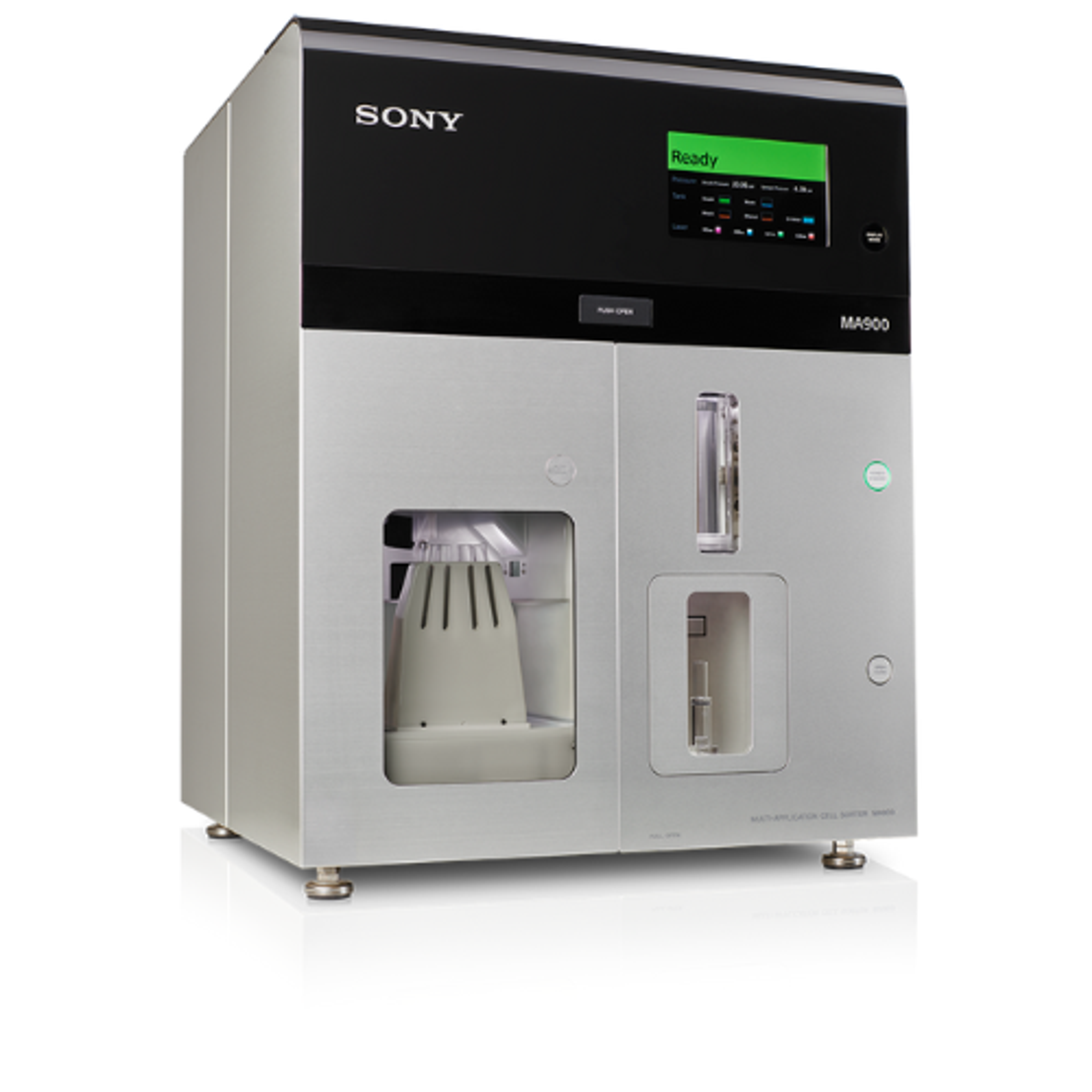
MA900 Multi-Application Cell Sorter
Sony BiotechnologyThe MA900 from Sony meets the needs of most sorting applications, supporting 12 fluorescence parameters and 4-way sorting. Powerful, modern technologies built into the MA900 system include a patented micro fluidic chip-based design, comprehensive fluidic controls, and advanced automation that dramatically simplifies operation to make sorting less subjective and improve reliability.
Other videos from Sony Biotechnology

Links
Tags
Frequently asked questions
Show frequently asked questions
How does SpermFACS improve forensic DNA profiling in rape casework at UZ Leuven – KU Leuven?
SpermFACS, developed in the Laboratory of Forensic Biomedical Sciences at UZ Leuven – KU Leuven, uses fluorescent antibodies and flow cytometry to label and sort sperm cells from post-coital swabs. It yields highly pure sperm fractions, even when only a few sperm cells remain, reducing mixed DNA profiles of victim and perpetrator and improving court-relevant forensic DNA evidence.
What role does the Sony MA900 cell sorter play in SpermFACS-based forensic DNA analysis?
The MA900 flow cytometer is used to sort very rare male sperm cells from heterogeneous vaginal samples containing epithelial cells, blood cells, yeast, and bacteria. It enables highly sensitive bulk sperm sorting and single sperm cell sorting, producing purified male DNA extracts and individual sperm cell DNA profiles for complex or multi-perpetrator rape cases.
How does single sperm cell sorting help identify multiple sperm contributors in sexual assault investigations?
In multi-perpetrator rape cases or when consensual intercourse occurred near the incident, traditional methods yield complex, hard-to-interpret mixed DNA profiles. With SpermFACS and the MA900, individual sperm cells are isolated into separate tubes, DNA profiles are generated per cell, and then compared with each other and with reference DNA profiles from persons of interest to distinguish multiple sperm contributors.