
Rapid qPCR Analysis from Highly Inhibited Tissue and Blood Sample Extractions
Rapid qPCR Analysis from Highly Inhibited Tissue and Blood Sample Extractions
21 Dec 2015Enzymatic inhibition, caused by both sample and extraction carryover inhibitors, is a significant obstacle when optimizing crude sample workflows. KAPA PROBE FORCE qPCR Kits include a highly processive third-generation enzyme—engineered via directed evolution—which enables direct crude sample analysis without sample purification. This application note demonstrates that, in combination with KAPA Express Extract, KAPA PROBE FORCE offers a highly efficient and streamlined sample-to-Cq workflow solution for both low- and high-throughput genotyping and gene expression applications (<1.5 hr).
Related products
Request Quote for All Products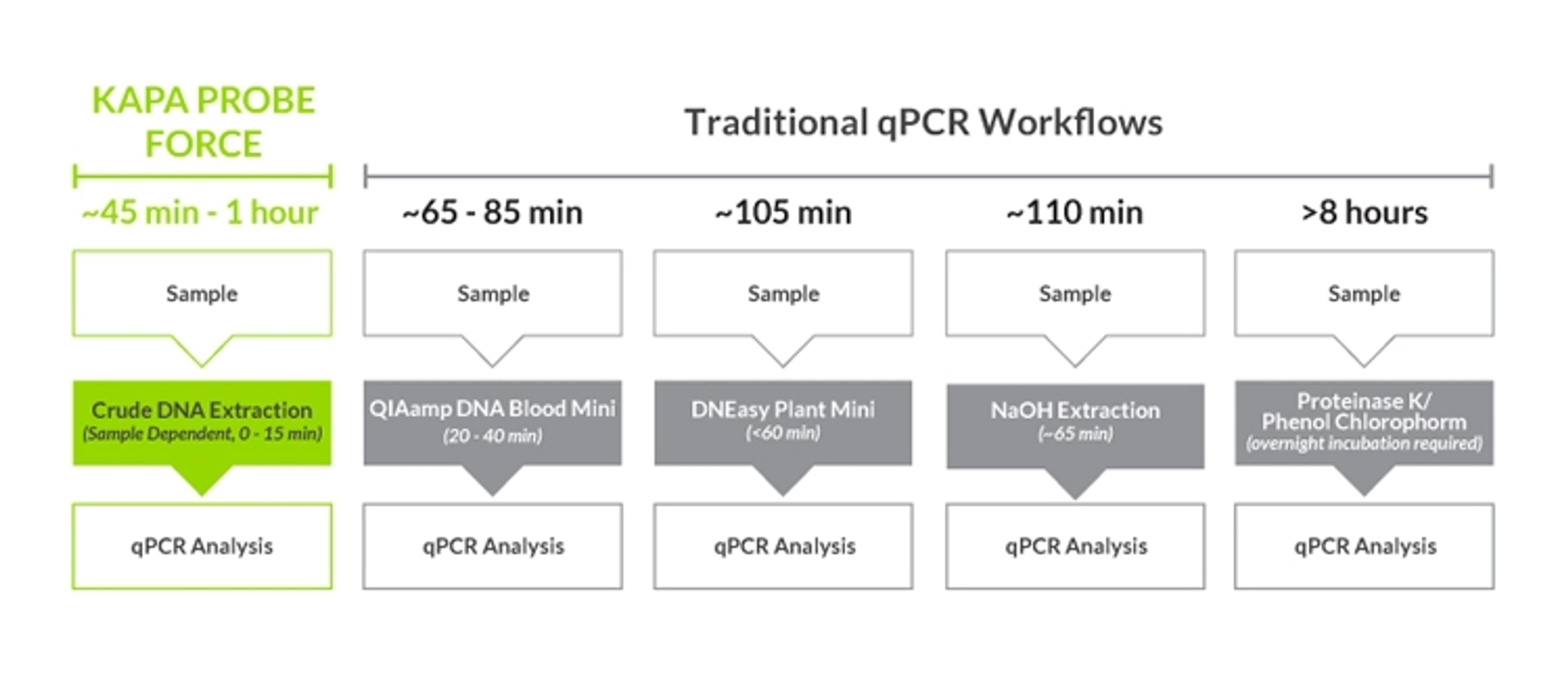
KAPA PROBE FORCE qPCR Kits
Kapa Biosystems, Inc.KAPA PROBE FORCE is a highly inhibitor resistant qPCR master mix that removes the need for DNA purification, enabling streamlined sample-to-Cq workflows. The master mix contains a third generation DNA polymerase evolved to overcome blood, tissue, and plant PCR inhibitors. Crude samples can now be analyzed with comparable accuracy, reproducibility, and sensitivity as purified DNA using KAPA PROBE FORCE. Features: Streamline sample-to-Cq workflows in <1 hour. Eliminate the time and cost of sample purification by amplifying directly from crude samples. Analyze a wide range of sample types including whole blood, cells, mouse tails, FFPE, leaf, stem, seed, and soil. Generate accurate and reproducible results. Kits include a third-generation DNA polymerase, evolved for robust target amplification and detection. Enzyme maintains high reaction efficiency in the presence of PCR inhibitors for reliable data generation. Break through high levels of qPCR inhibitors. Achieve greater levels of sensitivity for inhibited blood, tissue, and plant samples. Convert purified DNA assays to crude workflows without observable Cq delays. Multiplex crude samples efficiently. Accelerate genotyping analysis with single reaction allelic discrimination of crude DNA extracts. Maximize data collection from precious samples, increase throughput, and reduce costs. Applications: GMO testing. Mouse transgenics. SNP genotyping. Food/water pathogen detection. Infectious disease research. Cancer research.