
Measuring the Output of the CytoTox-Fluor™ Cytotoxicity Assay on the GloMax® Discover System
Measuring the Output of the CytoTox-Fluor™ Cytotoxicity Assay on the GloMax® Discover System
17 Sept 2015This application note describes the protocol for measuring fluorescence using the GloMax® Discover System with the CytoTox-Fluor™ Cytotoxicity Assay. The GloMax® Discover System in combination with the CytoTox-Fluor™ Cytotoxicity Assay provides a convenient, rapid and sensitive procedure for determining the number of dead cells in cell populations. Fluorescence correlates with the presence of a distinct protease activity associated with cytotoxicity and loss of membrane integrity.
Related products
Request Quote for All Products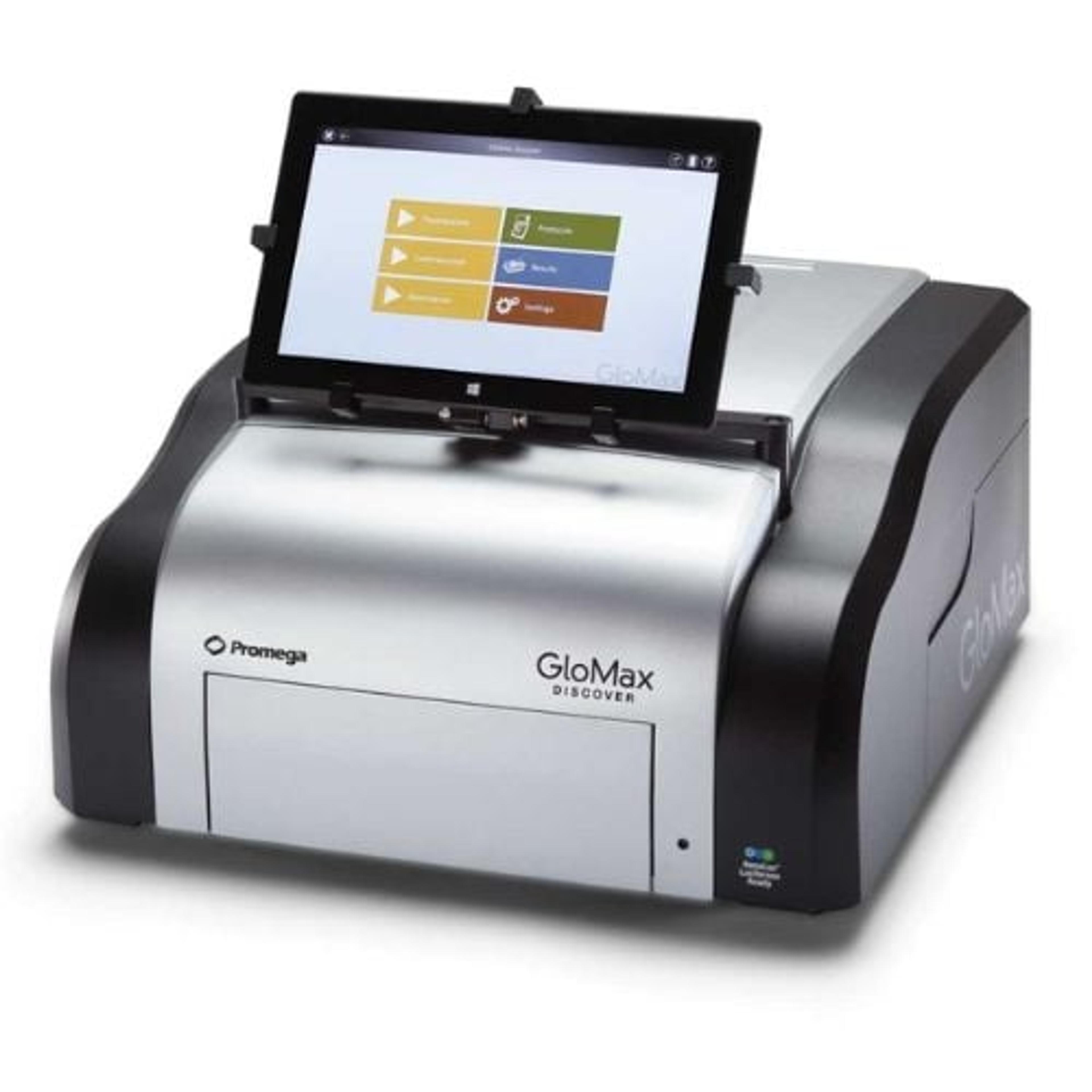
GloMax® Discover Microplate Reader
Promega Corp.This ready-to-use multimode detection system includes: high-performance luminescence, fluorescence, UV-Visible absorbance, BRET and FRET, two-color filtered luminescence and kinetic measurement capabilities. The GloMax® Discover System is a high-performance multimode detection instrument developed with Promega reagent chemistries to provide a simple means of detecting advanced chemistries. This instrument provides researchers superior luminescence sensitivity and dynamic range for both strong and weak bioluminescence experimental samples, as well as a seamless integration with Promega’s industry leading bioluminescent assays. GloMax® Discover also provides flexible use of filters for fluorescence intensity, BRET, FRET, filtered luminescence and UV-visible absorbance measurements. The instrument is operated by an integrated Tablet PC, which provides quick and easy navigation through the control options. Exporting your results is made seamless with a variety of options, including exporting to your local data network. The GloMax® Discover software provides the required technical elements of a 21 CFR Part 11-compliant system to be used with the appropriate laboratory workflow. GloMax® Discover System Features: Integrated with Promega Assays - Developed and optimized with Promega cell and gene reporter assays for seamless workflow; you will be up and running faster. Easy-to-Use - Simple Tablet PC touch screen navigation with full PC capabilities and a state-of-the-art graphical user interface. Superior Performance - Broader dynamic range, better sensitivity and lower well-to-well cross talk for more usable data from your experiment. Cost-Effective - Spend less time optimizing. Connected to Your Workflow - Use as a standalone instrument or integrate into your high-throughput automated workflow; export data to your laboratory network; enable 21 CFR, Part 11 electronic signature compliance. Applications: Integration with Promega reagent chemistries for detection of fluorescence intensity, BRET, FRET, filtered luminescence and UV-visible absorbance assays. Integration into low- and medium-throughput automation workflows. Optimization with Promega cell and gene reporter assays.
CellTox™ Green Cytotoxicity Assay
Promega Corp.The CellTox™ Green Cytotoxicity Assay measures changes in membrane integrity that occur as a result of cell death. The assay is intended to assess cytotoxicity in cell culture after experimental manipulation. The assay system uses a proprietry asymmetric cyanine dye that is excluded from viable cells but preferentially stains the DNA from dead cells. When the dye binds DNA released from cells, its fluorescence properties are substantially enhanced. Viable cells produce no appreciable increases in fluorescence. Therefore, the fluorescence signal produced by the binding interaction with dead cell DNA is proportional to cytotoxicity. The CellTox™ Green Dye is non-toxic to cells, and the signal remains constant after exposure of 72 hours, making it ideal for determining toxic effects of treatments throughout an extended exposure or as an endpoint determination. Features - Benefits • Accurate Cytotoxicity Determination: The CellTox™ Green Dye stably binds DNA of cells that have lost membrane integrity throughout 72-hour exposure and won’t underestimate cytotoxicity. • Kinetic Cytotoxicity Measures: Measure cytotoxicity at convenient time points from the same sample well to detect onset of toxicity with no duplication of plates. • Simple and Flexible Protocols: Add assay reagent directly to cells prior to plating or with dosing media to perform kinetic cytotoxicity measurements, eliminating a reagent dispensing step, or add diluted dye directly to cell culture wells as an endpoint add-mix-measure assay. • Multiplexing-Compatible: Get more informative data per well and reduce cell culture expenses by multiplexing with fluorescent and luminescent cell-based assays in the same well with no sample manipulation. • Easily Automated: Easily scale from 96- to 1536-well plate formats with “no-addition” or “single-addition” protocols. Applications Determine cytotoxic effects of treatments on cells in culture after long-term exposure.
CytoTox 96® Non-Radioactive Cytotoxicity Assay
Promega Corp.The Promega CytoTox 96® Non-Radioactive Cytotoxicity Assay is a colorimetric alternative to radioactive cytotoxicity assays. The CytoTox 96® Assay quantitatively measures lactate dehydrogenase (LDH), a stable cytosolic enzyme that is released upon cell lysis, in much the same way as [51Cr] is released in radioactive assays. Released LDH in culture supernatants is measured with a 30-minute coupled enzymatic assay that results in the conversion of a tetrazolium salt (INT) into a red formazan product. The amount of color formed is proportional to the number of lysed cells. Visible wavelength absorbance data are collected using a standard 96-well plate reader. The assay can be used to measure membrane integrity for cell-mediated cytotoxicity assays in which a target cell is lysed by an effector cell, or to measure lysis of target cells by bacteria, viruses, proteins, chemicals, etc. Features of the Promega CytoTox 96® Non-Radioactive Cytotoxicity Assay: • Non-Radioactive: Requires no radioactive waste disposal or [51Cr]. • Save Time: Eliminates labeling of target cells prior to experiment. • Use Standard Equipment: Collect absorbance (visible wavelength) data with a standard 96-well plate reader. • Adapt to Your Needs: Used for a variety of applications including measurement of: 1) cell-mediated cytotoxicity; 2) chemical-mediated cytotoxicity; and 3) total cell number. • Gain Sensitivity: Can reveal early, low-level damage to cell membranes that is often missed with other methodologies. Applications of the CytoTox 96® Non-Radioactive Cytotoxicity Assay: • Cytotoxicity. • Chemosensitivity. • Total cell number determination.