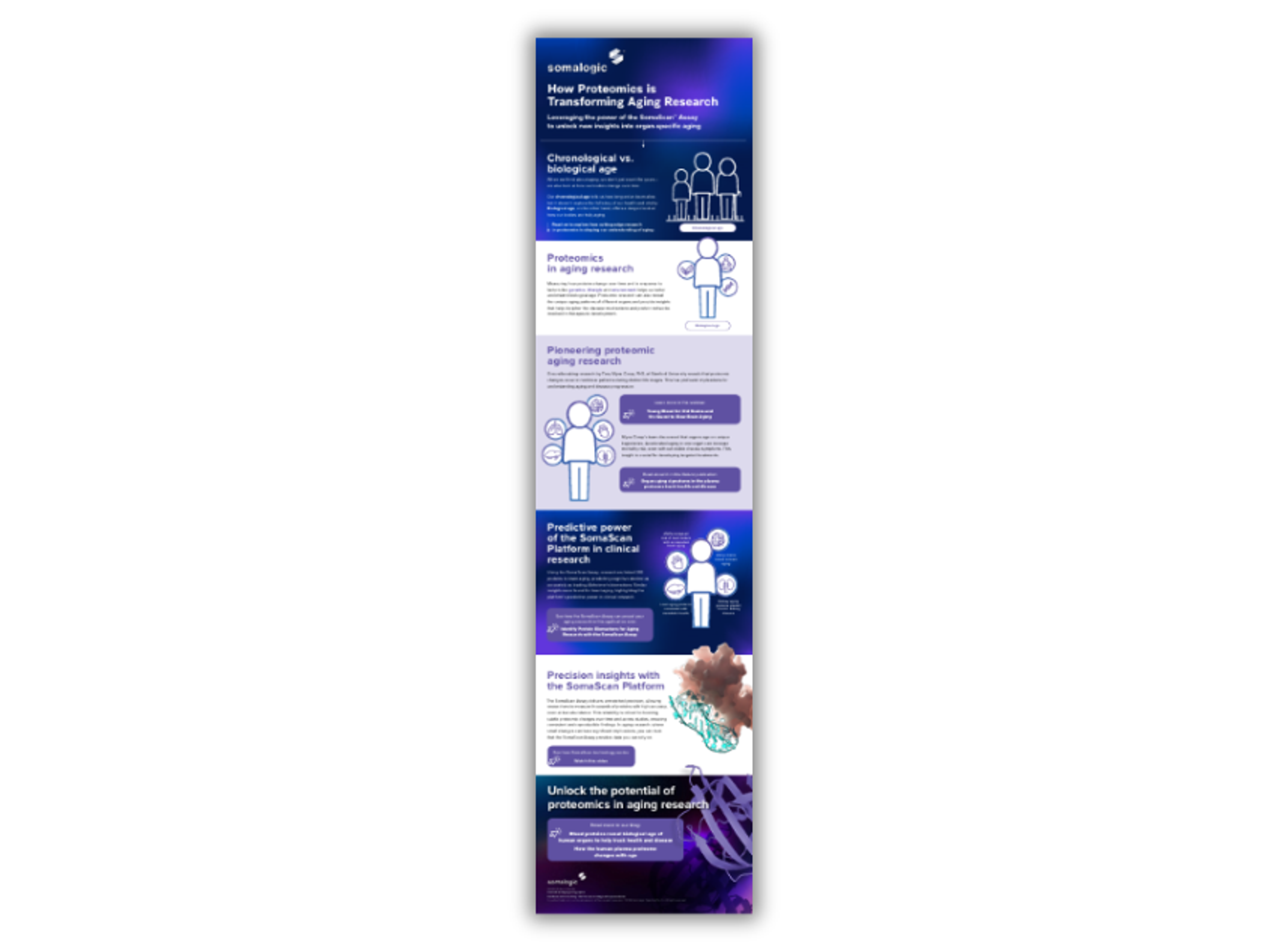
Why high-plex proteomics demands more from affinity reagents
7 Oct 2026As proteomic assays scale to measure more proteins, the number of potential unintended interactions also increases, placing greater pressure on assay specificity, precision and reproducibility.
This infographic from Illumina examines how synthetic SOMAmer™ Reagents support specific protein measurement in high-plex assays. It introduces the combination of reagent properties and assay-design strategies used to challenge weaker, non-specific interactions while retaining intended protein-reagent complexes.
Explore why affinity-reagent specificity is fundamental to precise, scalable proteomic analysis.
Resource details
- Resource type: Infographic
- Page count: 2 pages
- Read time: 4 mins
Related products
Request Quote for All Products
Illumina SomaScan Discovery Assay Services
SomaLogicSomaScan™ Discovery services employ a highly multiplexed, sensitive, quantitative, and reproducible proteomic platform that profiles up to 11,000 human protein measurements in diverse sample types and species – without enrichment or depletion. Ideal for biomarker discovery, it supports basic, translational, pre-clinical, and clinical research across a wide range of diseases. SomaScan Discovery was previously known as the SomaScan 11K Assay. SomaLogic is an Illumina company.