
Couple Any Ligand to Your Particle of Choice
20 Sept 2016This application note, shows a range of proteins covering several species and isotypes of antibodies, as well as bacterial recombinant proteins which can be successfully coupled to Anteo activated particles with minimal optimization. It also shows that different proteins do have different affinities for Anteo coupling, and can be titrated to produce multifunctional particles.
Related products
Request Quote for All Products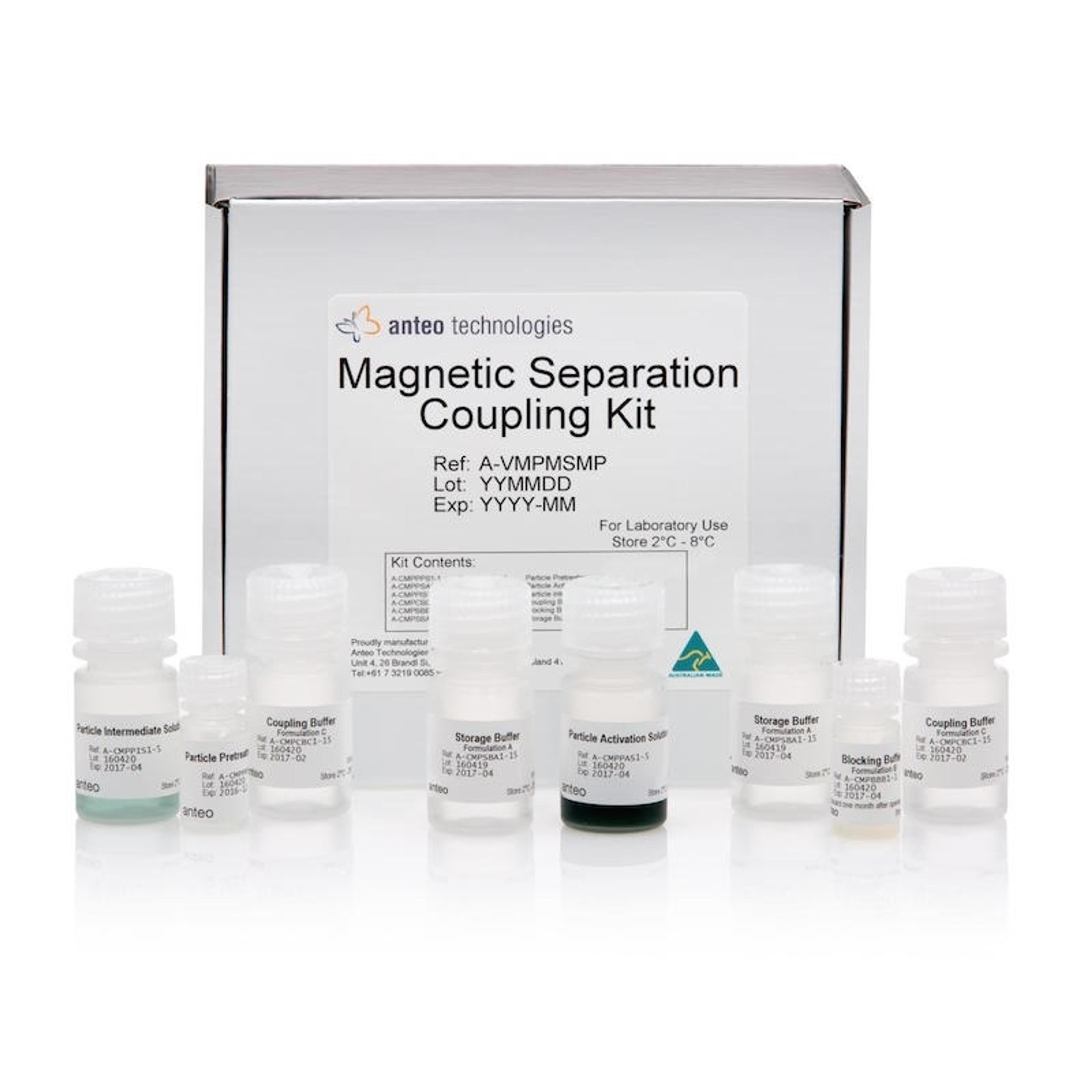
Magnetic Separation Coupling Kit
Anteo TechnologiesReduce labor costs by using our ready-to-use Magnetic Separation Coupling Kit. No messy pre-preparation of reagents required. Simply pipette Anteo's water-based Activation Reagent onto your chosen particle to activate. Hands-on time for surface activation and coupling is 60 minutes. This kit greatly reduces the risk of antibody damage, leading to less antibodies required for the experiment, increased antibody functionality, reduced interference and increased uniformity between experiments. This Anteo kit is also essential for exploratory work. Removing R&D steps required for this type of work, this Kit enables scientists to achieve results even when testing with unknown proteins. The Anteo Magnetic Bead Separation Kit is compatible with Carboxyl beads to give scientists a cost effective option, while supporting their experiments with all the benefits that Anteo’s technology provides. Features: Hand on time for surface activation and coupling is 60 minutes Essential for exploratory work, achieve results when testing with unknown proteins Couple any ligand to your particle of choice Allows the development of multi-functional coupled particles with easy titration of ligand coupling concentration No pre-treatment of proteins or antibody is required to achieve results An alternative to covalent NHS/EDC and passive binding the Anteo Kit is easy to use, while reducing damage to antibodies Less hazardous chemicals to work with than NHS/EDC, Anteo’s Activation Reagent is water based Easy to use: Simply pipette the Activation Reagent on your surface to activate Promotes monolayer binding which increases antibody functionality Reduces aggregation and interference Increases uniformity between experiments Supports multi-functional protein separation