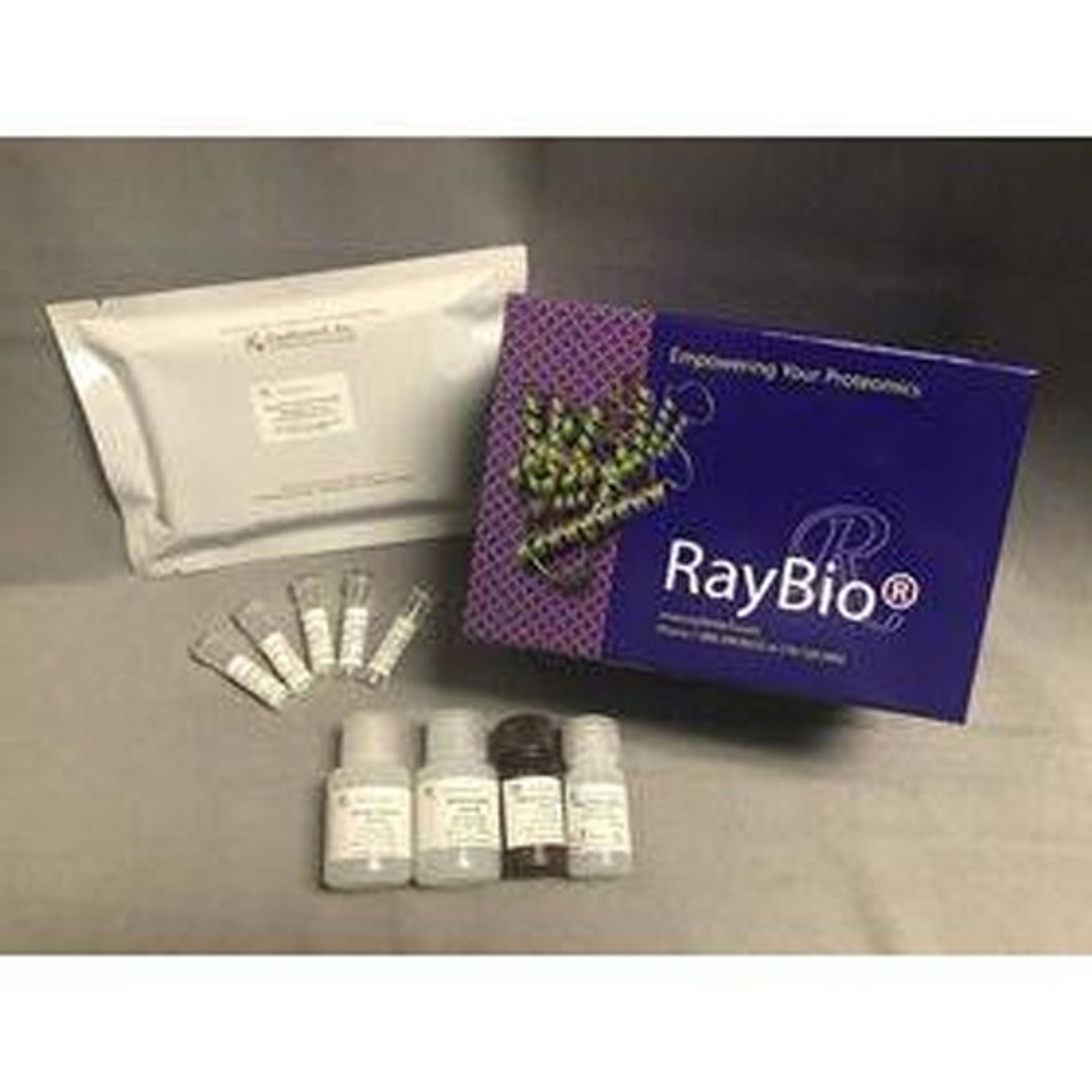
Human/Mouse/Rat Phospho-AKT (S473) and Total Akt ELISA
RayBio® Human/Mouse/Rat Phospho-Akt (S473) and Total Akt ELISA Kit. This assay semi-quantitatively measures phosphorylated Akt (Ser473) and Total Akt in lysate samples.


Place your order directly with the manufacturer.
Antigen Information
Accession Number: P31749
Gene ID: 391
Gene Symbols: AKT1; PKB; RAC
Protein Name & Synonyms: RAC-alpha serine/threonine-protein kinase (EC 2.7.11.1) (Protein kinase B) (PKB) (Protein kinase B alpha) (PKB alpha) (Proto-oncogene c-Akt) (RAC-PK-alpha)
Assay Format
Pathway: Insulin Signaling; mTOR Signaling; PI3K-AKT Signaling
Specificity: The antibody pair provided in this kit recognizes human, mouse and rat Phospho-Akt (pSer473) + pan Akt.
Number of Targets Detected: 2
Species Detected: Human; Mouse; Rat
Compatible Sample Types: Cell Lysates; Tissue Lysates
Design Principle: Sandwich-based
Method of Detection: Colorimetric
Quantitative/Semi-Quantitative: Semi-Quantitative
Solid Support: 96-well Microplate
Product Specifications
Size: 1, 2, or 5 x 96-Well Strip Microplate Kit
Product Features
- Simultaneously measure Phosphorylated protein and pan protein in one experiment (for normalization purpose)
- Screen numerous different cell lysates without performing a Western Blot analysis
- Minimal hands-on time, convenient, and non-radioactive material
Application Notes
Kit Components
- Pre-Coated 96-well Strip Microplate
- Wash Buffer
- Anti-Phospho Antibody
- Anti-Pan Antibody
- HRP-Conjugated Secondary Antibody
- Streptavidin-Conjugated HRP
- Assay Diluent
- TMB One-Step Substrate
- Stop Solution
- Lysis Buffer
- Positive Control Sample
Other Materials Required
- Distilled or deionized water
- 100 ml and 1 liter graduated cylinders
- Tubes to prepare sample dilutions
- Protease and Phosphatase inhibitors
- Precision pipettes to deliver 2 µl to 1 ml volumes
- Adjustable 1-25 ml pipettes for reagent preparation
- Benchtop rocker or shaker
- Microplate reader capable of measuring absorbance at 450 nm
Protocol Outline
Prepare all reagents and samples as instructed in the manual.
Add 100 µl of sample or positive control to each well.
Incubate 2.5 h at RT or O/N at 4 °C.
Add 100 µl of prepared primary antibody to each well.
Incubate 1 h at RT.
Add 100 µl of prepared 1X HRP-Streptavidin to each well.
Incubate 1 h at RT.
Add 100 µl of TMB One-Step Substrate Reagent to each well.
Incubate 30 min at RT.
Add 50 µl of Stop Solution to each well.
Read at 450 nm immediately.
Storage/Stability
Upon receipt, the kit should be stored at -20 °C. Please use within 6 months from the date of shipment. After initial use, Wash Buffer Concentrate (Item B), Assay Diluent (Item E), TMB One-Step Substrate Reagent (Item H), HRP-Streptavidin (Item G), Stop Solution (Item I) and Cell Lysate Buffer (Item J) should be stored at 4 °C to avoid repeated freeze-thaw cycles. Return unused wells to the pouch containing desiccant pack, reseal along entire edge and store at -20 °C. Reconstituted Positive Control (Item K) should be stored at -70 °C.

5 steps for writing a research paper
In this white paper, learn about the editorial process a manuscript goes through before publication. Publications are the cornerstone of science; they disseminate data that expand our understanding of the world around us and help researchers secure funding for additional studies. However, most manuscripts do not pass the journal’s initial editorial process. Here, discover 5 key steps for writing a research paper that will improve its chances of being published.
Rapid ELISA-Based Measurement of Protein Phosphorylation Using RayBioPhosphorylation ELISA Kits
RayBio® Phosphorylation ELISA is a rapid, convenient and sensitive sandwich ELISA for the in vitro measurement of key signaling pathway phosphoproteins in cell or tissue extracts. Over 20 different kits are available for well-studied pathway molecules such as EGFR, Akt, Erk1/2, p38 alpha, Mek1, STAT1, STAT3, and Met. RayBio Phosphorylation ELISA also features site-specific phospho-antibodies which can detect a single phosphorylated residue (for example, Tyr1086 of EGFR). This method is an improvement on traditional labor-intensive immunoblotting protocols that require 2-3 days of processing time.
Exploring Protein Phosphorylation with RayBio Antibody Arrays and ELISAs
By using antibody arrays and ELISAs, researchers can accomplish high throughput detection of a specific activated protein in multiple samples, or detect phosphorylation signatures through parallel detection of many related phospho-proteins. This application note outline how the RayBio system can be utilized for such applications, as well as a recommended procedure.