
Quantum Imaging Finally Saves Schrödinger's Cat
7 Oct 2014
For the first time, a team of scientists, with a novel experiment using an Andor electron-multiplying CCD (EMCCD) camera, have demonstrated quantum imaging with tangible impact for other imaging applications. In the elegant experiment they have improved on the previous ghost imaging and interaction-free imaging approaches by both proving the occurrence of quantum imaging and demonstrating the potential for future applications of this technique.
In classical imaging the photons that interact with the object are then detected to create the image. By using quantum imaging the researchers in this group have managed to utilise the exotic behaviour of quantum entanglement to image the object with an Andor EMCCD camera. The photons that created the image have not interacted directly with the object and are on a different wavelength to the photons that did.
This method raises intriguing possibilities in a wide range of imaging applications where the wavelength of the photon interacting with the object is a critical parameter. A noticeable example would be the imaging of biological specimens, including living or otherwise highly photolabile samples, which may be more susceptible to certain high-energy wavelengths. This novel work suggests the possibility of using a less damaging wavelength to interact with the object while imaging with a wavelength optimal for the detector; thus creating a route to potentially ground-breaking, low-phototoxicity imaging methods.
The newly-described quantum imaging method is based on the phenomenon of entangled photons – a pair of light particles sharing the same quantum states. These entangled photons can be created by non-linear crystals and then separated by optical means without losing their entanglement. Separating those photons into two distinct optical paths allows for using one beam to image an object “classically” while the other beam does not interact with the object at all.
The imaging beam is infrared (1550 nm), which means the photons interacting with the object are not detected by a silicon-based camera, while we can observe the higher-energy (810 nm) photons form the non-interacting beam. Due to the fact that the 1550-810 nm photon pair shares their quantum states, photons in the non-interacting beam acquire the information about the object without interacting directly with it. This means that ultimately, it is the photons from the 810 nm beam that are detected by the Andor EMCCD camera forming an image.
Reporting their results in Nature, the team from the Institute for Quantum Optics and Quantum Information (IQOQI), the Vienna Center for Quantum Science and Technology (VCQ), and the University of Vienna, have demonstrated that quantum imaging that relies on induced coherence without induced emission is not only theoretically possible but can indeed be realised experimentally. The study shows that knowledge of an object can be extracted from the system in a process in which the directly interacting photon is never detected by a camera.
According to Andor’s Colin Duncan, Application Specialist for Physical Sciences, “The recent study of the Viennese group is incredibly exciting – we can see in these results both the proving of quantum imaging in such an indisputable manner as well as the foundation of a whole new field of quantum imaging techniques. This experiment will undoubtedly break new ground in well-established fields of biomedical and physical imaging in the coming years.”
Related Products
Request Quote for All Products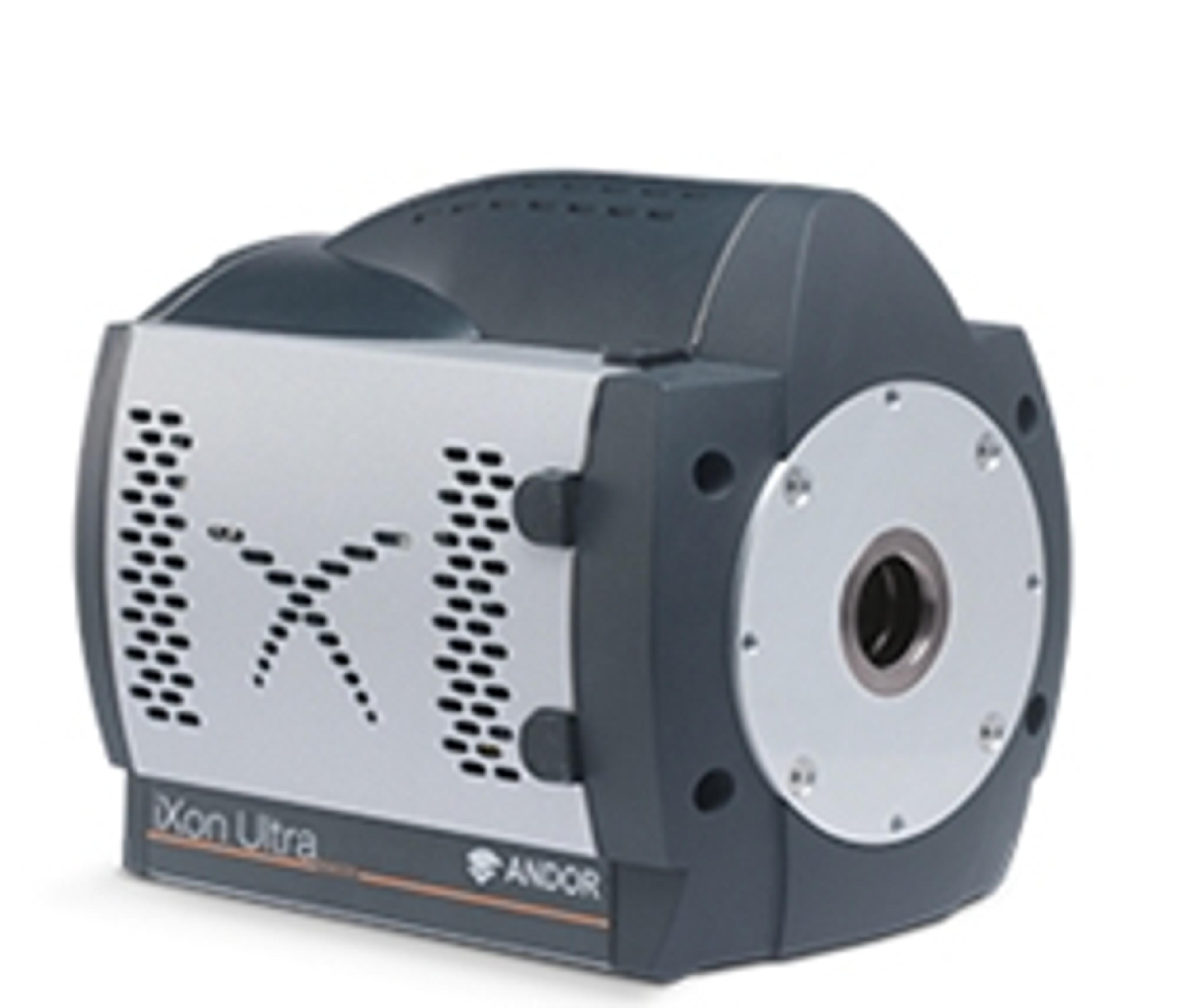
iXon Ultra 888 EMCCD Camera
Oxford Instruments AndorThe highly innovative iXon Ultra 888 is the world’s fastest Megapixel, Back-illuminated EMCCD camera, offering exceptional frame rates and single photon sensitivity across a large field of view. Building on a rich history of first to market innovation, the ‘supercharged’ iXon Ultra 888, represents a massive performance boost for the largest available EMCCD sensor, as well as the first USB3 enabled EMCCD camera. The iXon Ultra 888 has been fundamentally re-engineered to facilitate 3x overclocking of the pixel readout speed to an unprecedented 30 MHz, whilst maintaining quantitative stability, accelerating the full frame rate performance to video rate. Furthermore, Andor’s unique ‘Crop Mode’ can be employed to further boost frame rates from a user defined sub-region, for example pushing a 512 x 512 sub-array to 93 fps and a 128 x 128 area to 697 fps. With a 1024 x 1024 sensor format and 13 µm pixel size, the resolving power, field of view and unparalleled speed of the iXon Ultra 888 render it the most attractive and versatile EMCCD option for demanding applications such as single molecule detection, super-resolution microscopy, live cell imaging and high time resolution astronomy.Features: 30 MHz readout delivering 26 fps at 1024 x 1024 > 2.6x larger Field of View than ‘897’ model Optically Centered Crop Mode – Live Cell Super Resolution at 697fps Single Photon Sensitive EX2 Technology for wider QE response TE Cooling to -95°C
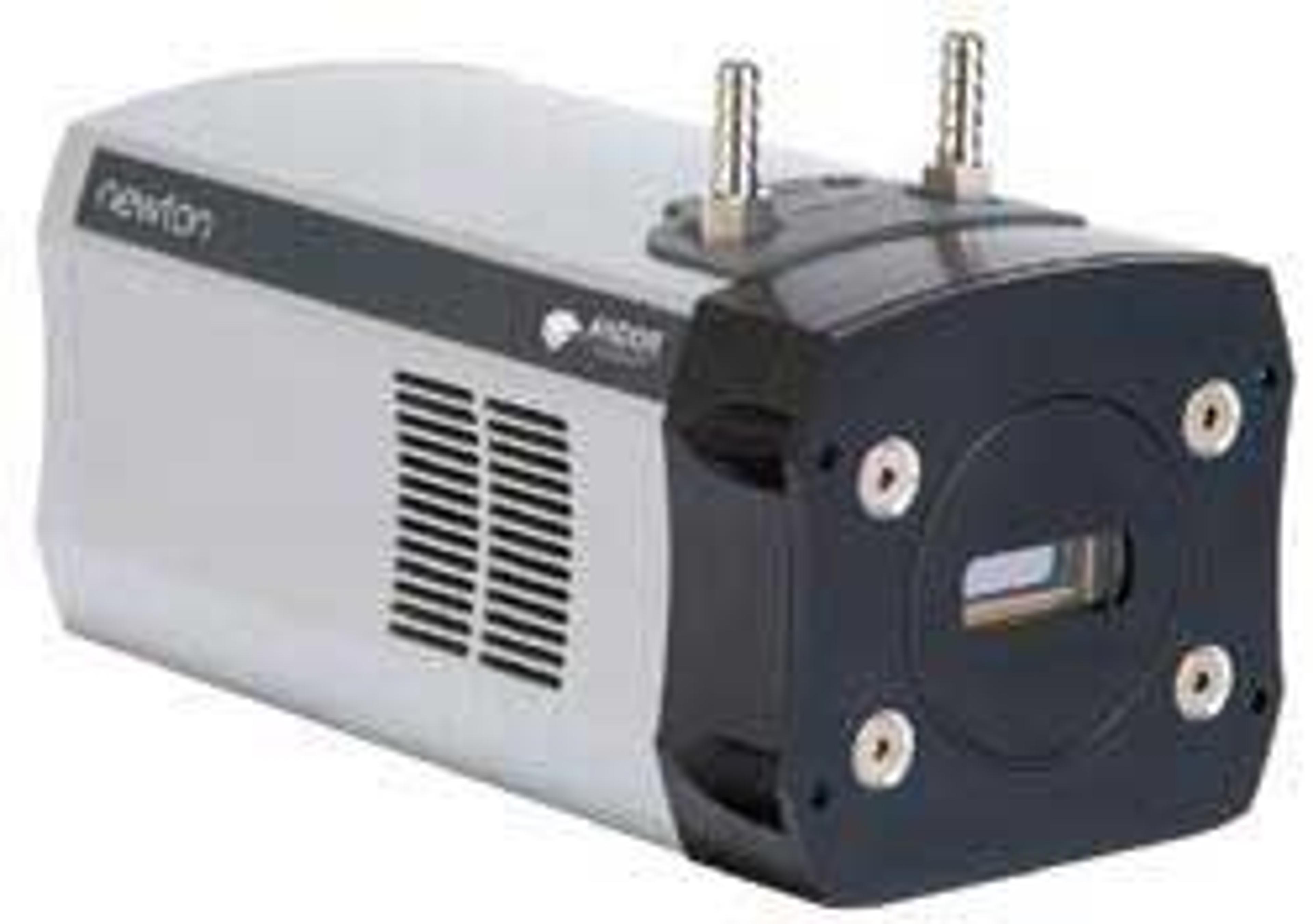
Newton EMCCD Detector
Oxford Instruments AndorBoth the Andor NewtonEM EMCCD and Newton conventional CCD detector systems have been optimized for high performance spectroscopic applications. All Newton detector systems employ low noise electronics, cooling to -100°C, up to 95% peak Quantum Efficiency (QE), multi-MHz readout, USB 2.0 connectivity and versatile readout modes. The NewtonEM employs Andor's electron multiplying CCD technology in an exclusive sensor format optimized for ultra-low light, level spectroscopy applications. The combination of the Newton's low noise electronics, high QE, fast readout, and the on-chip amplication (electron multiplication) makes this detector unbeatable for the most demanding ultra-low light level spectroscopy applications, including single photon light level spectra. Dual output amplifiers also allow the detector system to operate in both the electron-multiplication mode and the conventional low noise readout modes, making the detector even more versatile for a wider variety of applications. The Newton series of conventional CCD detectors employ industry leading low noise CCD sensors such as the 2048 x 512 and the 1024 x 256 pixel formats optimized for spectroscopy along with the standard features of ultra low noise electronics, deep cooling, high QE, multi-MHz readout, and USB 2.0 connectivity. The Newton CCD detector also provides dual output amplifiers for user selection of high sensitivity or high capacity operating modes. High performance, and extreme versatility make this the ideal CCD detector to use with Andor's line of Shamrock imaging spectrographs to form a very powerful spectroscopy measurement system for use in even the most demanding applications.