
Moving Liquids with Sound Using Labcyte Technology Finds Drug Candidates that Traditional Lab Techniques Miss
4 May 2013How do researchers know whether new molecules will have a positive or negative effect? How much does the technique for moving a liquid affect the results? What about testing compounds for their environmental or health impacts: Is one liquid handling process better than another when it comes to accuracy of the data?
A paper published by the journal PLOS ONE, May 1, 2013, demonstrates that the technique used to transfer compound solutions does indeed matter. The three researchers who wrote “Dispensing Processes Impact Apparent Biological Activity as Determined by Computational and Statistical Analyses”, (http://dx.plos.org/10.1371/journal.pone.0062325) conclude that if traditional techniques introduce errors early in the scientific process, the implications are vast.
“Biologists, chemists, and computational modelers who help design compounds—all types of scientists should be aware of this issue,” said study co-author Sean Ekins, senior consultant with Collaborations in Chemistry. “From our early training, every biologist learns to use pipettes, devices like eye-droppers, to move liquids.”
Traditional testing by drug companies uses pipettes to create serial dilutions before assessing biological activity. A newer method uses sound to transfer liquids in microscopic volumes without pipettes. This “acoustic” method minimizes significant errors in the resulting data, according to the new study.
“Among other problems, compounds can stick to pipettes and not get transferred,” said Ekins. “Hardly anyone questions the technique, but those doing drug discovery may see issues with their data and not know why.”
To improve drug efficacy and time-to-patient, researchers need the process to be effective and accurate. Scientists worldwide depend on shared databases for their research, yet they rarely know how the underlying data was produced. The study concluded that it is critical to consider that a key technique, moving liquid via pipettes, may be introducing significant errors.
“All data from the past and much of the data generated today is based on experiments done with traditional pipetting and serial dilutions,” said Ekins. “Errors in this first stage are carried forward into computational models that are used to guide drug discovery. Scientists who are trying to design effective compounds might be doing so on false models. Our findings suggest that moving liquids with sound could improve screening results and prevent the development of misleading models.”
The authors developed their analyses, in part, using data published by AstraZeneca in US Patent 7,718,653. The researchers measured the potency of a class of several anti-cancer drugs, which always measured higher when the compounds were transferred with acoustic dispensing compared to pipette transfer.
“The paper shows that compounds yield different results depending on whether they were transferred by sound or pipette,” said Joe Olechno co-author of the paper and senior research fellow at Labcyte Inc. “Other researchers have seen similar results and have adopted acoustic dispensing. It became even more exciting when we found that the acoustic computational modeling correctly predicted which compounds would be the most potent while the serial dilution model could not.”
A method that allows researchers to more accurately predict the best compound to treat a disease could have a major impact on the industry and society. By comparing the models created from pipette-dispensing results with the crystal structures of molecules in AstraZeneca’s protein target, the team showed that the acoustic technique was most consistent with biological structures.
“This work highlights that data generated with traditional technologies like pipettes may be suspect. More investigation of the observations is required,” said Antony Williams, of the Royal Society of Chemistry and the third co-author of the paper. “But clearly, how we move liquids has a dramatic impact on the biological activities measured and much caution when using pipettes is advised.”
“Incorrect processes have the potential to significantly affect chemical testing in many areas,” Ekins said. He urges scientists to ask questions about the data they use. How much of a database is generated using pipette methods? How much is erroneous? How does it affect all subsequent science and conclusions?
Related Products
Request Quote for All Products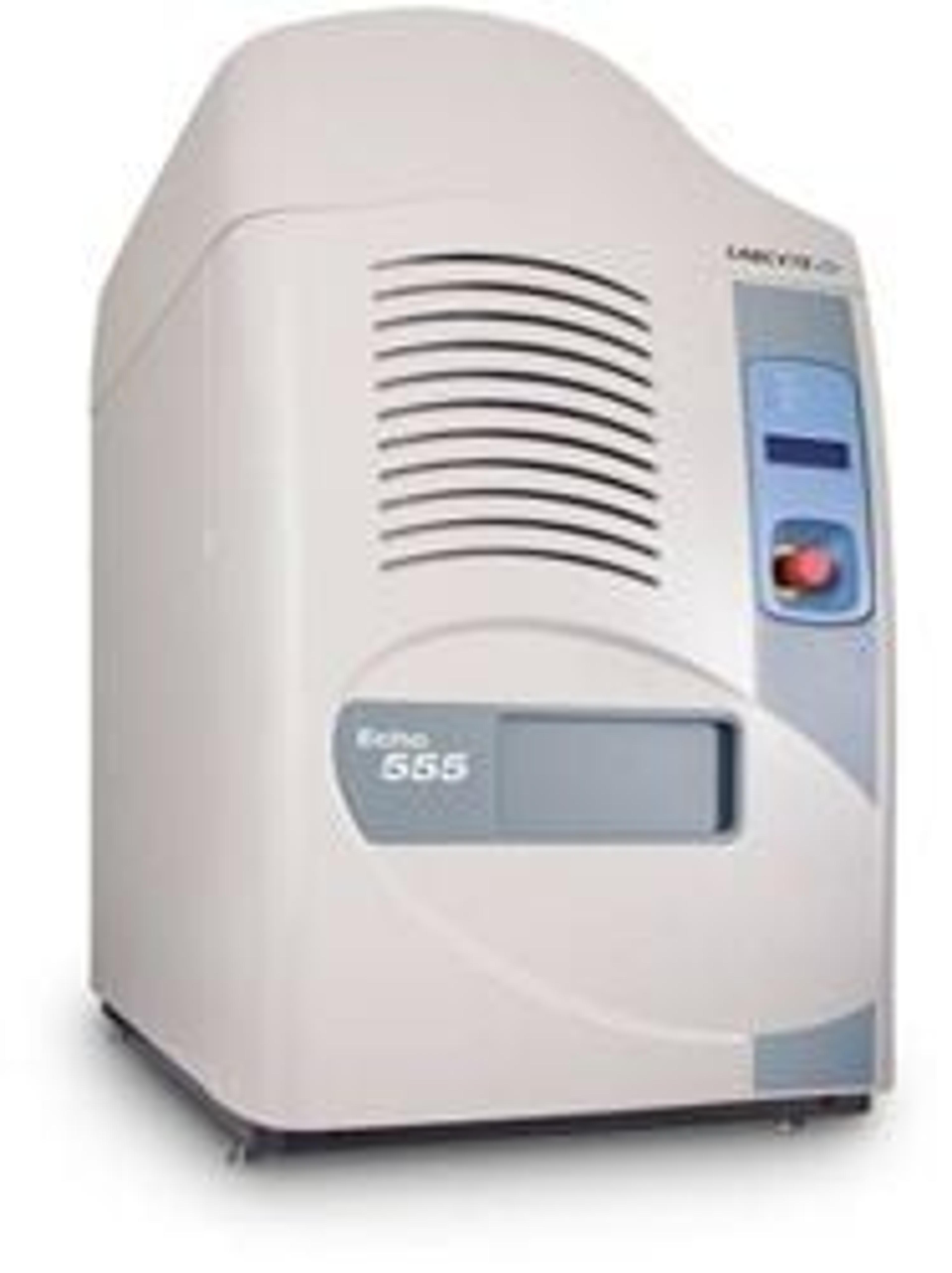
Echo® 555 Liquid Handler
Beckman Coulter Life SciencesEcho® 555 liquid handler - the world's fastest acoustic dispensing platform for life science applications. The Echo® 555 liquid handler is the world’s fastest acoustic liquid handling platform for life science applications. Laboratories that demand very high throughput rely upon the Echo 555 liquid handler for round-the-clock trouble-free operation to enable the fastest discovery.The Echo 555 doubles the throughput of the Echo 550 and provides transfers from as many as 660,000 wells per day. Like the Echo 520 and Echo 550 liquid handlers, the Echo 555 uses "touchless" ADE transfer technology. ADE uses sound energy to transfer 2.5 nL droplets from Echo-qualified 384- and 1536-well source plates into 96-, 384-, 1536- and 3456-well destination plates.This unique touchless technology eliminates consumable tip costs, washing, and cross-contamination. Unsurpassed volumetric precision (≤ 8% CV) and accuracy (≤ 10% CV) ensure superior results. Independent studies have shown that Echo liquid handlers eliminate false negatives due to sample loss on tip surfaces in low-concentration transfers. Like the Echo 550 liquid handler, the Echo 555 liquid handler reports both fluid volume and DMSO hydration.Echo® 555 Liquid Handler Features: Tipless transfer, resulting in dramatic cost savings Accurate, precise movement of nanoliter-scale quantities, enabling assay miniaturization and further reducing costs Elimination of cross-contamination, carryover or leachates Better results through direct dilution of compounds, an improvement over serial dilution methods Improved information about sample integrity and improved transfer quality through measurement of DMSO hydration level Applications: Compound management Compound screening siRNA screening Biochemical assays Cell-based assays PCR Genotyping Gene expression
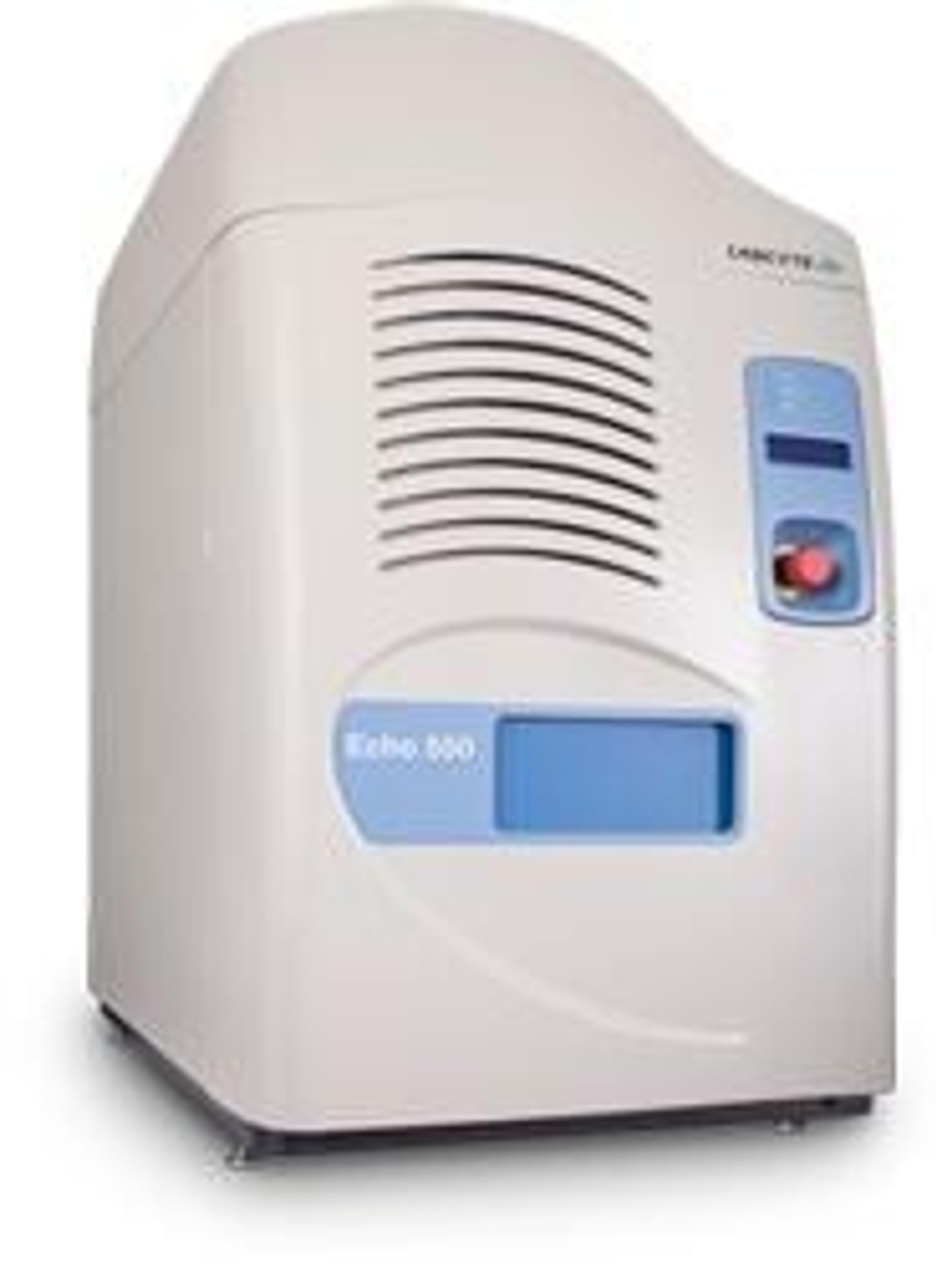
Echo® 550 Liquid Handler
Beckman Coulter Life SciencesImagine preparing assay plates for siRNA screening, compound screening with biochemical and cell-based assays, PCR reactions and more all on a single liquid handling platform, with no tips and no cross-contamination. Labcyte has developed new acoustic droplet ejection (ADE) parameters that deliver built-in intelligence to enable users to transfer many different fluid types from a single instrument. All Echo systems come pre-calibrated so that you can switch among different fluid types with just a click of the mouse. No further adjustment is required for you to be productive immediately. These developments combine the latest discoveries in wavelength, power and timing requirements for ADE with real-time fluid measurement at multiple points during a run. The resulting algorithms solve some of the most significant liquid handling challenges with volatile, low-surface tension and/or meniscus-shifting fluids. Volumetric accuracy and precision for all fluids tested so far—including buffers, nucleic acid and protein solutions, surfactants, serum and cell culture media—are comparable to established performance with DMSO. The Echo® 550 liquid handler introduced the world to acoustic droplet ejection (ADE). This award-winning instrument remains the proven choice for low-volume liquid handling in leading pharmaceutical and biotechnology companies worldwide. Like the Echo 520 and Echo 555 liquid handlers, the Echo 550 uses "touchless" ADE transfer technology. ADE uses sound energy to transfer 2.5 nL droplets from Echo-qualified 384- and 1536-well source plates into 96-, 384-, 1536- and 3456-well destination plates. This unique touchless technology eliminates consumable tip costs, washing, and cross-contamination. Unsurpassed volumetric precision (≤ 8% CV) and accuracy (≤ 10% CV) ensure superior results. Independent studies have shown that Echo liquid handlers eliminate false negatives due to sample loss on tip surfaces in low-concentration transfers. Like the Echo 555 liquid handler, the Echo 550 liquid handler reports both fluid volume and DMSO hydration. Applications: Compound management Compound screening siRNA screening Biochemical assays Cell-based assays PCR Genotyping Gene expression