
5 lab automation trends emerging at SLAS 2026
Industry leaders outlined how artificial intelligence, digital lab orchestration, and scalable automation will transform scientific discovery and operational resilience in 2026 and beyond
4 Mar 2026
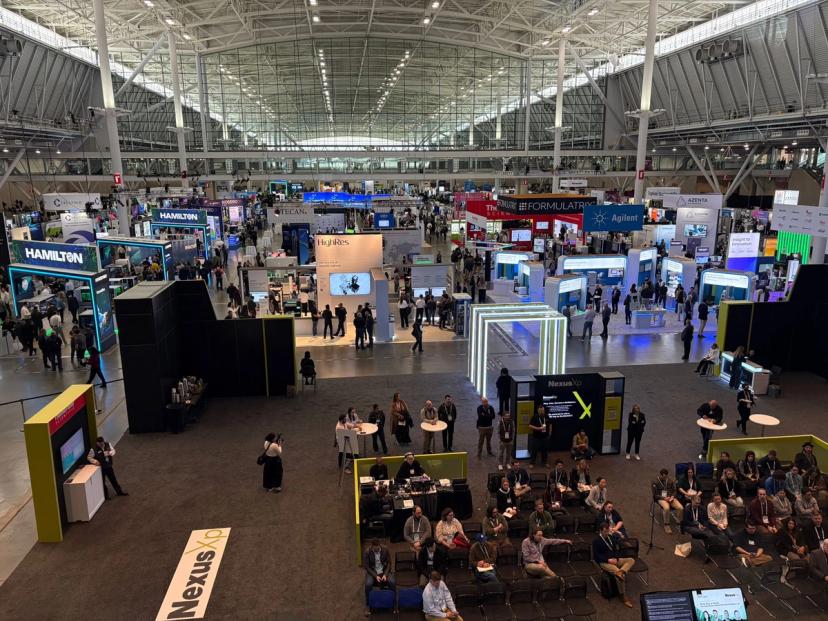
At SLAS 2026, the conversation around lab automation felt different. Instead of debating whether to automate or where AI might fit, many speakers talked as if these questions had already been answered: automation, digital backbones, and data-driven decision support are fast becoming the default operating model for modern labs.
Economic pressure, regulatory scrutiny, and the sheer complexity of today’s biology are forcing organizations to move beyond experiments and pilots. In their place, end-to-end, AI-ready ecosystems are taking shape, designed to scale, to prove return on investment, and to survive whatever shocks come next.
1. Automation is now foundational, not experimental
For many attendees, 2026 felt like a pivotal point. Mike Hampton, CCO at Sapio Sciences, described it as a transition “between exploration and actually moving into gaining some traction in the market in a couple of different areas.” Laboratory automation, he observed, is being approached with a new level of seriousness; the conversation is no longer about whether it might work, but about how to actually implement and scale it in production environments.
Hampton described a shift “from talking about how we do it, to ‘let’s do it,’” highlighting growing seriousness around digitally enabled laboratory automation that can orchestrate, drive, and capture high-value data assets at scale. The emphasis is no longer on a single robot or work cell, but on how automated labs plug into a broader informatics backbone.
Dr. Hansjoerg Haas, Senior Director and General Manager, Laboratory Automation at Thermo Fisher Scientific, echoed that labs are “shifting their thinking around smarter labs”, moving away from “thinking about automation and digitalization as being experimental to being foundational for building end-to-end operating models that are digitally orchestrated and ready to scale”. In this framing, automation is no longer a technology add-on; it is the scaffolding on which modern R&D is built.
2. Digital backbones and AI-ready labs
As labs become more automated, the conversation naturally turns to digital infrastructure and AI. Dr. Haas stressed that “digital systems are the backbone of scientific discovery,” particularly in regulated environments where traceability and trust are paramount.
“When automation and digital tools are co-designed, labs have a single source of truth for traceability, metadata, and compliance,” he explained, arguing that this is what will make labs ‘AI-ready’ in a practical sense.
Charles Anumonwo, Business Account Manager at Genedata, underscored that AI alone is not the endpoint: “We all know that AI is important, we're seeing it everywhere, but it can’t just be about AI. It must be about how this is going to bring value and how we are going to connect systems.’’ For many organizations, the next phase is not another AI proof-of-concept, but knitting together systems so that models, data, and decisions move seamlessly across the discovery lifecycle.
3. ROI and resource optimization drive buying decisions
If previous years were characterized by enthusiasm for innovation, 2026 brought a sharper focus on return on investment. Budget constraints, funding uncertainties, and higher expectations around utilization are reshaping how labs assess automation.
Werner Maas, CEO of Hudson Lab Automation, noted: “There is a focus from the customers that we talk to, to clearly have a return on investment message.” In earlier years, he recalled, customers might have said, “Oh, I like that, I like that. That could help me.” Now, the dominant question is, “What’s the return on investment for this particular device?” This is driving demand for smaller standalone systems, as well as automation that can squeeze more value from existing assets.
Multiple vendors described automation as a lever to maximize equipment utilization, protect high‑value samples, and reduce variability across experiments, strengthening both scientific and financial outcomes. The same logic is influencing service models: William LaMarr, Chief Scientific Officer at Momentum Biotechnologies, outlined how his company is expanding beyond mass spectrometry-based services into compound handling, protein production, bioinformatics, and database production. By offering a more complete package across discovery and development, Momentum aims to meet customers where they are and provide clearer, end-to-end value in a constrained funding environment.
4. Modular, flexible automation and integrated ecosystems
In line with these ROI expectations, the architecture of automation is changing.
Carola Schmidt, Global Head of Technology, Platforms at Revvity described the redefinition of automation as a “strategic lever for maximizing investment, protecting valuable samples, and driving measurable efficiency across the lab,” noting an industrywide move toward modular scalability rather than single, monolithic workstations. This allows teams to flex capacity up or down and adapt to new projects without rebuilding entire infrastructures, “making the modern lab more resilient than ever”.
Revvity’s own portfolio at SLAS illustrated this direction. “By integrating automation, high-performance detection, advanced imaging capabilities, and AI-based analysis, we help researchers reduce manual variability, eliminate workflow bottlenecks, and generate higher-quality data, which ultimately accelerates the path from discovery to decision,” explained Tony Bhalla, Product Portfolio Leader, Platforms at Revvity.
Del Rey Jackson, Director of Product Management at Hamilton, framed modularity through the lens of liquid handling and integration. “We've noticed that the core of what everybody in our field does is absolutely centered around liquid handling, and Hamilton leads the industry with the liquid handling solutions. But we know that we’re not able to make everything perfectly, right? We don’t make readers, for instance. So, by giving customers the freedom to pick the device that they want, that they're most used to, and integrating it for them is something else that we were happy to do for them.”
This focus on flexibility and usability was reinforced by Carey Rooks, Marketing and Portfolio Branding Director at SPT Labtech. “One of the clearest trends we’ve seen at SLAS 2026 is a strong push from scientists for more intuitive software and easier training pathways. Labs are no longer just investing in automation hardware, they’re focused on maximizing utilization across larger teams. That means platforms must be simple to learn, easy to scale across users, and designed around real laboratory workflows rather than engineering complexity. We’re also seeing increased demand for true cross-vendor solutions. Customers want flexibility, whether that’s seamless hardware integrations or software compatibility with a broad ecosystem of reagents and kits. Scientists don’t want to be locked into closed systems; they want automation that adapts to their preferred workflows and evolves with their research.”
5. Peer-to-peer communication and community as an innovation engine
Technology alone will not solve the challenges of modern science. Across interviews, experts repeatedly emphasized how peer-to-peer communication is essential for turning tools into impact. Many of the hardest challenges, like scaling in regulated environments, addressing data integrity, or breaking down silos, are less about products and more about how practitioners share what really happens at the bench.
Haas captured this reality: “Overcoming the challenges of modern science are rarely solved without peer-to-peer communication. At a meeting like SLAS 2026, you’re not just hearing success stories, you’re having candid, technical conversations with people who are facing similar constraints.” He argued that gathering insight from peers is often more actionable than any product spec sheet or marketing deck, because it surfaces lived experiences, workarounds, and the contextual nuances that never make it into brochures.
Rooks echoed that “scientists trust data and experience from other scientists. Real-world validation carries enormous weight, particularly in automation, where reproducibility, robustness, and workflow optimization are critical. When researchers share how they’ve implemented a method, overcome bottlenecks, or scaled a workflow, it accelerates progress for the entire community. It reduces duplication of effort and increases confidence in adopting new technologies.”
From Genedata’s perspective, Anumonwo highlighted the value of being vendor‑ and instrument‑agnostic. “We have smart people, but there are smart people who aren’t in our company. We want to make sure all those ideas come together.” Being deliberately vendor and instrument-agnostic allows companies like Genedata to act as connectors, learning from a wide range of partners and customers and translating those insights into more effective platforms and workflows.
Vendors such as Hamilton noted that SLAS is as much about listening as it is about showcasing. Being on the show floor is an opportunity not only to demonstrate new products and software, but also to listen: What trends are critical? What problems remain unsolved? In this sense, SLAS is not just a marketplace for innovation, but a crucible for shaping the next generation of lab practices collaboratively.
A more mature market
Perhaps the most striking takeaway from SLAS 2026 is the overall maturity of the conversation. Automation is now widely viewed as foundational infrastructure, not a side experiment. AI is expected to deliver measurable value, not simply generate interest. Digital systems are recognized as the backbone of scientific integrity, especially in regulated environments where traceability and compliance are nonnegotiable. Purchasing decisions are increasingly tied to ROI, scalability, and operational resilience.
As Hampton put it, the industry has moved from asking “How do we do it?” to declaring “Let’s do it.” The focus now is on building AI-ready, digitally orchestrated labs that can scale, adapt, and withstand scrutiny, while still enabling scientists to ask more ambitious questions.
If SLAS 2026 is any indication, the “smart lab” is no longer a distant vision. It is rapidly becoming the standard for competitive, compliant, and data-driven science; and the organizations that treat automation, AI, and digital backbones as core business infrastructure will be the ones best positioned to lead.