
The Use of Countercurrent Separation in Cannabinoids Purification
2 Sept 2018
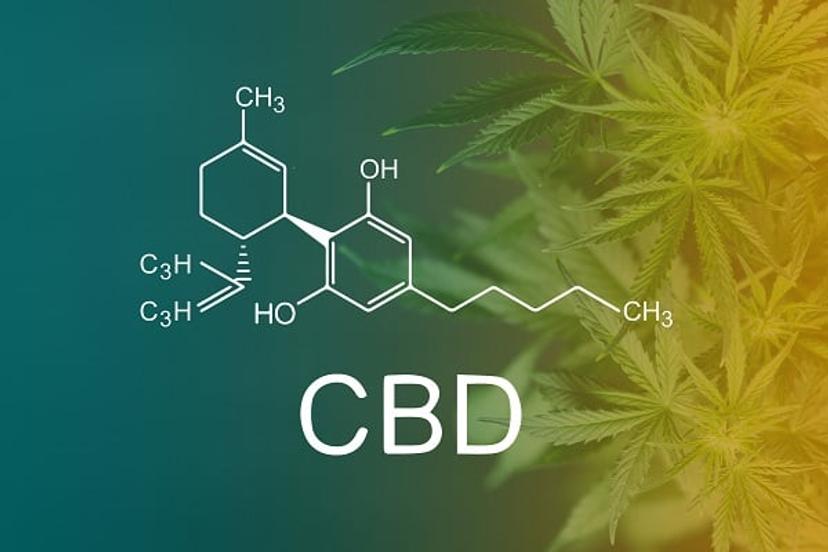
Cannabidiol (CBD) is a major component of the Cannabis sativa plant, making up about 40% of cannabis extracts. Due to its non-psychotropic nature, it is of increasing interest as a therapeutic medicine for conditions including chronic pain, inflammation, cancer and epilepsy.
What is the difference between CPC and CCC?
CCCS technology can be found across the industry listed as either centrifugal partition chromatography (CPC), a hydrostatic instrumentation, or countercurrent chromatography (CC), hydrodynamic instrumentation. Terminology proposed by Pauli Group, Univ. of Illinois, Chicago (ref 2).
Recent changes in the legal status of cannabis compounds for medicinal use have seen growing interest in the method used to purify, formulate and detect CBD. The purification of CBD from the sticky resin found on the surface of the Cannabis sativa plant can be carried out using countercurrent separation (CCS), an important tool which has been used in natural product purification for over 50 years. CBD purification is particularly important to avoid contamination with THC, the main psychoactive chemical found in cannabis.
The CPC 1000 PRO, developed by Gilson, has sought to provide a rapid and reproducible method for the large-scale purification of CBD. In this article, we consider the use of CCS for the purification of cannabinoids, with insights into CCS technology from industry expert, Guy Harris.
The Issues Involved in Cannabinoid Purification
The primary issues for cannabinoid purification are two-fold: solubility of extracts and separation of structurally similar analogs. Standard cannabis raw material processing results in an extremely non-polar, lipophilic extract, however direct injection on CCS systems is possible which is a great advantage, relative to more conventional chromatography. Solvent systems for such lipophilic compounds are either non-aqueous or mixtures of a hydrocarbon and an alcohol containing just a small amount of water. The crude extract can be dissolved in either, or a mixture, of the two phases. Removal of fine particulates is generally not necessary, although the extract should be completely soluble.
With over 100 cannabinoids known to come from C. sativa, the other issue facing cannabinoid purification is the presence of a high number of structurally related analogs in addition to the major components CBD and THC. This can be overcome by combining CCS with crystallization or more common column chromatography tools such as RP HPLC, to yield high-purity minor cannabinoids.
A brief guide to CCS – from Guy Harris
CCS is a separation process founded on the principles of liquid-liquid extraction, whereby a chemical compound is distributed between two immiscible liquid phases according to its relative solubility in the two phases.
As a preparative technique, CCS offers numerous advantages. Whilst the moderate resolution is ill-equipped for analytical work, for preparative work it is compensated for by high sample loading. Extracts of plants, fungi, marine organisms, and bacteria are extremely complicated mixtures of hundreds to thousands of primary and secondary metabolites; individual components can range from small molecules to polymers, water-soluble to extremely non-polar, and in quantities from trace to major component. Purification of individual components of these extracts is almost always a multistep process requiring the use of a combination of different separation methods, including CCS.
When successfully applied, the use of CCS in production will require the demonstration of robust, 24/7 operational, fully automated commercial instrumentation. In addition, methods must be robust from a chemical engineering perspective.
Proof of concept for the separation of cannabinoids using a form of CCS, centrifugal partition chromatography (CPC), was reported by Hazekamp in 2004 (3). D9-THC, THCA, CBD, CBDA, CBN, CBGA, and CBG were obtained at purities of greater than 90% (GC) in a single separation from a crude hexane extract of flowers. This was accomplished using a solvent system of hexane:methanol:water (5:3:2) containing 25mM formic acid for the acids and hexane:acetone:acetonitrile (5:2:3) for the neutral compounds.
CPC 250 PRO: Purification of Cannabidiol from Cannabis sativa
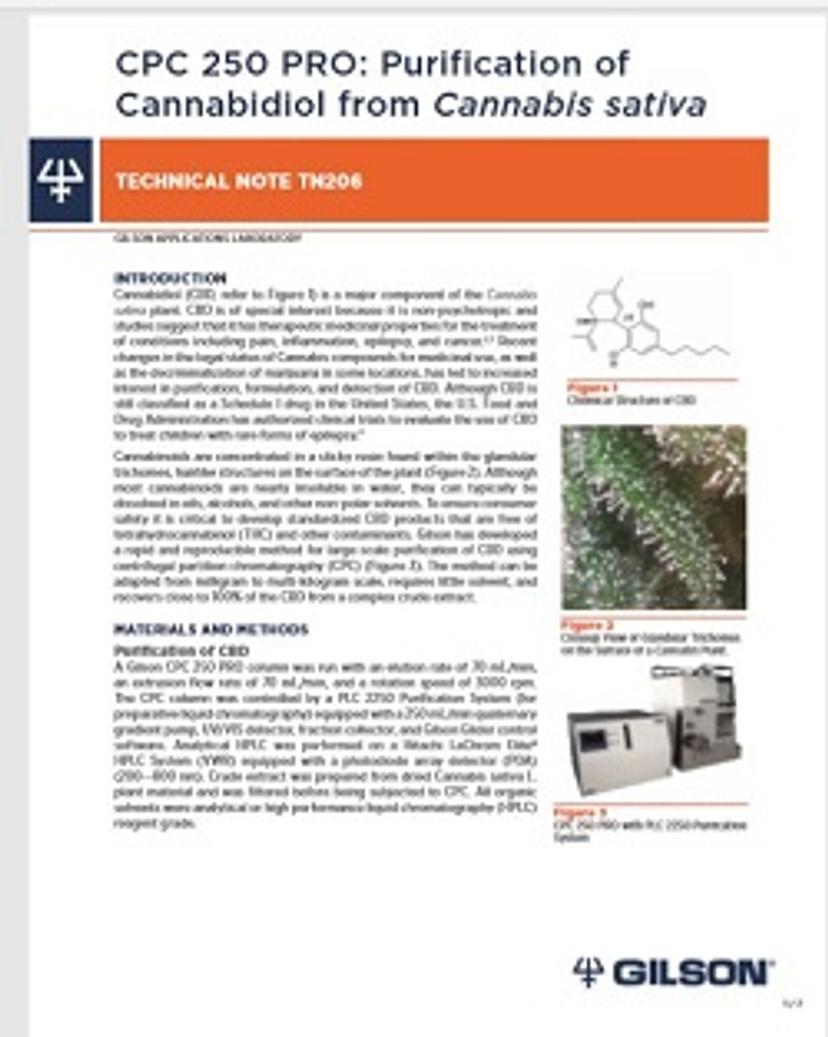
Download this technical note to discover how the CPC 250 PRO from Gilson can be used to purify cannabidiol from Cannabis sativa. The method boasts an almost 100% recovery of CBD from a complex crude extract and can be adapted from milligram to multi-kilogram scale, all whilst requiring little solvent.
A key benefit of CPC technology is the use of a silica-free liquid-liquid chromatography (LLC) column that can be used to purify CBD from crude extracts of cannabis in just one step. Purification parameters can be adjusted according to which cannabinoids are targeted or the desired purity level to achieve THC-free extracts, pure cannabinoids, pharmaceutical-grade products, or standard molecules for use as reference materials or for clinical evaluation.
The methodology is also adaptable from laboratory to industrial scale, and because the method does not use silica resin, there is no irreversible adsorption of the sample to the matrix and therefore no sample loss.
References:
1) A. Berthod, in Countercurrent Chromatography, The Liquid Stationary Phase, ed. A.
Berthod, Elsevier, 2002.
2) J.B. Friesen, et al., J. Nat. Prod. (2015) 78, 1765-1796.
3) A. Hazekamp, PhD Dissertation, University Leiden, The Netherlands, 2007.