Take a bite from our Food Contamination: Quality and Safety feature

Explore our curated selection of top food quality and safety resources to bolster your research

19 Jul 2021

Diane Li
Assistant Editor

Editorial article

Top resources for food contamination

As part of our new Food Contamination special feature, we’ve carefully compiled a selection of the latest techniques and technologies helping to optimize safety and quality across every stage of food production.

Read on to discover top resources covering issues such as overcoming the complexities of pesticide residue testing, how to increase your GC-MS/MS sensitivity and using Raman microscopy for advanced food packaging characterization — you’ll also learn about a workflow to analyze cannabis brownies, a tool for easily determining fat and protein content in plant-based foods and much more. Plus, don’t forget to register for this week’s webinar on benchtop NMR solutions for measuring oil, fats, and food components.

Ingrid Hayenga Merck

FOOD SAFETY: Overcoming the challenges of pesticide analysis

Dr. Ingrid Hayenga, global product manager for environmental standards at Merck, discusses the increasing complexities of pesticide residue testing and highlights a collection of reference material designed to help customers achieve compliance amid increasing regulations globally.

Read article

Amadeo Fernandex-Alba, Agilent

PESTICIDE ANALYSIS: Increase your GC-MS/MS sensitivity and throughput

Amadeo Fernandez-Alba, Head of the EURL for Pesticides in Fruits and Vegetables, reveals how the Intuvo 9000 GC System from Agilent Technologies helps overcome common GC-MS/MS workflow challenges such as low sensitivity and long run time.
Watch video

Raman HORIBA

RAMAN SPECTROSCOPY: Advanced packaging and polymer characterization

Watch this free on-demand webinar to discover the Raman microscopy solutions from HORIBA that allow scientists to obtain complete characterization data for polymer films, from defect analysis to multilayer materials characterization.

Watch on demand

Cannabis brownies Restek

PESTICIDES: An effective workflow for the complex analysis of cannabis brownies

Learn more about how Restek helped to develop an effective workflow for the analysis of pesticides & mycotoxins in cannabis brownies using LC-MS-MS and GC-MS/MS, which delivered linearity, accuracy and precision for all target compounds.
Download method

Fat and protein in plant-based foods

EXTRACTION: How to determine fat and protein content in plant-based foods

The growing popularity of vegetarianism necessitates the analysis of fat and protein content in plant-based alternatives. Discover how BUCHI’s automated Kjeldahl and Soxhlet extraction instrument can easily analyze plant-based foods, without specialized sample prep.
Download method

Lc-MS food

LC-MS/MS: How to effectively determine 16 PFASs in food

UCT, Inc shares a validated procedure developed by the FDA to effectively measure 16 PFASs in food by using a QuEChERS sample prep approach, combined with LC-MS/MS analysis, to detect extremely low concentrations in milk, bread and fish.
Download method

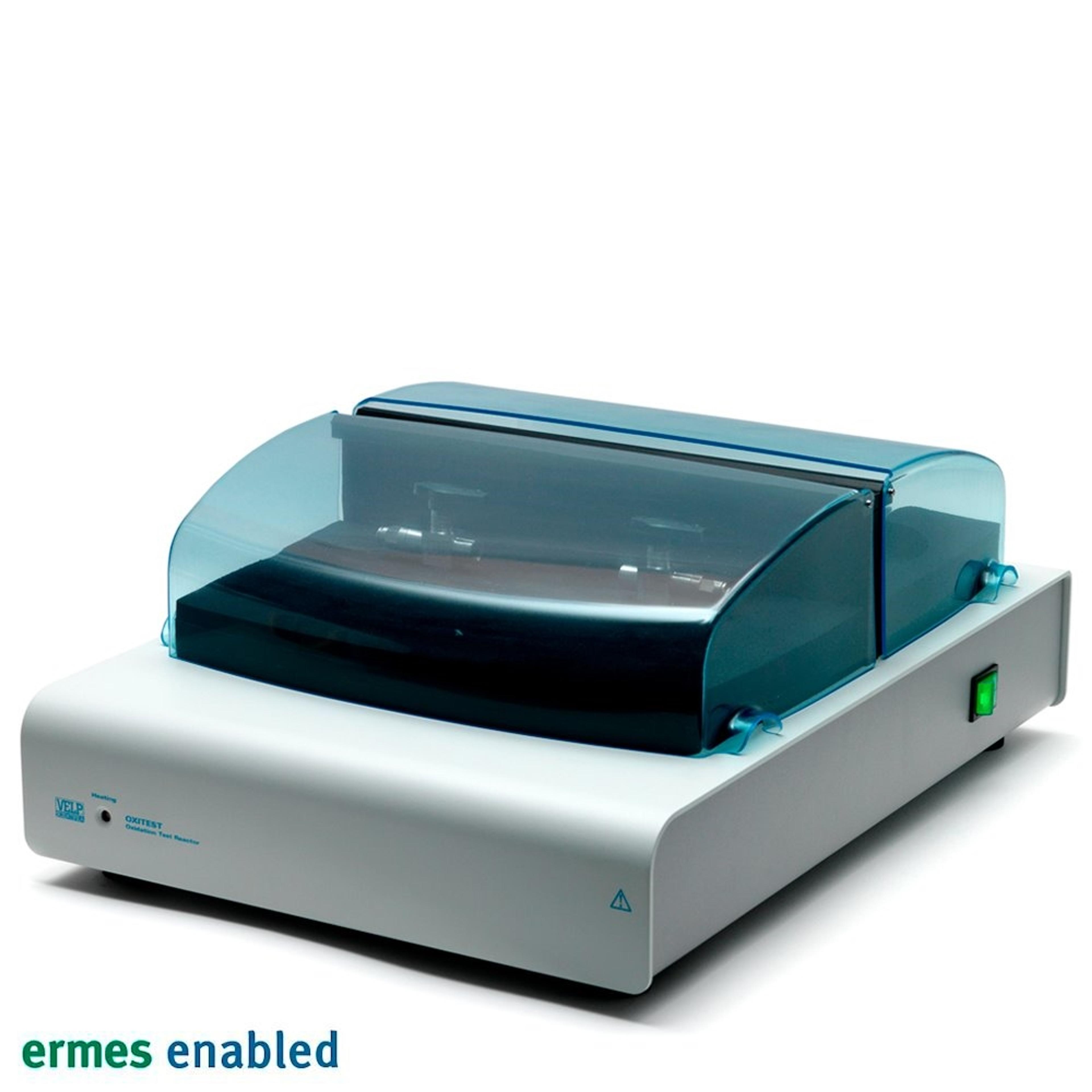
OXITEST

MEET THE SCIENTIST: Optimized fat oxidation stability testing

Fat and oil oxidation stability is a vital parameter for determining shelf-life. In this video, uncover the benefits of the OXITEST from Velp Scientifica, and hear from researchers at the University of Basilicata as they share their experiences and results.

Watch video

Oxford Instruments

NMR SOLUTIONS: How to effectively quantify fat content in foodstuffs

This free webinar with experts from Oxford Instruments explains how both TD-NMR and benchtop NMR spectroscopy can measure oils and fats, from harvest through to the manufacturing of ingredients and food products.
Register here

Matt Camption, Airborne Honey

VIDEO: Robust analysis for ensuring honey authenticity

Matt Campion shares how Airborne Honey’s in-house lab tests for honey authenticity using a range of techniques and new HPLC instrumentation that provides quality data at high throughput.

Watch video

Ion Chromatography eBook

ION CHROMATOGRAPHY: Food & beverage testing eBook

Elevate your food and beverage analysis to the next level with rapid and reliable methods.
Download eBook

NGS eBook

NGS eBOOK: Your guide to rapid food pathogen detection

Transform your food safety testing workflow for key pathogens with this free download.

Download eBook

Expert interviews:

  • Tackling the global PFAS contamination crisis with mass spec: Marco Zhong, Director of the National Reference Laboratory for Food Contact Material, discusses ‘forever chemicals’ and why effective FCM testing is more important than ever. Read article>>
  • Microbiologist shares secrets to brewing success: In this SelectScience® article, we speak with Margareth Krauter, the head microbiologist and Quality Assurance (QA) specialist at Grupo Petrópolis, about the many considerations of beer quality control. Read article>>
  • Scientists devise biosensor tests to tackle cocoa disease blighting West Africa: Dr. Jacqueline Barnett and Dr. Joel Allainguillaume discuss their work to develop handheld detectors to combat the spread of cacao swollen shoot virus and arrest the decline in the cocoa industry. Read article>>
  • How Coca-Cola bottlers perform microbiological QC checks: Christhian Contreras Quiroz, Process Quality Chief at the México division of Coca-Cola FEMSA, shares how regulatory standards are met at every bottling site. Read article>>

Other top resources:

  • Determination of fat and oil content in foodstuffs: In this application note, discover how fat and oil content can be measured to enable manufacturers to achieve higher standards in nutritional characterization and quality control of foodstuffs. Download method>>
  • How to minimize the risk of food fraud due to coronavirus: Dr. Bert Popping, manager director at FOCOS, explores risks for food fraud in the supply chain due to coronavirus, and how these risks can be mitigated. Watch here>>
  • The impacts of COVID-19 on food safety: Patrick Bird, principal consultant at PMB BioTek Consulting, discusses his team's work to create a certified validation process to accurately detect SARS-CoV-2 on environmental surfaces and explains the impacts of COVID-19 on the food safety industry. Watch on The Scientists' Channel >>
  • Robust NGS methods for the fight against food fraud: In this video interview, Roberta Pellesi explores Barilla Group's belief in the importance of sharing food fraud know-how and looks at how NGS can help guarantee product integrity and protect brand reputations. Watch on The Scientists’ Channel >>
  • Impact of Salmonella on the global meat and poultry supply chain: Join Erin Crowley, Chief Scientific Officer at Q Laboratories, and Martin Wiedmann, Gellert Family Professor in Food Safety at Cornell College of Agriculture and Life Sciences, as they present an overview of the global impact of Salmonella on the meat and poultry supply chain and look at the validation of qualitative and quantitative methods for microbiology in food. Watch here>>

Your recommendations:

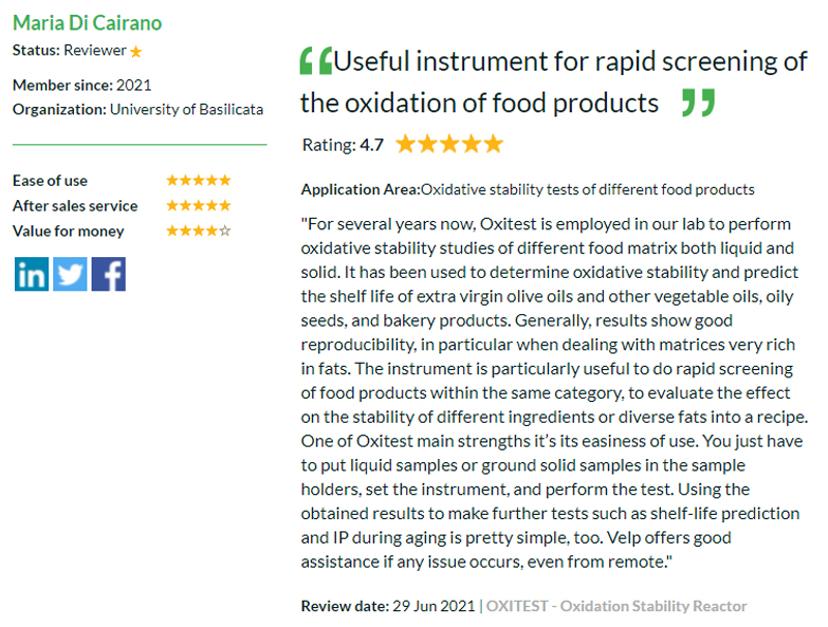
Take a look at what other researchers and scientists all over the world are saying about the latest equipment and technologies in food quality. Here, Maria Di Cairano, University of Basilicata, shares her opinion of the OXITEST - Oxidation Stability Reactor by Velp Scientifica.
Oxitest review Maria Di Cairano

Find more news and resources in our Food Contamination: Quality & Safety Special Feature>>

OXITEST - Oxidation Stability Reactor

Velp Scientifica

The OXITEST is designed for R&D and QC for the study of the behaviour of fat oxidation stability. The OXITEST speeds up the oxidation process and measures the absolute pressure change of oxygen inside the two titanium heating chambers at a constant temperature, thus monitoring the oxygen uptake by reactive components in the sample and automatically generating an IP value for further analysis via software.
(4)

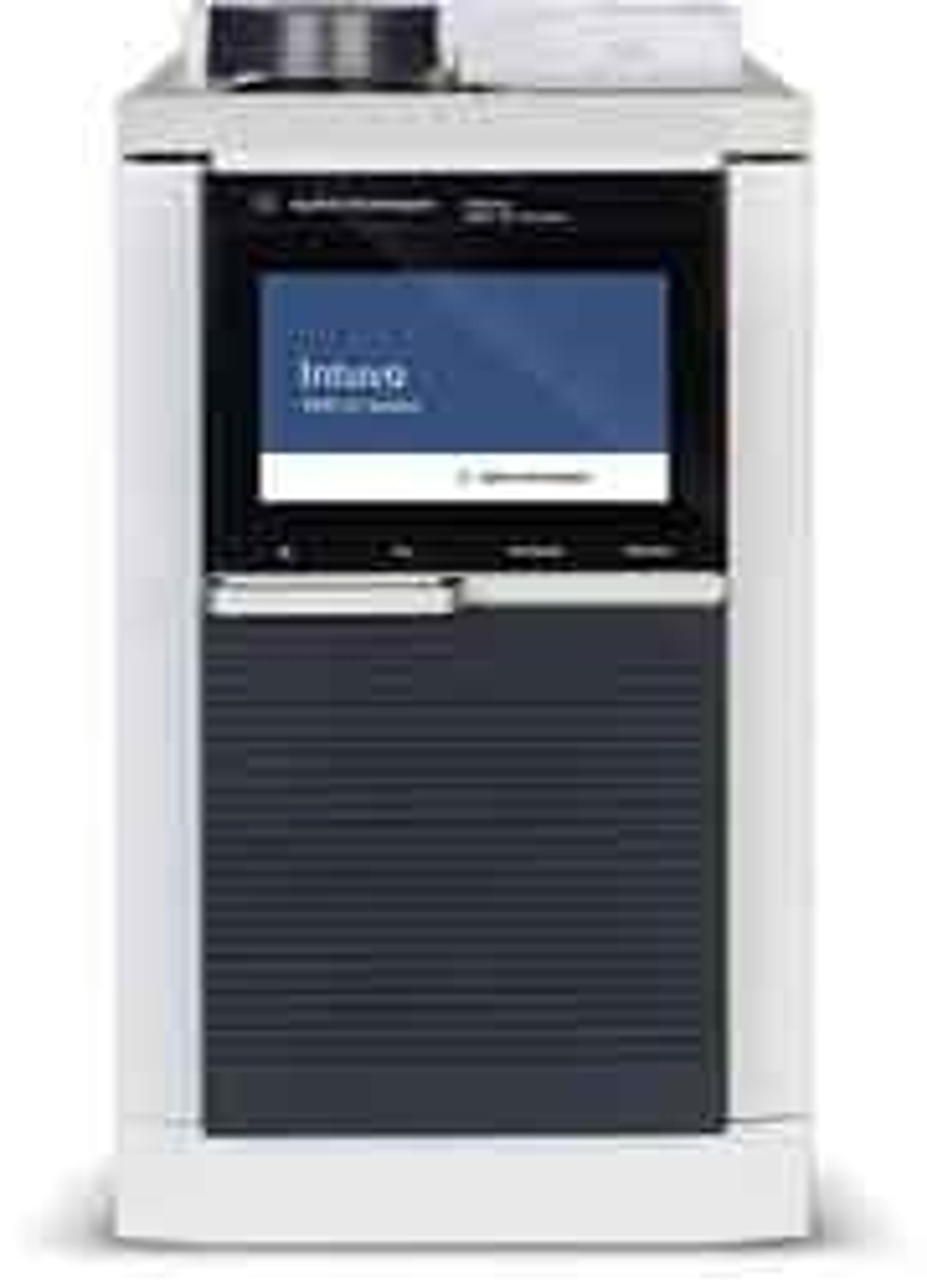
Agilent Intuvo 9000 GC System

Agilent Technologies

Specifically designed for fast gas chromatography, higher productivity, and improved ease-of-use through its ballistic column heating. Never do column maintenance again with click-and-run connections. Built-in intelligence further increases productivity and usability.
(9)

Links

Tags

Gas ChromatographyGas chromatography (GC) is an analytical technique used to separate and quantitate mixtures of small and volatile compounds. Gas chromatographs or GC systems include components such as GC columns, detectors, pumps and autosamplers. Choose from packed or capillary GC columns, flame ionization (FID), photoionization (PID) electron capture detectors and selective or non-selective detectors. Find the best gas chromatographs in our peer-reviewed product directory: compare products, check customer reviews and receive pricing direct from manufacturers.UHPLC and HPLCHigh performance liquid chromatography (HPLC) and ultra high performance liquid chromatography (UHPLC), also known as UPLC, are analytical techniques used to separate, identify and quantitate components of complex mixtures including biological samples such as proteins and lipids as well as chemical mixtures of pesticides, drugs and oils. Both techniques are liquid chromatographic methods but differ by operating pressures (HPLC < 6000 psi < UHPLC ). Components of HPLC and UHPLC systems include columns, detectors, pumps, autosamplers and column heaters. Explore a range of UHPLC and HPLC columns for your specific sample needs including reverse phase, normal phase, ion exchange, HILIC, ion exclusion and size exclusion columns. For more specialized HPLC, explore FPLC, countercurrent LC and simulated moving bed systems. Find the best UHPLC and HPLC equipment in our peer reviewed product directory: compare products, check customer reviews and receive pricing direct from manufacturers.Atomic Absorption / Emission SpectroscopyAtomic absorption spectroscopy (AAS) and atomic emission spectroscopy (AES) — also called optical emission spectroscopy (OES) — are used to detect the elemental constituents in samples. Both techniques involve the atomization of a sample. Atomic absorption spectrometers may use a flame or furnace to create an atomic vapor of the sample before irradiation with spectral light. Optical emission spectrometers may use a flame, inductively coupled plasma (ICP), microwave plasma (MP) or spark arcs to atomize and excite the sample. At higher excitation energies, electrons can be emitted instead of photons, which can be useful for samples that can’t be atomized and for surface analysis. Explore electron spectroscopy equipment such as Auger spectrometers and photoelectron spectrometers for surface elemental analysis of samples. Find the best atomic absorption, photoelectron and optical emission spectrometers in our peer-reviewed product directory: compare products, check customer reviews and receive pricing direct from manufacturers.Infrared / IR SpectroscopyInfrared (IR) spectroscopy measures the interaction of infrared light with a sample, including transmission, reflectance & absorbance, facilitating the identification of analytes. Equipment used for quantitative analysis includes Fourier-transform infrared (FTIR) spectrometers, infrared cameras, FTIR gas analyzers, as well as attenuated total reflectance (ATR) accessories and pellet or film presses. Find the best IR spectroscopy products in our peer-reviewed product directory: compare products, check customer reviews and receive pricing direct from manufacturers.LC-MSLC-MS (liquid chromatography-mass spectrometry) systems and equipment are used for separation and quantitative analysis of complex mixtures, combining liquid chromatography and mass spectrometry. Quantify proteins, contaminants, pesticides or screen for drug metabolites with a high level of sensitivity. LC-MS systems and equipment include reverse phase, normal phase and specialized columns integrated with various MS detectors such as time-of-flight (TOF), quadrupole, orbitrap or ion trap mass analyzers. LC-MS/MS instruments equipped with a qTOF or triple quadrupole analyzer give greater sensitivity and resolving power to your analysis. Find the best LC-MS equipment in our peer-reviewed product directory: compare products, check customer reviews and receive pricing direct from manufacturers.Mass SpectrometryMass spectrometry (MS) is a powerful analytical technique used to identify and quantify molecules based on the mass-to-charge ratio of gas-phase ions. It provides detailed information about the structure, composition, and properties of compounds and is widely used across fields such as environmental monitoring, materials science, drug discovery and development, food and beverage testing, and wider chemical research. Key MS techniques include tandem mass spectrometry (MS/MS), liquid chromatography–mass spectrometry (LS-MS) and inductively coupled plasma (ICP-MS). Choosing from these wide range of techniques and technologies can be a daunting task, so keep up to date with scientific applications, performance expectations, and customer reviews here all in one place. Visit our product directory to receive quotes direct from the manufacturer. UV-Visible SpectroscopyUltraviolet-visible (UV-Vis) spectrophotometers are used to measure the interaction of UV and visible light with a sample, including transmission, reflectance & absorbance. The two major instrument classes are single-beam or double-beam spectrophotometers. More specialized equipment includes colorimeters, spectroradiometers and refractometers. Portable and microvolume spectrophotometers are also available. For the modular spectroscopy lab, explore a range of light sources for combination with a spectrograph/spectrometer and optics. Find the best UV-Vis spectroscopy products in our peer-reviewed product directory: compare products, check customer reviews and receive pricing direct from manufacturers.PCR and Thermal CyclingPolymerase chain reaction (PCR) kits and thermal cyclers are used for the in vitro amplification of DNA permitting subsequent analysis and experimental procedures. Explore a range of high-quality polymerase, primers and nucleotides or simplify your workflow with a PCR mastermix. Find reverse transcription PCR (RT-PCR) and cDNA synthesis kits for RNA products and libraries. Quantitatively measure the amplification of DNA with real-time PCR (qPCR) and droplet digital PCR (ddPCR) kits and systems, and discover automated PCR setup solutions to increase throughput. Alternative DNA amplification methods also include recombinase polymerase amplification (RPA) kits. Find the best PCR kits and thermal cyclers and purification equipment in our peer-reviewed product directory: compare products, check customer reviews and receive pricing direct from manufacturers.MicrobiologyMicrobiology is the study of microorganisms including protists, prokaryotes, fungi, and, often, viruses. Microorganisms are a useful research tool as genetic vectors and, in immunology, for antibiotic susceptibility testing, cellular biology and genetics. Microorganisms commonly grow readily in incubators with microbial culture media; this can contain chromogenic supplements to differentiate between cell lines. Estimate your culture’s density of microorganisms with colony counters, or screen and select colonies for desirable clones with automated colony pickers. Additionally, equipment is available to monitor environments for the presence of microbes and identify with microbial identification instruments. Find the best microbiology products in our peer-reviewed product directory: compare products, check customer reviews and receive pricing direct from manufacturers.Solid-Phase ExtractionSolid-phase extraction (SPE) is used for clean-up, extraction and concentration of semi-volatile or non-volatile analytes from complex mixtures including blood, urine and food samples. Multiple formats are available for conducting SPE, including prepacked SPE cartridges, disks and microplates, as well as SPE sorbent powders for manual packing. SPE systems can be used to automate the process and extract multiple samples at once. Solid-phase microextraction (SPME) and supported liquid extraction (SLE) products are also available in the same formats. Find the best SPE, SLE and SPME equipment in our peer-reviewed product directory: compare products, check customer reviews and receive pricing direct from manufacturers.pH and Conductivity MetersIon and pH meters, used for electrochemical techniques and measurements, measure the concentration of specific ions using electrodes (probes) and a meter. Features of ph and ion meters to consider include temperature compensation, auto-calibration, adjustable resolution, measurable range and accuracy. Meters can be handheld, portable, benchtop and modular.Next Generation SequencingNext-generation sequencing (NGS), also known as whole-genome sequencing, high-throughput sequencing and massive parallel sequencing, produces and analyses thousands to millions of nucleotide sequences at once. Sequencing systems operate via varying technologies depending on the manufacturer, including sequencing by synthesis, ligation, pyrosequencing, ion semiconductor and single-molecule real-time sequencing. For NGS, library preparation is paramount to successful sequencing. In this section, explore a range of library preparation kits, from targeted, amplicon-based or hybridization-based kits including epigenomic, transcriptomic and genomic workflows to fragmentation kits. Find the best next-generation sequencing products in our peer-reviewed product directory: compare products, check customer reviews and receive pricing direct from manufacturers.CalorimetryCalorimetry is a technique used to determine the heat released or absorbed in a chemical reaction. Calorimeters can be categorized into bomb calorimeters, constant pressure calorimeters, differential scanning calorimeters, isothermal titration calorimeters, X-ray microcalorimeters, heat-loss calorimeters, and high-energy particle calorimeters. The choice of calorimeter depends on the application.KjeldahlKjeldahl is an analytical chemistry technique for the quantitation of nitrogen in chemical substances. Applications of Kjeldahl include analyzing the protein content of food, nitrogen analysis in environmental sciences and the pharmaceutical industry and total kjeldahl nitrogen, nitrate and ammonia analyses in agricultural sciences.TitrationTitration is an analytical technique for determining substance concentration in a solution. For titration consider a manual or automated system, volumetric or coulometric reagent addition and indication by a potentiometer, spectrometer, turbidometer or by the Karl Fischer method. Other features of titration to consider include burettes, reagents, concentration range, reaction time and autosamplers.