
Your ASMS Day 3 briefing: Enabling technologies & data interpretation
Midweek at ASMS brings another full day of technical sessions, posters, and workshops, with increasing focus on how complex data are generated, interpreted, and applied
3 Jun 2026
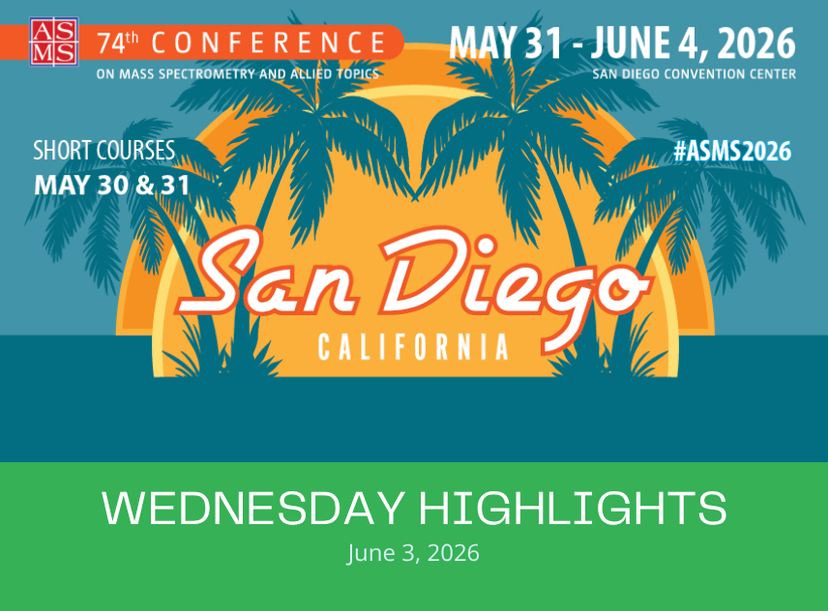
Explore the latest news and announcements from ASMS 2026 on our dedicated show page >>
Wednesday, June 3rd at a glance
- All eyes on: Morning oral sessions across core MS disciplines
(08:30am–10:30am, multiple rooms) - Don’t miss: Afternoon sessions spanning AI in MS, biotherapeutics, and data workflows
(14:30pm–16:30pm) - On the floor: Posters and exhibits continue
(10:30am–14:30pm, Exhibit–Poster Hall) - Later today: Evening workshops across specialist topics
(17:45pm–19:00pm)
Program highlights (morning oral sessions)
Where: 08:30am–10:30am, multiple rooms
Wednesday opens with parallel sessions covering:
- Proteomics and quantitative analysis (Hall D)
- Metabolomics and lipidomics (Ballroom 20A)
- Instrumentation and method development (Ballroom 20BC)
- Complex sample analysis (Ballroom 20D)
- Biomarkers and clinical applications (Room 6A)
- Ion mobility and separations (Room 6B)
- Environmental and applied MS (Room 6CF)
- Natural products and applications (Room 6DE)
Product announcements follow-up
Where: Exhibition hall
Following Monday’s press conferences, updates from Bruker, Shimadzu, SCIEX, Agilent Technologies, Thermo Fisher Scientific, and Waters Corporation continue to be reflected across the show floor.
For full details and the latest announcements visit our dedicated ASMS 2026 show page >>
Posters and exhibition
Where: Exhibit–Poster Hall
Time: 10:30am–14:30pm
- Poster sessions run 10:30am–12:00pm and 13:00pm–14:30pm
- Coverage spans instrumentation, omics workflows, environmental analysis, and clinical MS
Afternoon oral sessions
Where: 14:30pm–16:30pm, multiple rooms
Parallel sessions continue across areas including:
- Structural and systems-level MS
- Data analysis and interpretation
- Biotherapeutics and applications
- Emerging instrumentation and workflows
Evening workshops
Where: 17:45pm–19:00pm, multiple rooms
Workshops focus on:
- Advanced data analysis
- Ion mobility and separations
- Proteomics workflows
- Software and computational tools
Tags
Frequently asked questions
Show frequently asked questions
What is ASMS?
The American Society for Mass Spectrometry (ASMS) is a professional organization dedicated to advancing the science and application of mass spectrometry. The annual ASMS conference is one of the largest global meetings in the field, bringing together researchers, instrument developers, and industry professionals to share new data, technologies, and applications.
What is the ASMS 2026 conference?
The 74th ASMS Conference on Mass Spectrometry and Allied Topics is the 2026 annual meeting of the society. The program includes oral presentations, poster sessions, award lectures, workshops, networking events, and a large exhibition featuring instrument vendors and technology providers.
Where is ASMS 2026 being held?
ASMS 2026 is being held in San Diego, California, at the San Diego Convention Center, a large waterfront venue that hosts the conference’s multiple parallel sessions, exhibition halls, and poster areas. The program references spaces within the convention center such as Hall D, Grand Ballroom suites, Pacific Ballroom rooms, and the Exhibit–Poster Hall, which are all part of the convention center complex.
Who attends ASMS?
The conference attracts a global audience including academic researchers, industry scientists, instrument manufacturers, software developers, and students, all working in areas where mass spectrometry plays a role, such as proteomics, metabolomics, clinical analysis, environmental science, and drug development.