
Waters launches reversed phase bioseparation columns for faster GLP-1 and LNP analysis
New column platform enhances impurity resolution and accelerates biopharmaceutical development workflows
10 Jun 2026
Waters Corporation has launched the BioResolve™ Peptide and GTxResolve™ Lipid Phenyl-Hexyl+ and C18+ Columns, an industry-first reversed-phase (RP) column platform engineered to deliver up to 3x faster GLP-1 characterization and 2x faster lipid nanoparticle (LNP) component analysis, helping biopharmaceutical scientists accelerate development timelines, reduce production bottlenecks, and improve regulatory readiness.
Addressing critical challenges in GLP-1 and LNP impurity analysis
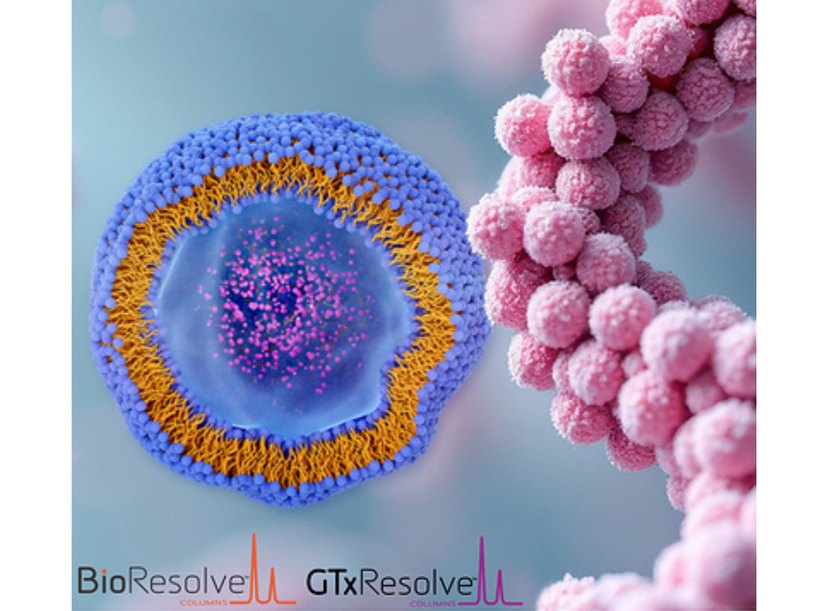
In GLP-1 receptor agonists and newer mRNA-based therapies such as in vivo CAR T, reliably resolving structurally and chemically similar impurities is a persistent analytical challenge. Difficulty separating low-level or closely related impurities can delay time to market, weaken regulatory confidence, and affect patient safety.
Traditional RP columns do not always separate low-level or closely related impurities effectively, often requiring longer analyses, detector-suppressing mobile-phase additives, or repeated method redevelopment.
The new BioResolve Peptide and GTxResolve Lipid Columns are designed to overcome these limitations with ready-to-use methods that improve both resolution and speed while fitting into existing U(H)PLC and HPLC workflows.
Faster run times and higher resolving power for biopharmaceutical development
The BioResolve Peptide and GTxResolve Lipid Phenyl-Hexyl+ and C18+ Columns deliver faster run times for GLP-1, insulin, and LNP drug substance testing, helping to accelerate biopharmaceutical development timelines and reduce production bottlenecks. The columns provide up to a 2x increase in resolving power and sensitivity to identify and track low-level impurities, supporting improved regulatory readiness.
Industry-first chemical and physical particle optimization enables reproducible methods for increasingly complex biologics, from early-stage research through manufacturing.
Advances in chemistry and particle physics for GLP-1 and LNP workflows
BioResolve Peptide and GTxResolve Lipid Columns use specially designed surface chemistries and superficially porous particles to deliver precise RP separations with selectivity for two difficult sample types: GLP-1 peptides and LNPs. Available in Phenyl-Hexyl+ and C18+ chemistries with 230 Å pore size particles, they are designed to support efficient mass transfer, consistent performance across U(H)PLC and HPLC systems, and reliable, batch-tested results from discovery through commercial manufacturing.
Enhanced GLP-1 peptide impurity resolution
GLP-1 peptides are especially challenging to analyze because many impurities differ by just one atom, while others have no difference in atomic composition and vary only in how their atoms are arranged spatially.
BioResolve Peptide Phenyl-Hexyl+ and C18+ Columns are built to resolve these difficult impurities, with specialized 300 mm formats available when maximum separation performance and deeper impurity characterization are required.
Optimized performance for lipid nanoparticle and lipid analysis
For LNP and lipid workflows, the charged surface of GTxResolve Lipid Columns helps sharpen peaks for ionizable lipids by reducing tailing. The larger pore size makes it easier for a wide range of lipid molecules to move through the column, improving peak shape and resolving challenging co-elutions.
In addition, the superficially porous particle design speeds the movement of molecules through the stationary phase, shortening run times without reducing selectivity.
Erin Chambers, Vice President, General Manager, Consumables & Lab Automation, Waters Analytical Sciences, Waters Corporation, said, “BioResolve Peptide and GTxResolve Lipid Columns are designed to resolve chemically similar GLP‑1 impurities and LNP components faster when speed matters, and with extraordinary resolution when certainty is required. The result is simpler method development, regulatory‑ready data, and faster, highly reproducible methods, ultimately helping to reduce cost burdens on important new therapeutics.”
Want the latest science news straight to your inbox? Become a SelectScience member for free today>>
Links
Tags
Frequently asked questions
Show frequently asked questions
How do Waters BioResolve Peptide and GTxResolve Lipid Columns improve GLP-1 and LNP impurity analysis for biopharmaceutical scientists?
Waters Corporation’s BioResolve Peptide and GTxResolve Lipid Phenyl-Hexyl+ and C18+ Columns deliver up to 3x faster GLP-1 characterization and 2x faster LNP component analysis. They address challenges in resolving low-level and closely related impurities, offering ready-to-use RP methods that increase resolving power and sensitivity, reduce production bottlenecks, and support regulatory-ready impurity profiling in biopharmaceutical development.
What makes the BioResolve Peptide and GTxResolve Lipid Columns an industry-first RP platform for GLP-1 and lipid nanoparticle workflows?
These Waters columns combine advances in chemistry and particle physics, including specially designed surface chemistries and superficially porous particles with 230 Å pores. They are the first Waters columns QC batch-tested specifically for GLP‑1 and lipid nanoparticle analysis, providing up to 2x higher resolving power, faster run times, and reproducible methods across U(H)PLC and HPLC systems from discovery through commercial manufacturing.
How do GTxResolve Lipid Columns enhance lipid nanoparticle and lipid analysis compared to traditional RP columns?
GTxResolve Lipid Columns feature a charged surface that sharpens peaks for ionizable lipids by reducing tailing and improving peak shape. Their larger pore size facilitates mass transfer for diverse lipid molecules, resolving challenging co-elutions. The superficially porous particle design shortens run times without sacrificing selectivity and supports flexible detection with UV, MS, ELSD, and CAD for comprehensive lipid quantitation and impurity analysis.