
Waters Announces New Reference Library for Metabolite Profiling
With more than 900 Collision Cross Section Values, Metabolic Profiling CCS Library
2 Jul 2016Waters Corporation has introduced a new metabolic profiling reference library for use during ion mobility mass spectrometry-based research.
The Metabolic Profiling CCS Library includes more than 900 measurements of collision cross-section (CCS) values, which measure the gas phase three-dimensional shape of a molecule for an additional identification coordinate used to confirm analytical results. The library also includes more than 600 MS/MS spectra.
The library is included in Waters® UNIFI® Scientific Information System, the company’s unique software platform that combines instrument control and data analysis, visualization, and management of both chromatography and mass spectrometry results. The library is also available for use with Progenesis® QI Software. The new resource was announced at the 64th American Society for Mass Spectrometry meeting.
The Metabolic Profiling CCS Library enables research scientists to accurately identify biomarkers in complex sample matrices when using ion mobility separations. A collisional cross section (CCS) value is a precise physicochemical property of an ion related to its size, shape, and charge in the gas phase. In untargeted metabolomics studies involving small sample amounts that are highly complex, researchers can use CCS values in the library to confirm identifications of endogenous metabolites and lipids showing statistically significant changes between different sample groups.
“Metabolomics and lipidomics are critical techniques for biomarker discovery and translational research, whether identifying endogenous biomarkers of interest for efficacy, or understanding disease progression. Ion mobility mass spectrometry is an enabling technology for performing untargeted metabolomics studies where the researcher wants to learn as much as possible to Increase Researcher Confidence during Untargeted Studies about the underlying biology. Where ion mobility increases overall chromatographic peak capacity, CCS values improve confidence that a researcher has correctly identified a particular metabolite/s,” commented David Heywood, senior business development manager for Waters’ omics solutions.
The Metabolic Profiling CCS Library for UNIFI is available with the VionTM IMS QTof and SYNAPT® G2-Si HDMS® Systems, high-resolution mass spectrometers that reduce the complexities of executing ion mobility-based analyses.
When used in conjunction with Progenesis QI Software, which aids in the identification of compounds that are significantly changing in a sample, the technologies enable researchers in biomarker identification to robustly and routinely mine complex samples with high coverage and statistical rigor.
Related products
Request Quote for All Products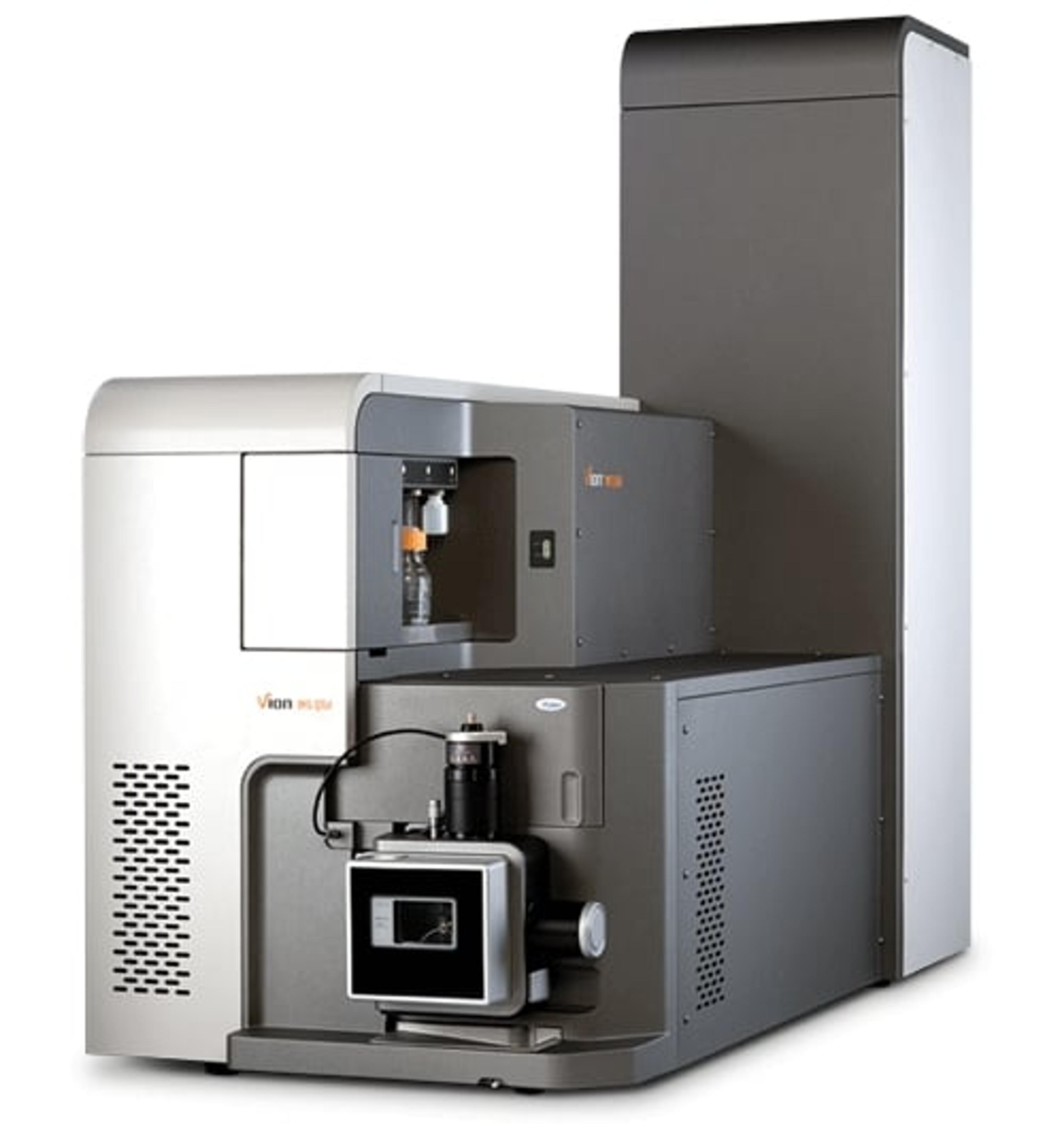
Vion IMS QTof
WatersVion IMS QTof is a high resolution QTof mass spectrometer that delivers the selectivity of ion mobility to every scientist, for every analysis. Does high resolution, accurate mass data always lead to the correct answer first time? Avoid additional confirmatory experiments by utilizing the selectivity of ion mobility. Featuring new geometry and including XS Ion Optics and the QuanTof2 detection system, the Vion IMS QTof has the sensitivity and dynamic range to make ion mobility quantitative and routinely usable, enabling: Easier data interpretation as ion mobility cleans up and simplifies every spectrum Confident identification and quantification of analytes Faster method development and higher sample throughput Greater selectivity than conventional MS/MS with HDMSE With Vion IMS QTof you can use the selectivity of ion mobility to quickly refine spectra and discount chromatographically co-eluting compounds and background interferences. Enabling you to characterize your compounds with confidence. The ability to gather and process CCS data for every ion gives you more confidence in your data than ever before. Vion IMS QTof is driven by UNIFI scientific information system to deliver the most comprehensive analytical workflow, enabling you to target, identify, and review results in a single software platform. Make more informed decisions, faster. CCS provides chromatographic retention time independent data points, enabling confident identification of your analytes and reducing the risk of false positives and false negatives. Even during initial sample analysis, without any retention time knowledge, you can use theoretical exact mass and CCS library values to identify unknown and unexpected components. Applications: Screening - Meeting legislative and regulatory demands requires the utmost confidence in your data. UNIFI informatics workflows integrate the value of CCS, reducing false positives and false negatives driving laboratory efficiency. Pharma - The combination of UNIFI and Vion IMS QTof brings ion mobility to your drug discovery experiments while maintaing ease and efficiency you need for your routine Met ID processes. Omics - A recurring challenge for omics studies is the identification and structural elucidation of metabolites, lipids, and peptides of interest. Incorporating Vion IMS QTof into your workflow gives you not only CSS data from every component, but also increase analytical space and resolution.
SYNAPT G2-Si MS
WatersTransform your lab's discovery capability with the SYNAPT G2-Si MS. Information. Informatics. Impact. SYNAPT enables extensive characterization of complex mixtures and molecules with uncompromising qualitative and quantitative performance, streamlined workflows and unparalleled platform versatility. With the SYNAPT G2-Si you get ultimate UPLC/MS/MS performance, powerful data independent & data dependant solutions, CID and ETD fragmentation capabilities, and a wide range of experimental options.