
Touchscreen Spiral Plater Launched by Don Whitley Scientific

15 May 2016
Alex Waite
Editorial Assistant

Product news

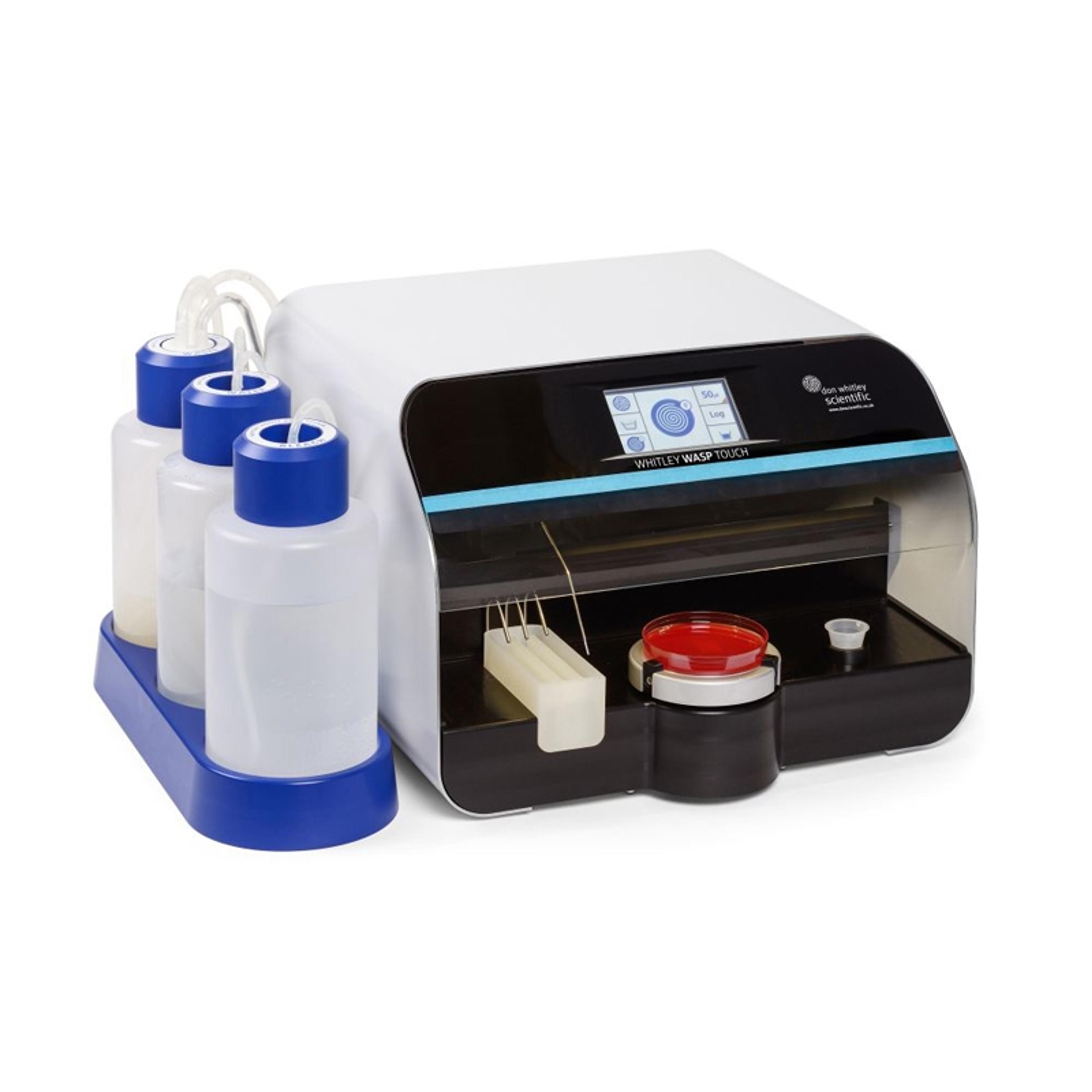
Launched at analytica 2016, WASP Touch is a new spiral plater, designed for the needs of modern microbiology laboratories.

This is a fundamentally different plater with no need for a separate vacuum source. The system is simple to use and provides real cost savings and process improvements.

WASP Touch features:

  • Touchscreen operation
  • New automatic sanitising system automatically maintains correct liquid levels in sanitising solutions – patent pending
  • Illuminated, covered working area

Automated Intelligent Monitoring Software (AIMS) guides users through set-up and daily check routines to ensure consistent, trouble-free plating. Sample may be aspirated from beakers, bottles and tubes – providing maximum flexibility in use.

The system incorporates a powerful diagnostic tool that automatically logs date, time, deposition, user name and number of plates produced.

Precise quantities of sanitising fluids are dispensed automatically to maintain optimum levels. This ensures effective and efficient sanitisation takes place. Sanitising system reservoirs contain sufficient fluid for over 900 wash cycles.

A space-saving feature is the fully integrated vacuum waste system.

Robust, reliable and easy to service, WASP Touch eliminates serial dilutions and produces perfect plates.
Links

Tags

Autoclaves and SterilizersAutoclaves and sterilizers are commonly used to sterilize laboratory equipment, instruments and growth media using constant pressure and temperature. When choosing an autoclave or sterilizer consider medical or laboratory application, size, loading and sterilization method. Sterilization methods include flame (Bunsen burners), heat (steam or dry), chemical and UV.Washing EquipmentWashing equipment is more convenient than ever before with automated systems, integrated and multi-application systems available. For instance microplate washers can be programmable, combined with reagents dispensers and used for applications such as ELISA, multiplex assays and PCR clean up.Labware and Lab SuppliesLabware and lab supplies include various forms of glassware, plasticware, reagents and personal protective equipment (PPE) and are used across all scientific laboratories, enabling daily tasks to be performed. Explore a range of flasks and beakers, petri dishes, carboys and storage bottles. Labware such as condensers, desiccators and burettes are also available for more specific tasks. Find the best labware and lab supplies in our peer-reviewed product directory: compare products, check customer reviews and receive pricing direct from manufacturers.MicrobiologyMicrobiology is the study of microorganisms including protists, prokaryotes, fungi, and, often, viruses. Microorganisms are a useful research tool as genetic vectors and, in immunology, for antibiotic susceptibility testing, cellular biology and genetics. Microorganisms commonly grow readily in incubators with microbial culture media; this can contain chromogenic supplements to differentiate between cell lines. Estimate your culture’s density of microorganisms with colony counters, or screen and select colonies for desirable clones with automated colony pickers. Additionally, equipment is available to monitor environments for the presence of microbes and identify with microbial identification instruments. Find the best microbiology products in our peer-reviewed product directory: compare products, check customer reviews and receive pricing direct from manufacturers.Sample ManagementSample management systems include sample storage devices such as freezers and plate storers, sample environment enclosures and sample organization, retrieval and sorter systems. Useful system features include high-throughput, automation, robotic arms, automated liquid handling and associated database systems. Accessories in sample management include barcode scanners, heat sealers and tubes.Robotic InstrumentsRobotic instruments can be used for high-throughput automation of many lab processes. Such processes use instruments for assays like cell based assays and ELISA, for sample preparation like shakers, centrifuges and incubators, and for analysis such as sequencing and western blot analyzers. Useful features of robotic instruments include speed, reproducibility, barcode readers, software and automation.Software PlatformsSoftware platforms are useful for various stages of laboratory experiments from data collection to data storage and processing. For instance lab software is available for system control, data management, data analysis and qualification / validation.Automation Supplies / AccessoriesAutomated accessories and consumables make lab processes fast, efficient and reliable. Useful automation accessories include microplate sealers, label printers and reagent reservoirs.Automated Liquid HandlingAutomated liquid handling equipment is used to mix, dilute and dispense allotted volumes of liquid into microplates and other vessels automatically. The robotic, liquid handling arms can dispense from single channel to 3456 multichannel as well as operate nanoliter dispensing, enabling high throughput of samples. Find the best automated liquid handlers in our peer-reviewed product directory: compare products, check customer reviews and receive pricing direct from manufacturers.AutomationAutomation in laboratories and manufacturing processes enhances efficiency, precision, and scalability by reducing the need for manual intervention. It plays a critical role in improving productivity, minimizing human error, and accelerating workflows in fields like diagnostics, drug development, and industrial testing. Automation technologies include robotic systems, automated liquid handlers, and process control systems that streamline complex tasks and ensure consistent, reproducible results. Explore our peer-reviewed product directory to discover the best automation solutions, compare options, read user reviews, and get prices directly from manufacturers.Sample HandlingProper and careful handling of samples is important in scientific studies to ensure the integrity of specimens. This will prevent deterioration and cross contamination, and improve the accuracy of sample tracking procedures.VacuumMicrobiologySample ProcessingSample processing is required to prepare samples prior to analysis. Technologies used for sample processing include homogenizers, grinders, mills and mixers.Sample Preparation