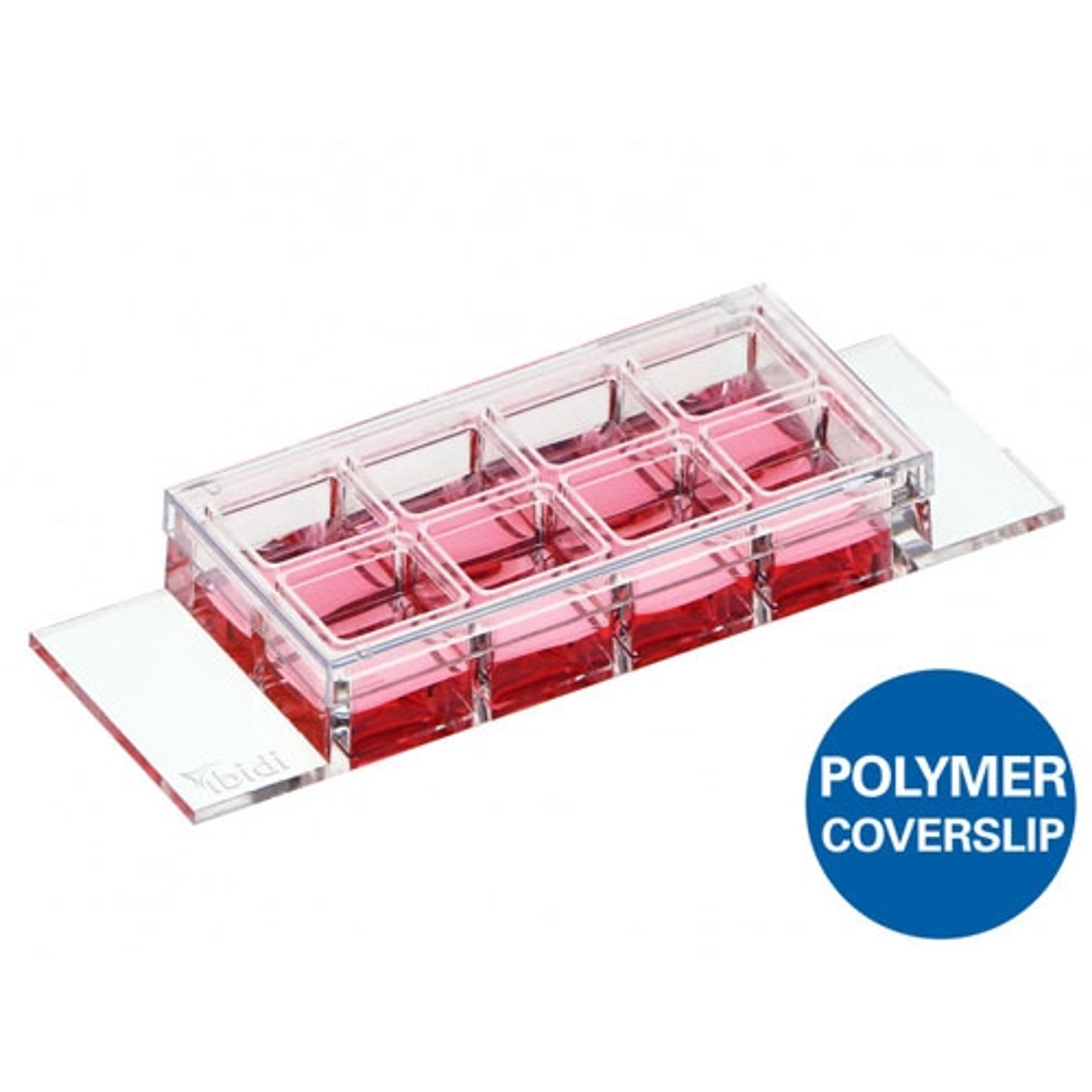
The new bioinert µ-slides - no adhesion of suspension cells and spheroids

The completely non-adhesive Bioinert surface is now available in a range of ibidi’s most requested µ-Slides, including the µ-Slide 8 Well high

2 Sept 2021

Rory Shadbolt
Publishing / Media

Product news

The Bioinert surface is a thin polyol hydrogel layer that is covalently bound to the ibidi Polymer Coverslip Bottom of the µ-Slide. It does not allow binding of any cells or biomolecules, which makes it superior to standard ultra-low attachment (ULA) products. The stable passivation is maintained for days, or even weeks, which is especially important during long-term experiments. Furthermore, high-resolution microscopy is guaranteed with the flat, thin bottom material and the excellent optical properties of the ibidi Polymer Coverslip.

The ready-to-use Bioinert products combine the highest optical quality with complete surface passivation. They are the ideal solution for all researchers who want to culture cells or cell aggregates without any adhesion to the surface (e.g., suspension cells, spheroids, and embryoid bodies). For controlled cell adhesion, ibidi has also recently launched µ-Slides with µ-Patterns, which have defined adhesion spots surrounded by Bioinert. Adherent cells from a suspension are caught by these spots, leading to spatially controlled cell adhesion.

For more of the latest science news, straight to your inbox, become a member of SelectScience for free today>>

µ-Slide 8 Well high

ibidi GmbH

Use this chambered coverslip with 8 wells for cell culture, immunofluorescence, and high-end microscopy. Also available with 2, 4, or 18 wells.

(1)

Links

Tags

Cell Adhesion AssaysCell adhesion assays are used to quantitate attachment and analyze the molecular mechanisms for extracellular matrix adhesion, cell migration and sensitivity to inhibitors. Find the best cell adhesion assay equipment in our peer-reviewed product directory: compare products, check customer reviews and receive pricing direct from manufacturers.Cell / Tissue CultureCell culture or tissue culture is used to study the biology of cells or tissues and to isolate cellular products in an environment which can be manipulated and well defined. Accurately control your culture environment with bioreactors or culture incubators, bind your cells to a surface or together with an extracellular matrix. Distinguish cell types with differential media or proliferate cells with certain characteristics using selective media. Enrich your media with supplements such as growth factors, sera and vitamins. Find the best cell and tissue culture products, kits and equipment in our peer-reviewed product directory: compare products, check customer reviews and receive pricing direct from manufacturers.MicroplatesMicroplates are multi-well plates used to increase the throughput of biological investigations. The number of wells microplates contain can range from 6 to 3243 wells, with the 96-well format being the most commonly used. Microplates can come tailored for a range of applications including cell culture, PCR, filtration, storage, non-binding surface, protein crystallization, as well as pre-coated, deep well and normal Standard microplates. Additionally, options for microplate colors include clear , black, white or black with clear bottom and white with clear bottom for absorbance microplate reader applications. Find the best microplates for your lab in our peer-reviewed product directory: compare products, check customer reviews and receive pricing direct from manufacturers.Cell Lines Stem Cells and Primary CellsPrimary cell cultures, established cell lines and stem cells are vital for <i>in vitro</i> and <i>ex vivo</i> experimentation. High-quality cells, optimized for your applications, alongside optimized cell substrates, growth medium and supplements, are critical for experimental success. Explore a range of cells suitable for your applications, including isogenic cell lines, competent cells, induced pluripotent stem cell (iPSC)-derived cell lines, fungal/bacterial/mammalian cell lines, stem cells and cancer cell lines. Find the best cells for your research in our peer-reviewed product directory: compare products, check customer reviews and receive pricing direct from manufacturers.PolymersPolymers are large molecules made up of many repeat units. Natural polymers such as DNA and proteins are essential to life, whereas synthetic polymers such as polystyrene and polyethylene are used widely due to their functionality. Typical techniques for analysis include GPC, SEC, DSC, FT-IR and NMR.Super Resolution MicroscopySpheroidsSpheroids are clusters of cells that have been grown in 3D culture to be used as <i>in vitro</i> model systems. These 3D microtissues can be used for toxicology testing, DMPK studies and many other applications involving cell analysis.Cell Adhesion