
The hidden gap between a cell culture protocol and how it's actually performed
Every cell biologist knows the feeling of staring at two identical experiments with different outcomes and wondering whether the answer lies in the biology or the handling
23 Sept 2026

Yannik Breitkreuz, Product Manager for Cell Biology at Hamilton
Cell culture is often described as more art than science, where a steady hand can matter as much as the written protocol. Even in labs that follow rigorous standard operating procedures, results can vary across runs, operators or passages, leaving scientists to wonder whether they are seeing genuine biological signal or an artifact of process.
Few people understand this tension better than Yannik Breitkreuz, Product Manager for Cell Biology at Hamilton, a global leader in automated liquid handling and laboratory automation. Before moving into product management, he spent years at the bench during his bachelor's, master's and doctoral research, with a strong focus on 2D and 3D cell culture.
That hands-on experience now informs his work at the intersection of science and product development. Through conversations with researchers about the challenges they encounter in day-to-day workflows, he helps identify where automation can provide practical support without introducing unnecessary complexity. Many of the scientists he speaks with are still confronting the same questions about variability that he encountered during his own time at the bench.
When the same protocol doesn't mean the same result
Those experiences continue to shape how Breitkreuz thinks about consistency in cell culture today. "You follow the same protocol, use the same reagents, and you are convinced you handled the cells exactly as you did the last time, yet the downstream result looks different," he said, describing the exercise of retracing steps, wondering whether confluence, incubation time or pipetting technique explain the discrepancy. "The frustrating part is that you often cannot answer that question with confidence afterwards." What strikes him most is how little has changed. "Years later, I still hear very similar stories from scientists I speak with today," he said. "Cell biology has advanced enormously, but many of the routine cell maintenance workflows behind it are still highly manual."
That gap raises an uncomfortable question: if two scientists follow the same SOP, why do their results sometimes diverge? For Breitkreuz, the answer lies in the difference between a protocol and its execution. "A protocol describes what should happen, but it cannot capture every detail of how each step is performed in practice," he said. Two people can each follow an SOP correctly and still differ slightly in timing, aspiration or mixing, or in how they count cells manually. "None of these differences necessarily represent poor technique," he said. "They are simply part of manual execution." Because such differences accumulate across passages, Breitkreuz believes it is worth distinguishing between standardizing a protocol and standardizing its execution, since identical instructions do not guarantee every cell experiences the same process when performed manually.
Where variability hides
Variability rarely announces itself. It enters a workflow through small, cumulative details: how long a flask sits outside controlled conditions, how cells are washed or detached, how a suspension is mixed, or how cultures are handed over between colleagues. "Individually, these differences may seem insignificant," Breitkreuz said. "But cells are living systems that continuously respond to their environment. Their condition at any given time reflects not only the current procedure, but also the cumulative history of how they have been maintained and handled." Documentation compounds the problem, since records typically confirm a step was completed but rarely capture exact timing or exposure. "By the time an unexpected result appears, its underlying cause often traces back to events that occurred days earlier or several passages upstream, making it extremely difficult to pinpoint ," he said.
That difficulty extends to distinguishing genuine biology apart from process-related artifacts. "Sometimes, you simply cannot tell with certainty after the fact, and that is exactly the challenge," he said, preferring instead to ask how much avoidable variability can be removed before an experiment even begins. "That does not remove biological variability, but it can give scientists greater confidence that the differences they observe are actually related to the biology they want to study."
A protocol describes what should happen, but it cannot capture every detail of how each step is performed in practice.
Yannik Breitkreuz, Product Manager for Cell Biology Hamilton
Building consistency into the process
Rather than viewing inconsistency or contamination risk solely as the result of individual technique, Breitkreuz argues that process and system design deserve equal attention. "Good laboratory technique will always matter," he said. "But if consistency depends on every scientist performing every repetitive step in exactly the same way, every day, then we should also look at the process itself." This is not about replacing scientific judgment, he emphasized, but about letting scientists apply their expertise "where it creates the most value, rather than relying on them to manually reproduce the same routine movements hundreds of times."
That philosophy also shapes how automation should enter a lab. Scientists spend years optimizing culture conditions, reagents and timings for specific cell lines, creating an understandable "never change a running system" mindset, Breitkreuz said. "If implementing automation means redesigning the entire process around the instrument, it creates a significant barrier to adoption and potentially introduces a whole new set of variables. Automation should preserve the scientific intent of the workflow while automating the repetitive execution around it."
A new approach to routine T-flask culture
This thinking underpins Hamilton's Cell Care FLASK, designed, in Breitkreuz's words, "around the way scientists already perform T-flask cell culture rather than trying to adapt their workflows to a conventional robotic platform." The system automates routine maintenance of adherent and suspension cultures in T175 and Triple Flasks within a closed, controlled environment. Its Swivel Unit uses controlled movements inspired by manual flask handling, while its MagPearl® Technology creates a closed fluid path for reagent and cell transfer, letting steps such as seeding, media exchange, passaging and harvesting be performed repeatably without a robotic arm. "The key benefit is not any single technology or feature," he said. "It is that movements, liquid handling, timing, and flask transport can all be executed in a defined way from one run to the next, while scientists can still adapt workflow parameters to their cell culture needs."
Breitkreuz draws a clear line between automating an experiment and automating its execution. Scientists still decide which cells to use, how they should be cultured and how to interpret results, while the system handles routine tasks through adaptable workflow templates. He said, based on current workflow data, the automated execution of multiple media exchange, passaging and harvesting protocols can free up to two to two and a half hours of hands-on time per run. "The value of this approach goes beyond simply reducing time at the bench," he said. "By automating repetitive and standardized cell maintenance tasks, scientists can dedicate more time to experimental design, data interpretation, and troubleshooting."
Consistency as a foundation for more complex biology
As laboratories increasingly work with organoids and other complex, human-relevant cell-based models under the umbrella of New Approach Methodologies (NAMs), Breitkreuz believes reproducible cell culture becomes even more important. "The more sophisticated our biological models become, the more important it is to understand and control what happens upstream," he said. Variability in a starting cell population can carry forward into downstream experiments, making an already complex biological system harder to interpret. He pointed to growing regulatory momentum, noting that both FDA initiatives around NAM validation and the NIH Standardized Organoid Modeling (SOM) Center emphasize robust, reproducible methodologies.
That reinforces a principle tying his perspective together, Breitkreuz said: as biology becomes more complex, the processes surrounding it should become more controlled. "The goal is not to remove biological variation," he said. "It is to reduce avoidable process variation so scientists can have greater confidence in the biological signals they are trying to understand." It is as much a shift in mindset as it is a technological advancement, one that views standardized execution not as a constraint on scientific work, but as the foundation for trusting the data and allowing scientists to focus on biology rather than the processes behind it.
To learn more about Cell Care FLASK and how it can help standardize routine T-flask workflows in your lab, click here.
Want the latest science news straight to your inbox? Become a SelectScience member for free today>>
Related products
Request Quote for All Products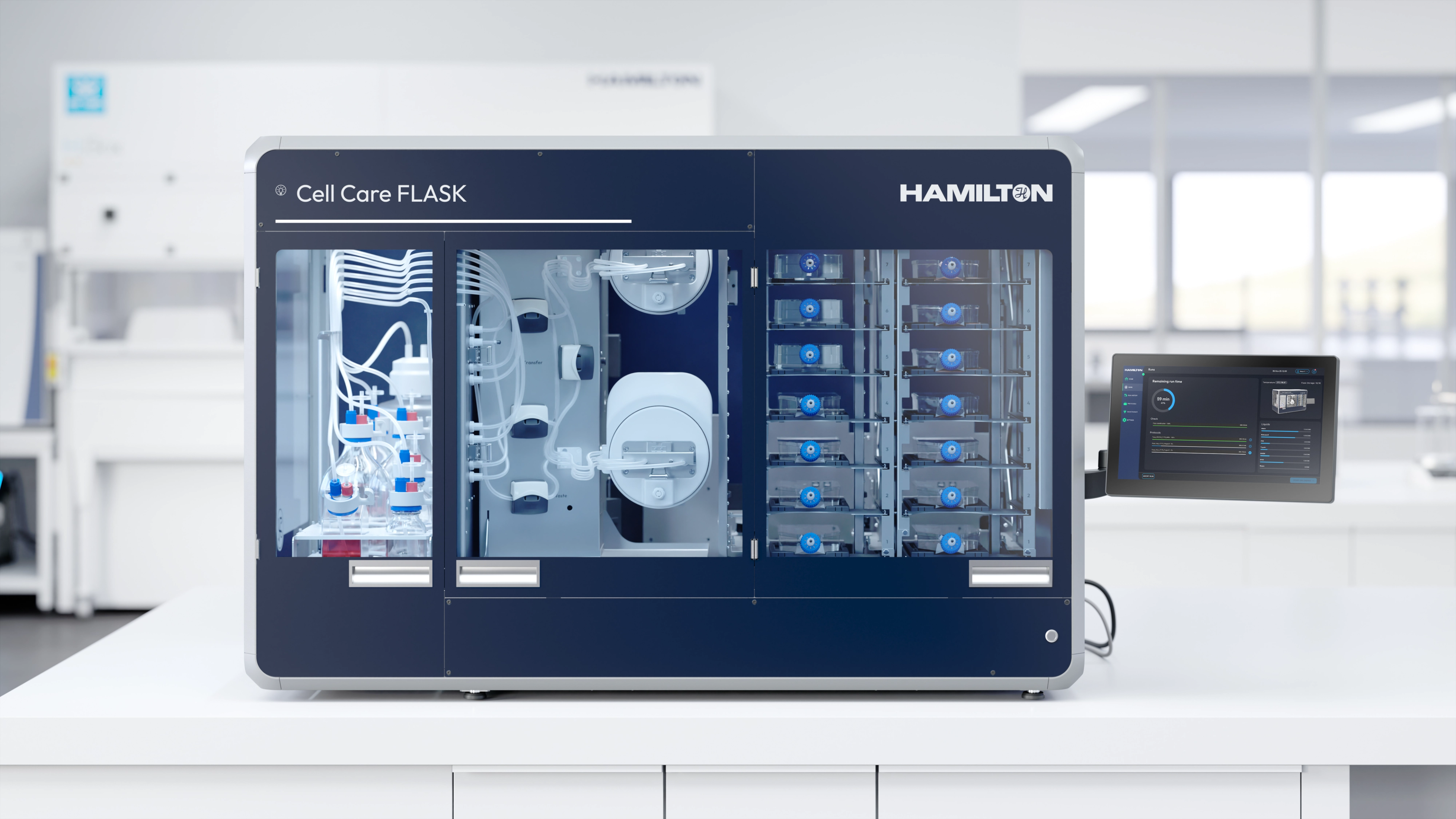
Cell Care FLASK
HamiltonPredictable Cell Culture. Confident Decisions. Cell Care FLASK removes repetitive T-flask maintenance from your bench. Automated feeding, passaging, and harvesting reduce variability and frees your team from routine handling, delivering consistent cultures and reliable results.
Links
Tags
Frequently asked questions
Show frequently asked questions
Why can the same cell culture SOP produce different results?
A protocol defines what should happen but cannot capture every detail of manual execution. Differences in timing, aspiration, mixing, cell counting, incubation, confluence and pipetting technique can accumulate across passages, creating process-related variability even when scientists correctly follow the same SOP.
How does Hamilton Cell Care FLASK improve T-flask cell culture consistency?
Hamilton Cell Care FLASK automates routine maintenance of adherent and suspension cultures in T175 and Triple Flasks. Its Swivel Unit and MagPearl® Technology standardize movements, liquid handling, timing and flask transport for repeatable seeding, media exchange, passaging and harvesting in a closed, controlled environment.
Why is reproducible cell culture important for organoids and New Approach Methodologies (NAMs)?
Variability in starting cell populations can carry into downstream organoid and other complex cell-based experiments, making biological results harder to interpret. Standardized execution reduces avoidable process variation, supporting the robust, reproducible methodologies emphasized by FDA NAM initiatives and the NIH Standardized Organoid Modeling Center.