
Simple reproducible assay for detection of early and late apoptosis
19 Jun 2008The Guava Nexin® Assay from Guava Technologies Inc. accurately monitors induction and progression of apoptosis quickly and easily.
The newly revised Guava Nexin Assay, for the first time, conveniently provides all necessary reagent components in a single cocktail to minimise assay steps, assay time and possible sources of contamination. This provides a much simpler apoptosis detection assay with the same ease of use, simplicity and performance you expect from Guava Technologies assays. You can now discern between early and late stage apoptotic cells faster and with minimal possible sources of error to ensure reliable results. The newly reformulated Guava Nexin Reagent obviates the need for pre-assay dilutions, cocktail preparations, or time consuming wash steps. The assay protocol is identical for use on all Guava® Systems, using both tube and plate-based approaches. Furthermore, the proven, assay-specific Guava Nexin® Software not only automatically calculates results, but also offers an easy-to-use interface for additional adjustments. The end result is an ideal assay that easily distinguishes between non-apoptotic cells, early apoptotic cells, late stage apoptotic and dead cells as well as nuclear debris.
The new mix-and-read Guava Nexin Assay relies on a two-dye strategy. The assay utilises Annexin V-PE to detect the translocation of phosphatidylserine (PS) to the external surface of the membrane of apoptotic cells, an early indication of commitment to apoptosis. The Guava Nexin Assay incorporates this PS-Annexin V-PE binding as an indicator of early stage apoptotic cells. The cell impermeant dye 7-AAD is included in the Guava Nexin Reagent as an indicator of membrane structural integrity. 7-AAD is excluded from live healthy cells and early apoptotic cells, but permeates late stage apoptotic and dead cells. In conjunction, the two dyes, added in one simple step as a reagent cocktail, provide quick and accurate determination of early and late stage cellular apoptosis.
Related products
Request Quote for All Products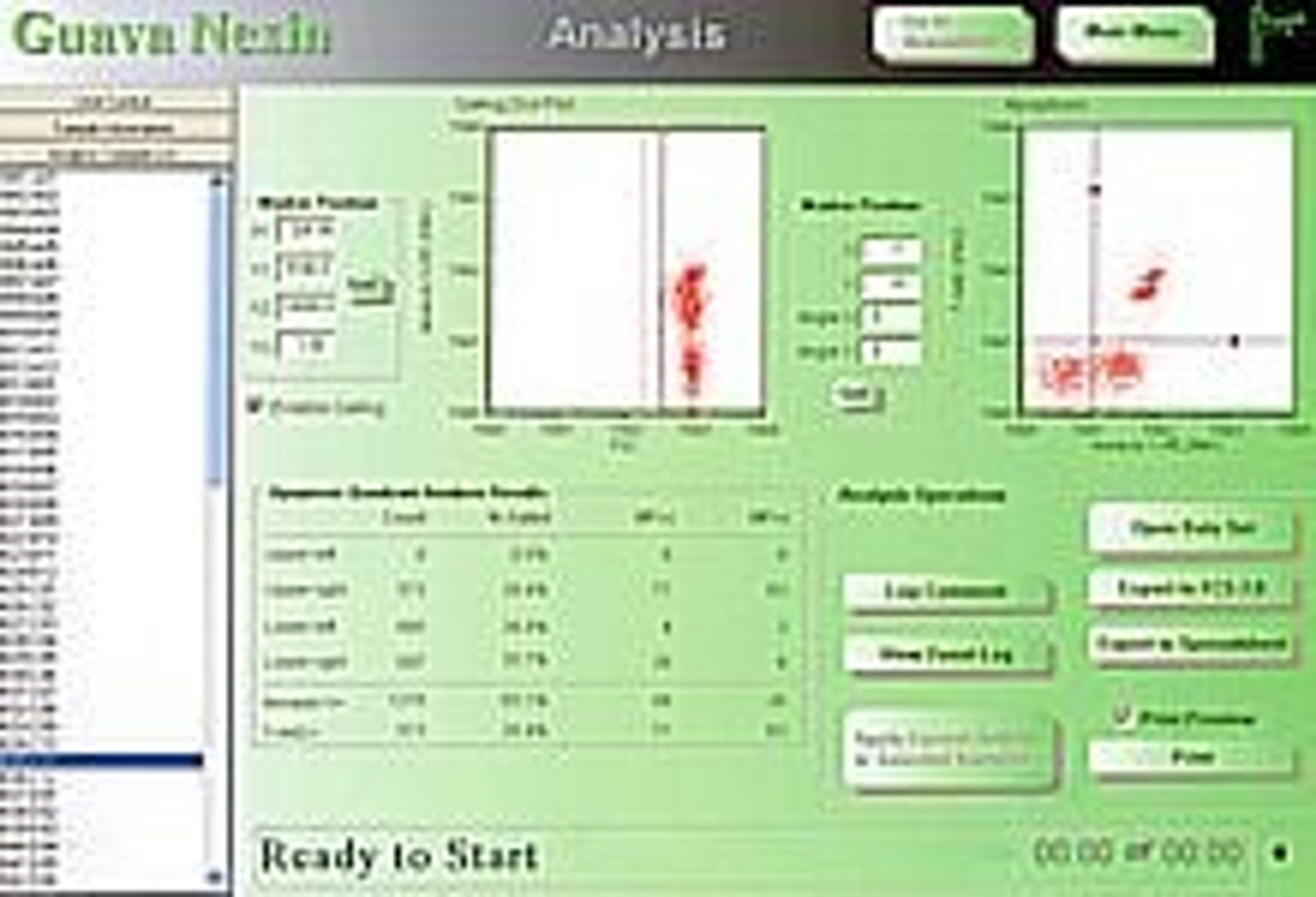
Nexin Assay Kit
MerckThe new Guava Nexin® reagent monitors induction of apoptosis quickly and easily, with minimal chance for contamination. Annexin V is a calcium-dependent phospholipid binding protein with high affinity for phosphatidylserine (PS), a membrane component normally localized to the internal face of the cell membrane. Early in the apoptotic pathway, molecules of PS are translocated to the outer surface of the cell membrane where Annexin V can readily bind them. The Guava Nexin® assay incorporates this PS-Annexin V binding as an indicator of early stage apoptotic cells. The Guava Nexin® assay kit utilizes Annexin V-PE to detect PS on the external membrane of apoptotic cells. The cell impermeant dye 7-AAD is included in the Nexin kit as an indicator of membrane structural integrity. 7-AAD is excluded from live, healthy cells and early apoptotic cells, but permeates late stage apoptotic and dead cells. The following populations of cells can be distinguished in this assay: Non-apoptotic cells: Annexin V(-) and 7-AAD(-) Early apoptotic cells: Annexin V (+) and 7-AAD(-) Late stage apoptotic and dead cells: Annexin V(+) and 7-AAD(+)