
Amsbio launches ultra sensitive multiplex biomarker detection kits
Kits help reduce complexity while improving consistency and turnaround time
14 Aug 2026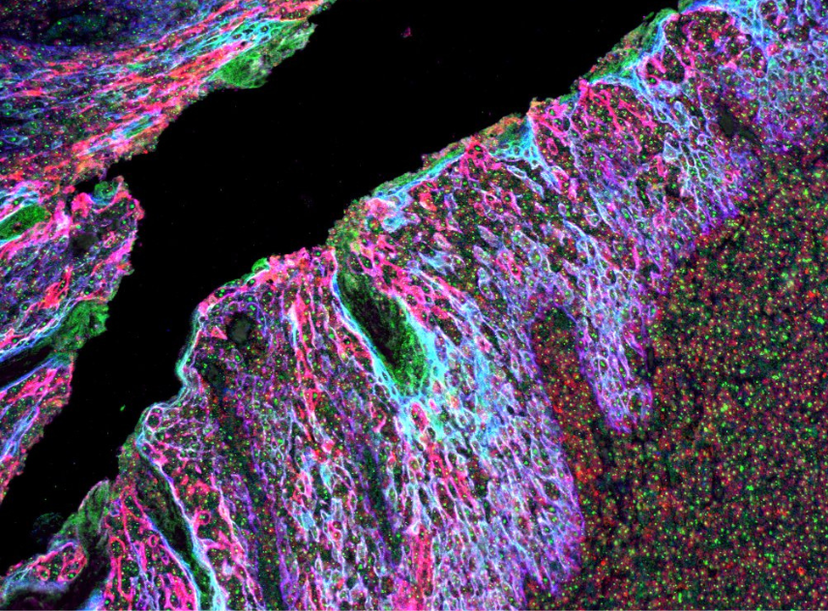
Stained FFPE section of human tonsils
Utilizing enzyme-free DNA nanotechnology, immunoMUSE® kits from Amsbio enable researchers to perform ultra-sensitive, 2-plex to 4-plex custom biomarker detection in tissue while generating same-day imaging results without species or isotype constraints.
Traditionally, tissue immunofluorescence techniques have required compromises. Researchers working with FFPE tissue, low-abundance biomarkers, and complex immune environments have typically had to choose between sensitivity, workflow complexity, and panel flexibility. Often repeated staining cycles have risked morphological damage.
The proprietary design of immunoMUSE® kits allows users to use their own validated primary antibodies to detect low abundance targets with higher sensitivity than secondary antibodies and generate results the same day in a workflow that fits easily into their lab.
The kits are designed for researchers who need more from multiplex staining: more flexibility, more sensitivity, and more confidence to handle challenging samples.
Fitting into existing immunofluorescence workflow, immunoMUSE® kits help reduce complexity while improving consistency and turnaround time. The immunoMUSE® staining protocol is efficient and simple requiring only two steps at room temperature and no extra specialised equipment. The kits are proven to deliver automation ready stained-to-imaged slides in less than a single day.
Beneficially, immunoMUSE® kits also preserve morphology by avoiding the need for harsh stripping or repeated staining cycles that can damage tissue integrity.
Want the latest science news straight to your inbox? Become a SelectScience member for free today>>
Links
Tags
Frequently asked questions
Show frequently asked questions
How do immunoMUSE kits from Amsbio improve multiplex immunofluorescence staining of FFPE tissue?
immunoMUSE® kits from Amsbio use enzyme-free DNA nanotechnology to deliver ultra-sensitive 2-plex to 4-plex custom biomarker detection in FFPE tissue. They allow researchers to use their own validated primary antibodies, achieving higher sensitivity than secondary antibodies. The workflow fits into existing immunofluorescence protocols and provides same-day imaging results without species or isotype constraints.
What workflow and equipment advantages do immunoMUSE kits offer for tissue biomarker detection?
immunoMUSE® kits integrate into existing immunofluorescence workflows, reducing complexity while improving consistency and turnaround time. The staining protocol requires only two steps at room temperature and no extra specialized equipment. These kits are automation-ready and can deliver stained-to-imaged slides in less than a single day, supporting efficient biomarker detection in challenging tissue samples.
How do immunoMUSE kits help preserve tissue morphology during multiplex staining?
immunoMUSE® kits preserve tissue morphology by avoiding harsh stripping procedures and repeated staining cycles that can damage tissue integrity. Their proprietary design enables sensitive detection of low-abundance biomarkers in complex immune environments without compromising tissue structure, giving researchers more confidence when working with FFPE tissue and other challenging samples.