
Scientifica Introduces LASU, the 'Laser Applied Stimulation & Uncaging' System, Perfect for Optogenetic and Uncaging Studies
21 Nov 2014
Scientifica are excited to announce the launch of LASU, the brand-new solution for optogenetic stimulation and uncaging studies. The Laser Applied Stimulation and Uncaging system is specifically designed to enhance the combination of electrophysiology, optogenetics and uncaging, for advanced studies of neuronal processes.
LASU provides pinpoint positioning of laser beams for fast, accurate and repeatable experimental protocols. The custom made software allows you to visualize your sample in real-time and change essential experimental parameters in its user-friendly interface. Galvanometric scan mirrors give flexible control of the lasers enabling directional programming in a “point and click” manner, a predefined pattern (covering the whole field of view), or a random point selection order.
The modular assembly, based on the award-winning design of the Multiphoton Imaging System, piggybacks onto the Scientifica SliceScope upright microscope. This makes the setup both streamlined and upgradeable (as new techniques lead to further developments).
LASU uses high-speed laser diode technology combined with triggering electronics and coupling optics all in one compact box. This technology means power can be instantly delivered without the need to keep the laser on permanently and with no physical shutter, minimizing vibrations.
Options are available to choose lasers for uncaging or photo-activation or a combination of both. The laser can be delivered through fiber coupling or freespace optics, whichever solution works best for the research technique being used. A variety of wavelengths can be selected depending on your requirements.
Within the software you can control the speed and timing of all stimulation protocols with the ability to change laser dwell time, point-to-point timings, intensity control, exposure time, gain and image optimization.
Mark Johnson, Managing Director/CEO, said:
“Optogenetics and uncaging are becoming increasingly popular tools for neuroscience research.”
“The LASU system has been designed with the input of researchers developing these techniques to make it as effective as possible. As a result, LASU is a well-made, cost-effective and future-proof product for those wishing to use optogenetics and uncaging in their laboratories.”
Dr Rodrigo Aviles, Electro-Mechanical Development Manager and lead designer/engineer on LASU, said:
“Applying diverse colors of light into different types of neurons loaded with light sensitive compounds will enable sketching out the brain circuitry for a better understanding of its activity and connectivity.
“LASU is a user-friendly system providing the researcher with the necessary resources to perform in vitro optogenetics and uncaging. The modular design of the system will enable researchers to expand functionality as their research progresses and these techniques develop.”
Dr Simon Butt, Associate Professor of Neuroscience at the university of Oxford, said:
“We are trying to understand the physiological mechanisms underpinning emergent circuits of the mammalian cerebral cortex. Laser scanning photostimulation (LSPS) enables rapid assessment of synaptic connectivity across a region of interest. We map connections onto recorded neurons across single and adjacent cortical columns in acute in vitro slice preparations of the mouse whisker barrel cortex. For LSPS to provide an effective measure of synaptic connectivity it is necessary to have good spatial and temporal resolution in terms of photo-activation. LASU achieves this with ease.”
The LASU Uncaging System was displayed at the Society for Neuroscience Annual Meeting 2014 (15th – 19th November, Washington, DC).
Related products
Request Quote for All Products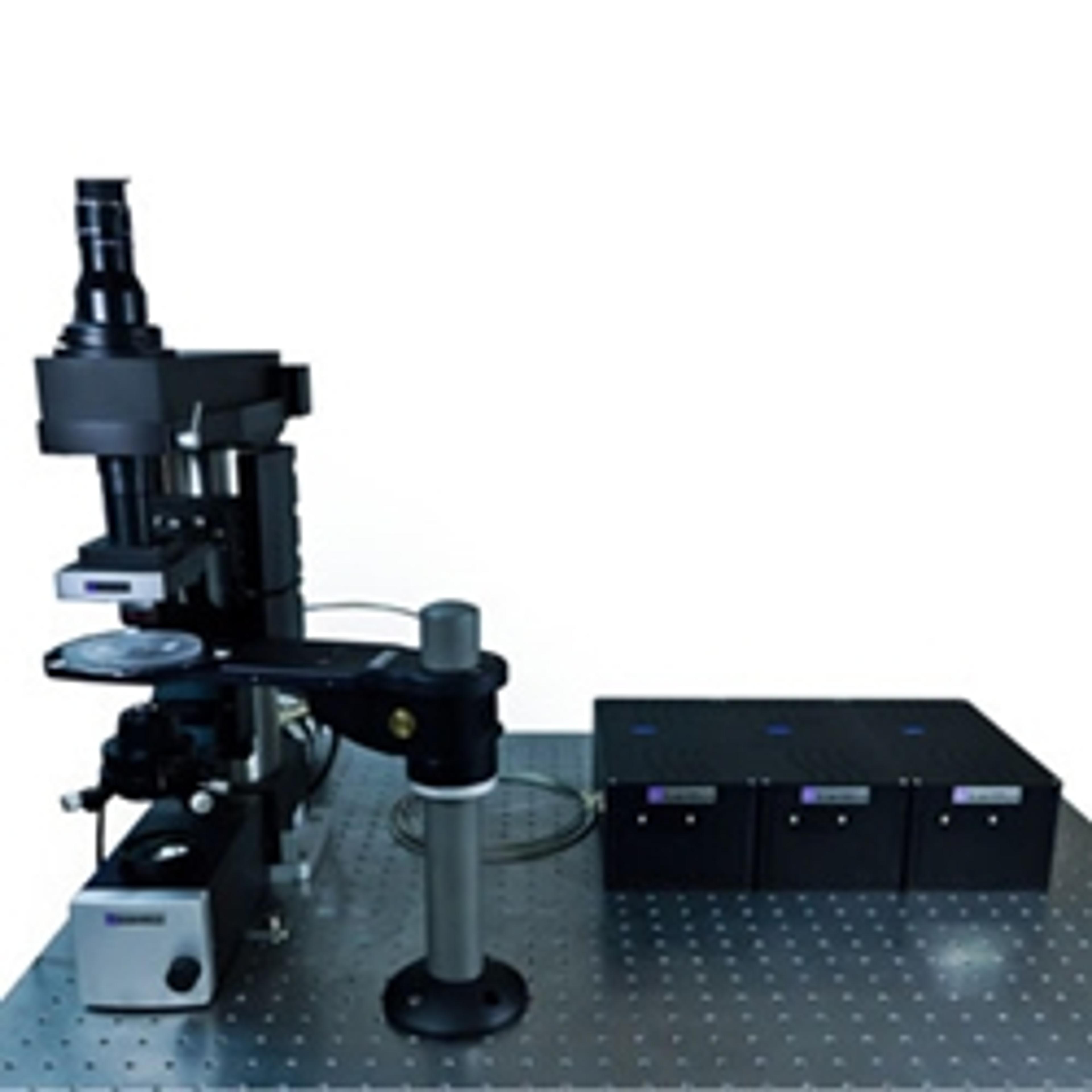
LASU - Laser Applied Stimulation & Uncaging
Scientifica LtdThe LASU system is perfect for users engaging in optogenetics, uncaging or other photo-stimulation experiments. The laser spot positioning is accurate and repeatable enabling fast experimental manipulation of biological systems. Based on the highly successful design of Scientifica's award-winning Multiphoton Imaging System, LASU uses 'Galvo' mirrors for fast, accurate and repeatable laser spot positioning. The wide range of laser modules means you can select one or more wavelengths and add to these as your needs, and the range of 'opsins', develop.The LASU system was developed in collaboration with VU University Amsterdam and provides the ability to carry out uncaging or optogenetics experiments by selecting the specific laser modules. The versatility of LASU means that it is also possible to integrate both techniques into one setup.The reliable hardware and powerful software enables convenient stimulation-spot positioning as well as full control of the laser power and firing frequency. The integrated imaging system also allows for patch clamping and other visibly guided experimentation, making the LASU an extremely versatile system.Benefits: Choice of laser wavelengths For precise control of your experiment, LASU is able to deliver a Laser spot smaller than 2 microns (depending on the objective used). This means you are able to stimulate exactly where you need. This provides much greater experimental control than 'full field' stimulation. Powerful software The LASU software is easy to use enabling control of stimulation site, laser power and pulse duration. With these functions and the live camera feed make this an extremely user friendly system. Simple integration The LASU system fits directly onto the Scientifica upright microscope 'SliceScope' making it an easy upgrade for existing rigs. Proven technology The Galvo mirror driven hardware and optical components are based on the Scientifica award-winning Two-Photon system giving you complete confidence when choosing LASU. Compact The compact nature of the LASU scanhead, SliceScope fram and laser modules mean that it can be mounted on most standard antivibration tables, saving you space and money. Free space launched or fibre guided laser delivery The choice of laser input through either fibre or free-space launch optics means that you can choose which method best suits your experimental setup. Perfect for optogenetics The choice of laser wavelengths available are suitable for 'channelrhodopsin' and 'halorhodopsin'. Allowing compete control over the laser power and stimulation frequency makes the LASU an essential tool for optogenetic experiments. Perfect for glutamate uncaging The 405nm wavelength Laser module is perfectly suited to Glutamate uncaging experiments when used with commercially available caged compounds. Applications: Glutamate uncaging Optogenetics Photo-activation Photo-stimulation Laser uncaging Channelrhodposin activation Halorhodopsin activation In vitro optogenetics Neural network studies