
Salt Content in Processed Foods – Is Your Method Good Enough for EU Regulation No. 1169/2011?
14 Aug 2014
In the future it will be mandatory in all member states of the European Union to indicate the calorie content on processed foods along with the following six nutrients: fat, saturated fatty acids, carbohydrates, sugar, protein and salt (EU Regulation No. 1169/2011). When it comes to the determination of the salt content, thermometric titration is superior to any other method with regard to cost, accuracy, ease of use, and robustness.
According to the new EU Foodstuffs Directive, the indication of the salt equivalent of foodstuffs will then be calculated as the total sodium content x 2.5. Thermometric titration offers a specific, quick and inexpensive method of determining the sodium content. The results obtained with the 859 Titrotherm from Metrohm show that, with only minimal sample preparation required, thermometric titration enables the direct and exact determination of the sodium content in foodstuff samples.
During thermometric titration, the enthalpy or entropy occurring during a defined specific chemical reaction is used to determine the endpoint. The temperature sensor used is unaffected by chemicals or sample constituents. No particular care has to be exercised with respect to the storage of the sensor between measurements. This method is therefore not influenced by electrochemical, solvent or sample effects, as can be the case with potentiometric measurements.
General benefits of thermometric titration
• High degree of automation: Serial measurements at the sample changer
• Fully automated addition of reagents and water
• Inline sample comminution using an homogenizer
• The sample is automatically aspirated after determination
• Simple: Weigh in the sample and start the analysis
• Complete integration in tiamoTM, the world's most successful titration software
Benefits compared with AAS and ICP-MS
• Significantly lower procurement and operating costs
• Minimum demands on laboratory infrastructure
• Easy to operate by lab technicians
Benefits compared to direct potentiometry with ion-selective electrodes:
• No calibration of sensor needed
• No problems with electrodes, as the measurement is performed with an insensitive temperature sensor
• No interference from fat, protein, sugar, solids, etc.
• Greater accuracy and reliability
• Greater robustness
• Significantly less time required (less than 3 minutes)
Related products
Request Quote for All Products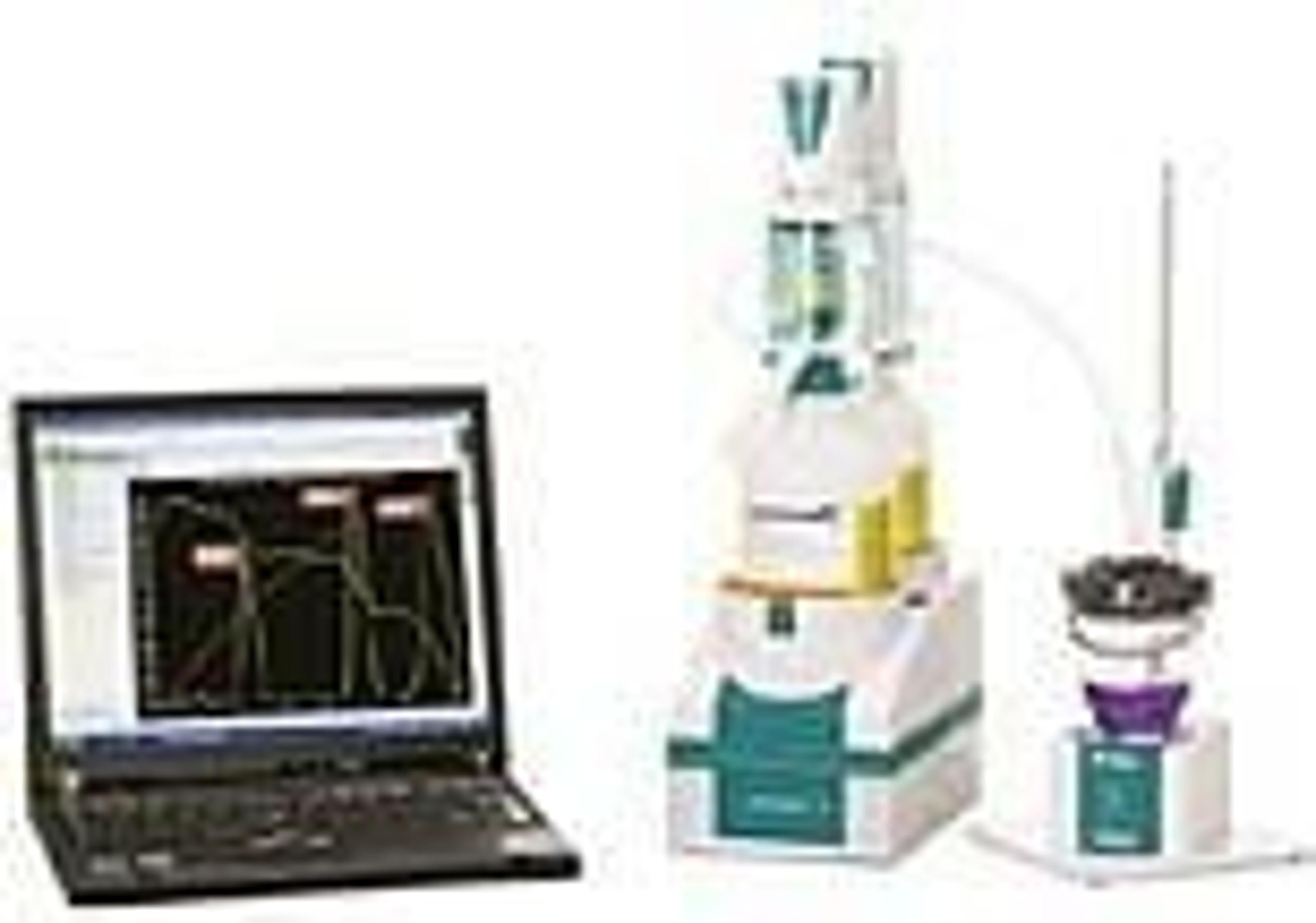
859 Titrotherm
Metrohm AGThermometric titration is a very versatile determination method and an ideal complement to potentiometric titration. In principle it is suitable for any reaction that produces a sufficiently large temperature change in the sample solution. It is particularly suitable for applications for which no suitable potentiometric sensor is available, for which no suitable reference electrode is available, in which the sample affects the indicator electrode or destroys it, for which no solvent is available that is suitable for potentiometry. The 859 Titrotherm combines innovative sensor technology with Metrohm's titration know-how. The temperature sensor based on semiconductor technology (thermistor), has a short response time of 0.3 s and a high resolution of 10-5 K. This makes the Thermoprobe the ideal sensor for thermometric titration, as it can follow any change in temperature quickly and accurately. Metrohm's Dosino technology has defined a new standard for volumetric titration. The Dosing Unit with its drive motor is mounted on the reagent bottle and thus guarantees maximum precision with minimum space requirements. The clearly laid out Titrotherm software allows adaptation of the screen view to the particular method parameters and thus provides rapid access to important commands or parameters. The endpoints are determined by calculating the first and second derivatives of the titration curve; by means of additional optimization parameters, the reproducibility can be improved even further.