
Queen’s researchers develop innovative 3D-printed battery to help tackle global climate challenge
Low-cost, 3D-printed flow battery from Queen’s University Belfast to support long-duration renewable energy storage
24 Jul 2026
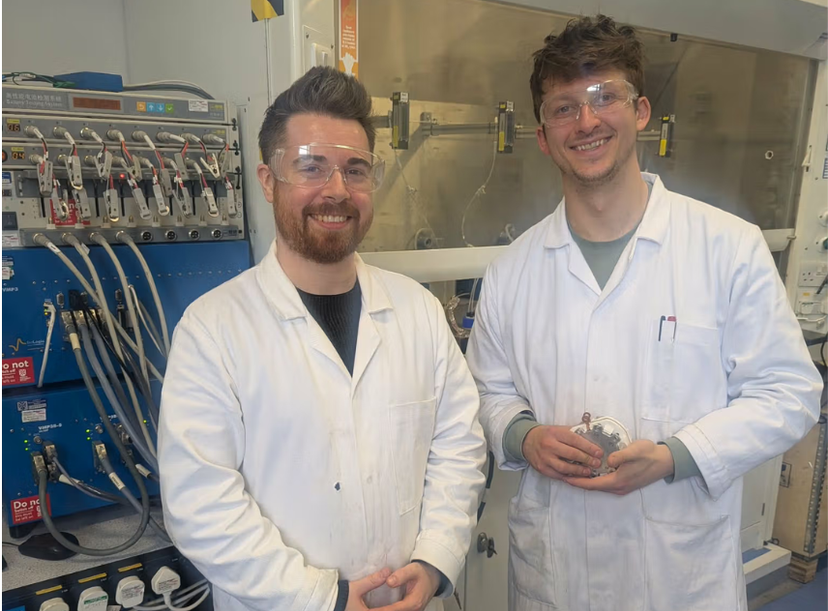
Dr. Josh Bailey and Dr. Hugh O’Connor from the School of Chemistry and Chemical Engineering, Queen’s University Belfast
Researchers at Queen’s University Belfast, Northern Ireland, have developed an innovative, low-cost 3D-printed flow battery cell that could accelerate the transition away from fossil fuels by enabling large-scale, long-duration renewable energy storage.
Led by Dr. Josh Bailey and Dr. Hugh O’Connor from the School of Chemistry and Chemical Engineering at Queen’s University Belfast, the project aims to tackle the challenge of storing intermittent clean energy from sources such as wind and solar power.
Addressing the fossil fuel reality and climate change
Dr. Hugh O’Connor highlights what he describes as an “uncomfortable reality” for modern society: most of our lives are still powered by fossil fuels. Although governments across the UK and Ireland have set ambitious targets to reduce greenhouse gas emissions and transition to net zero, clean energy still only accounts for around 16 percent of overall energy use in both regions.
O’Connor explains that the biggest challenge with renewable energy is that we cannot control when the sun shines or when the wind blows. Without reliable, scalable energy storage, fossil fuels will continue to dominate power systems, limiting the impact of renewable energy technologies.
Why new battery technologies are needed
Many people look to lithium-ion batteries as a potential solution to the energy storage challenge. This is the same battery technology used in mobile phones, laptops, and an increasing number of electric vehicles. While lithium-ion batteries are effective at small scale, they are less suitable for longer-duration, grid-scale energy storage.
Lithium-ion systems are more expensive to scale up than flow batteries and present a greater fire hazard due to their more flammable components. There are also ethical concerns associated with the mining of cobalt, which until recently was used in the majority of lithium-ion batteries.
Flow batteries and the limitations of vanadium
Flow batteries, which use liquid electrolytes stored in external tanks, are emerging as a promising technology for grid-scale, long-duration energy storage. The most commercialized flow battery chemistry uses an aqueous electrolyte based on vanadium, a metallic element that is more abundant than lithium and does not require cobalt.
However, vanadium production is currently concentrated in only a few locations worldwide and is closely linked to steelmaking. This limited supply chain makes vanadium prices vulnerable to large fluctuations, creating uncertainty for large-scale deployment of vanadium flow batteries.
Developing an iron-based 3D-printed flow battery
To overcome these challenges, the Queen’s University Belfast researchers are developing a flow battery based on iron, a metal that is significantly easier to source globally. By focusing on iron-based chemistry, the team aims to create a more sustainable and scalable solution for long-duration energy storage.
As part of his PhD research, Dr. Hugh O’Connor found that purchasing a commercial flow battery cell could cost up to £3,000. In response, he began 3D-printing his own cells. After extensive trial and error, he succeeded in producing a robust, high-performing flow battery cell for around £75.
This 3D-printed design dramatically reduces the cost of experimental flow battery hardware, opening up new opportunities for research groups to explore iron-based and other aqueous flow battery chemistries.
Tackling the lack of standardization in flow battery research
While testing his 3D-printed cell, O’Connor compared his results with other published research and identified a major barrier to progress: a lack of standardization across laboratories. Different research groups were using different cell designs, operating conditions, and testing protocols, making it difficult to compare data or reproduce results.
O’Connor notes that at conferences, meetings, and on calls, many colleagues reported similar issues. Researchers around the world were interested in the Queen’s University Belfast cell design and recognized the need for a common platform to benchmark performance.
To address this, O’Connor created an “Ikea-style” instruction manual for assembling and operating the 3D-printed flow battery cell. He then distributed the design and documentation to research groups worldwide, enabling scientists to build and test an identical cell using well-defined protocols.
Global collaboration using the Queen’s flow battery cell
Using the standardized cell developed at Queen’s University Belfast, scientists across the globe are now working together to understand the major differences in flow battery performance observed between laboratories. By performing nominally identical tests with the same cell design and operating procedures, the international community can more reliably compare results and identify the true performance limits of different flow battery chemistries.
Dr. Josh Bailey describes the impact of this collaborative effort, “It’s been fantastic to see that we’re already making global impact. By distributing the Queen’s cell around the world, we have been able to lead a large, international research study in collaboration with Massachusetts Institute of Technology (MIT), bringing together over 35 research groups from across the globe, including teams at Harvard (US) and Cambridge (UK).”
Accelerating long-duration energy storage and the road to net zero
The work led by Queen’s University Belfast and its international partners is helping to accelerate breakthroughs in long-duration energy storage, a critical technology for integrating higher levels of renewable energy into power grids. By enabling more reliable, scalable, and cost-effective storage of wind and solar power, flow batteries could significantly reduce reliance on fossil fuels.
Dr. Bailey, said, “It’s been fantastic to see that we’re already making global impact. By distributing the Queen’s cell around the world, we have been able to lead a large, international research study in collaboration with Massachusetts Institute of Technology (MIT), bringing together over 35 research groups from across the globe, including teams at Harvard (US) and Cambridge (UK).”
“The work is helping to accelerate breakthroughs in long-duration energy storage, advance the transition away from fossil fuels, and firmly position our team at Queen’s as leading the development of clean, reliable energy technologies.”
Want the latest science news straight to your inbox? Become a SelectScience member for free today>>
Links
Tags
Frequently asked questions
Show frequently asked questions
How is Queen’s University Belfast using 3D-printed iron-based flow batteries to support long-duration renewable energy storage?
Researchers at Queen’s University Belfast, led by Dr. Josh Bailey and Dr. Hugh O’Connor, have created a low-cost, 3D-printed iron-based flow battery cell. Costing about £75 instead of £3,000, this cell enables scalable, long-duration storage of intermittent wind and solar power, helping reduce reliance on fossil fuels and supporting net-zero targets in the UK and Ireland.
Why are iron-based flow batteries from Queen’s University Belfast considered more sustainable than lithium-ion and vanadium systems?
The Queen’s University Belfast team focuses on iron-based flow battery chemistry because iron is easier to source globally than vanadium and avoids cobalt, which is linked to ethical mining concerns in many lithium-ion batteries. Flow batteries are also less flammable and cheaper to scale than lithium-ion systems, making the iron-based, 3D-printed design a more sustainable option for grid-scale energy storage.
How is the Queen’s University Belfast 3D-printed flow battery cell driving global collaboration in flow battery research?
Dr. Hugh O’Connor created an ‘Ikea-style’ manual and shared the 3D-printed flow battery design worldwide, standardizing cell design and testing protocols. Using this common Queen’s cell, over 35 research groups, including MIT, Harvard, and Cambridge, now perform comparable experiments, helping identify true performance limits of flow battery chemistries and accelerating advances in long-duration energy storage.