
Ozelle debuts O-Cyte 1 at ADLM 2026, bringing speed to AI-powered morphology intelligence
O-Cyte 1 is an AI-powered hematology analyzer that combines morphology intelligence with scalable laboratory throughput
30 Jul 2026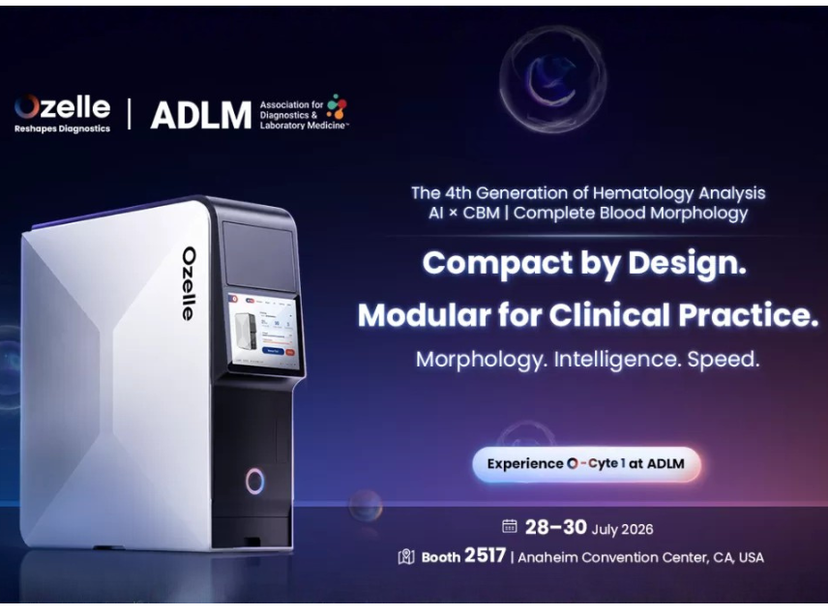
Alongside its broader clinical hematology portfolio, Ozelle will unveil O-Cyte 1, its newest automated hematology analyzer, at Booth 2517 during ADLM 2026. Ozelle will showcase how O-Cyte 1 advances the 4th generation of hematology analysis through AI × CBM (complete blood morphology), helping clinical laboratories accelerate AI-powered morphology intelligence in routine hematology workflows.
Advancing AI-powered hematology and morphology intelligence
For decades, cellular morphology has been one of the most valuable sources of hematology insight. However, integrating morphology into routine hematology workflows without slowing productivity has remained a challenge. Manual microscopy depends on specialist expertise, while image-based approaches have expanded what laboratories can see but have not always fit seamlessly into routine high-throughput workflows.
O-Cyte 1 is designed to address this gap by bringing morphology intelligence, scalable throughput, and operational simplicity into one compact system. Built on Ozelle’s AI × CBM technology, the analyzer transforms cell images into structured morphology insight, supporting a workflow that moves beyond numerical parameters toward image-based evidence and consistent interpretation.
Key features of the O-Cyte 1 automated hematology analyzer
Designed for productive clinical workflows, O-Cyte 1 supports up to 60 tests per hour as a standalone unit and up to 360 tests per hour through cascaded expansion. Its compact footprint, modular architecture, minimal-maintenance workflow, and service-ready design are intended to help healthcare providers and laboratory operators improve efficiency while reducing operational complexity.
By combining AI-powered morphology intelligence with high-throughput performance, O-Cyte 1 aims to make advanced morphology more practical and scalable for everyday hematology practice. The system is engineered to help laboratories move from purely numerical hematology parameters toward richer, image-based diagnostic insight.
“O-Cyte 1 reflects our vision of making advanced morphology intelligence more practical, scalable, and accessible for everyday hematology workflows,” said Raymond, head of Ozelle North America division. “At ADLM, we look forward to showing global partners how AI-powered morphology can move into more productive hematology workflows.”
Follow SelectScience throughout ADLM 2026 for exclusive interviews, daily round-up articles, Scientists' Choice Awards® coverage, and the latest news from the exhibition floor.
Want the latest science news straight to your inbox? Become a SelectScience member for free today>>
Frequently asked questions
What is the Ozelle O-Cyte 1 automated hematology analyzer and how does it use AI × CBM technology?
O-Cyte 1 is Ozelle’s newest automated hematology analyzer, debuting at ADLM 2026. Built on AI × CBM (Complete Blood Morphology) technology, it transforms cell images into structured morphology insight. This helps clinical laboratories move beyond purely numerical hematology parameters toward image-based evidence and consistent interpretation in routine hematology workflows.
How does O-Cyte 1 improve hematology workflow efficiency and throughput for clinical laboratories?
O-Cyte 1 is designed for productive clinical workflows, supporting up to 60 tests per hour as a standalone unit and up to 360 tests per hour through cascaded expansion. Its compact footprint, modular architecture, minimal-maintenance workflow, and service-ready design help healthcare providers and laboratory operators improve efficiency while reducing operational complexity in routine hematology practice.
Where can visitors experience Ozelle’s O-Cyte 1 at ADLM 2026 in Anaheim, California?
Visitors and partners can experience O-Cyte 1 at Booth 2517 during ADLM 2026, alongside Oselle’s broader clinical hematology portfolio, and can discuss regional collaboration opportunities via its online contact channels.