
New Tribrid Mass Spectrometer Delivers New Levels of Power and Performance for Protein and Small Molecule Characterization
Thermo Scientific Orbitrap Fusion Lumos Tribrid mass spectrometer features integrated UVPD, advanced peak determination and 1M resolution
6 Jun 2017
Scientists facing highly complex characterization challenges can now gain a deeper understanding of their samples with new enhancements to the industry-leading Thermo Scientific Orbitrap Fusion Lumos Tribrid mass spectrometer that extend its power, performance and versatility.
“When we launched the Orbitrap Fusion Lumos Tribrid mass spectrometer at ASMS two years ago, we redefined protein and small molecule quantitation and characterization, and this year, we pushed these limits even further,” said Ken Miller, vice president, omics marketing, chromatography and mass spectrometry, Thermo Fisher. “The ability to intelligently select the most promising precursor ions, create new sequence- or structure-informative fragments, and characterize them to the level of fine isotope structure is a constellation of new capabilities that make the Fusion Lumos mass spectrometer essential for the most advanced proteomics, metabolomics and small molecule research discoveries.
The Orbitrap Fusion Lumos instrument brings an unprecedented level of structural information for improved identification and characterization to scientists performing top down proteomics, small molecule characterization, lipidomics and biopharma research. New enhancements include:
- Integrated Ultraviolet Photodissociation (UVPD) that allows researchers to perform large and small molecule structure determination on an LC time scale. Now an optional feature on Orbitrap Fusion Lumos systems, this unique fragmentation mode is designed to improve sequence coverage and antibody characterization, decreases scrambling in top-down hydrogen deuterium exchange (HDX) experiments and created to be a complete solution for structural characterization of lipids and other metabolites. This provides researchers with more complete structural information to solve their complex structure assignment challenges. The enhancement is supported by the new Thermo Scientific Xcalibur 4.1 software, an easy-to-use, flexible and efficient solution that is intended to enable simple method setup, data acquisition, processing and reporting through an intuitive interface.
- New Advanced Peak Determination (APD) algorithm that is designed to improve performance of most proteomic workflows with high peptide and protein identification rates in data-dependent experiments.
- 1M resolution, which is now available for researchers who need ultra-high resolution to confidently measure fine isotope structures or separate isobaric compounds. This new option, used to obtain unique structural and quantitative information for a wide range of compound classes, aids scientists in proteomics, pharmaceutical, metabolomics, fluxomics and industrial chemical applications
Thermo Fisher is featuring the Fusion Lumos Tribrid mass spectrometer during the 65th Annual American Society for Mass Spectrometry (ASMS) Conference, being held June 4-8, in the White River Ballroom F-J at the JW Marriott, Indianapolis. For more information, visit http://www.thermofisher.com/lumos.
Related products
Request Quote for All Products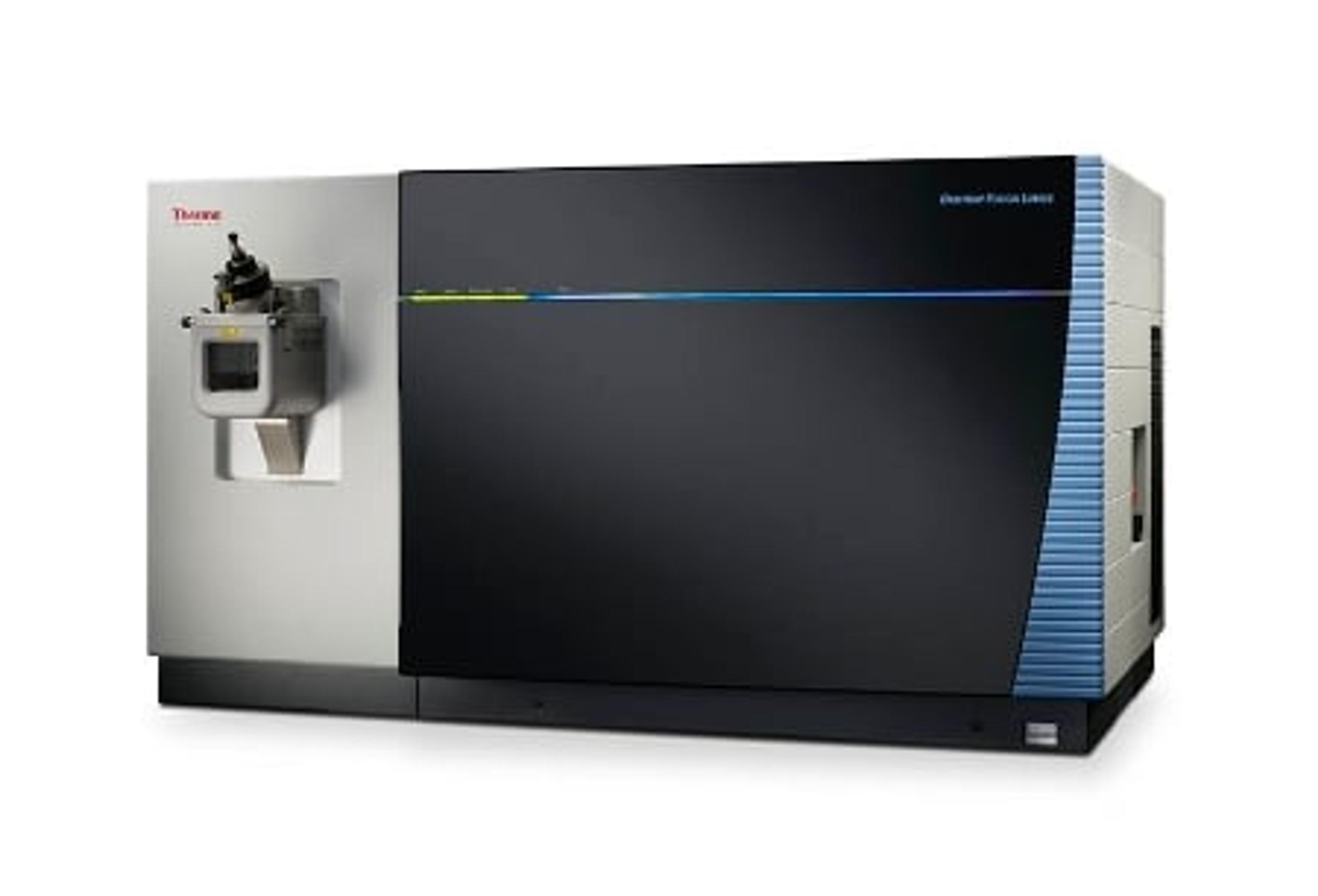
Thermo Scientific™ Orbitrap Fusion™ Lumos™ Tribrid™ Mass Spectrometer
Thermo Fisher ScientificTest new limits of detection, characterization and quantitation with the latest Tribrid™ mass spectrometer. The Thermo Scientific™ Orbitrap Fusion™ Lumos™ Tribrid™ Mass Spectrometer is designed to expand performance in advanced proteomics, biopharma and metabolomics applications, including quantitation using isobaric tags, low level PTM analysis, data independent acquisition (DIA), and top down proteomics. The new instrument features enhanced sensitivity resulting in improved analyte detection, characterization and quantitation, enabling scientists to perform more comprehensive sample analyses faster and with better accuracy than ever before. Novel Orbitrap Fusion Lumos MS Features: Novel high-sensitivity API interface combines a High Capacity Transfer Tube and an Electrodynamic Ion Funnel for increased ion flux and lower limits of detection Advanced Active Beam Guide prevents neutrals and high velocity clusters from entering the resolving quadrupole Advanced Quadrupole Technology combines high selectivity and efficiency of transfer for selected ions symmetrically across the isolation window Advanced Vacuum Technology improves transmission of high molecular weight ions to the Orbitrap analyzer Novel ETD HD—high dynamic range ETD provides significantly increased fragment ion coverage Established Tribrid MS Features: Tribrid architecture — includes quadrupole mass filter, linear ion trap and Orbitrap mass analyzers Ultrahigh resolving power up to 500,000 FWHM, with isotopic fidelity up to 240,000 FWHM at m/z 200 Acquisition rates of up to 20 Hz for both Orbitrap and linear ion trap MSn analyses Full parallelization of MS and MSn analyses with intelligent ADAPT™ (All Dynamically Available Parallelizable Time) technology Synchronous Precursor Selection (SPS) for MS and MSn experiments significantly increases the number of peptides and proteins identified and improves quantitative accuracy when using isobaric mass tags Flexibility of fragmentation — CID, HCD and optional ETD and EThcD available at any stage of MSn with detection in either the Orbitrap or linear ion trap detector enables detailed structure determination of metabolites, glycans and other small molecules Universal Method provides maximal peptide identifications without method optimization for samples of unknown concentration, reducing sample and instrument time requirements for routine peptide identifi cation experiments Intuitive and flexible drag-and-drop user interface simplifies method development and enables unique and complex workflows