New live cell pathway analysis method uses DRAQ5

18 Jun 2008

Product news

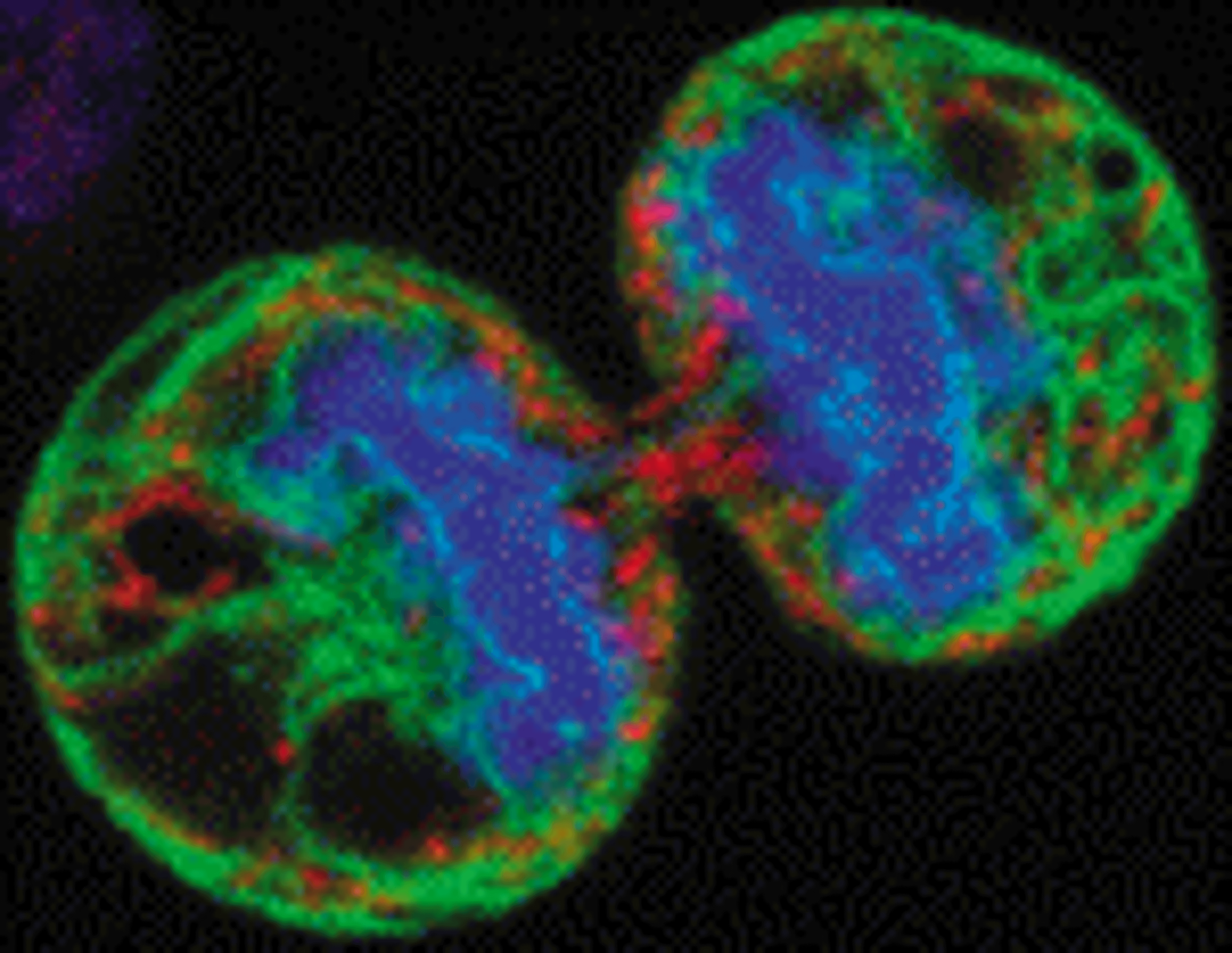
A recent publication in PLoS ONE has again proved DRAQ5 to be the perfect choice as nuclear counterstain in HCS assays. Rosado et al (from the laboratory of Dr Wolfgang Link at Centro Nacional de Investigaciones Oncologicas, Madrid) described development of an exciting new technology that permits the monitoring of compounds interfering with pathways in tumour cells. Cells were stably-transfected with EYFP or ECFP and then respectively to be akt-dependent or akt-independent. Thus, when the isogenic mixtures of these cells were exposed to akt-specific inhibitors, in the absence of IL-3, the EYFP (yellow) cells apoptosed, while the ECFP (blue) cells remained, unperturbed.

The cells were also labelled with DRAQ5. Compounds with generalised cytotoxicity were indicated by reduction of the total numbers of DRAQ5-positive cells (red) over the 12h time-course of the experiment performed on BD Biosciences Pathway 855. In this way it was possible to separate the effects of specific and generalised or cytotoxic inhibitors with reference to a single signalling pathway.

This work demonstrated DRAQ5 as the ideal nuclear counterstain - it efficiently labels live cells, stably demarks the nucleus and has no spectral emission overlap with either CFP or YFP. Furthermore, it demonstrated the compatibility of DRAQ5 with the Pathway 855.

DRAQ5

Biostatus Limited

The proven far-red probe for live or fixed cells, spectrally compatible with UV / Vis-range fluors.

(267)

Links

Tags

ADME-ToxicologyADME-toxicology (ADME-Tox) studies are used in pharmacology and pharmacokinetics to assess the activity/toxicity of drugs <i>in vivo</i> or <i>in vitro</i>. Find bioassays for absorption, distribution, metabolism, and excretion of drug molecules including cytotoxicity, transporter/permeability, metabolism and activity assays as well as hepatocytes and cell lines for ADME. Find the best ADME-toxicology products in our peer-reviewed product directory: compare products, check customer reviews and receive pricing direct from manufacturers.Cell-Based AssaysCell-based assays are used to monitor the presence, quantity and activities of a desired cellular analyte including drug molecules or biomarkers. This can reveal information on cell health (apoptosis, cytotoxicity, viability and proliferation assays), cell metabolism, cell migration and cell signaling mechanisms. Find the best cell-based assay products, kits and equipment with our peer reviewed product directory: compare products, check customer reviews and receiving pricing direct from manufacturers.High-Content ScreeningHigh-content screening (HCS), also known as high-content analysis (HCA), is a high-throughput technique used in drug discovery to identify substances that alter the phenotype of cells. HCS uses fluorescent microscopic imaging and automated image analysis to investigate cellular events such as apoptosis, cell viability, GPCR activation, oxide production, neurite outgrowth, and cell signaling. Find the best fluorescent labeling reagents, cellular assays, and high-content imaging systems in our peer-reviewed product directory: compare products, check customer reviews and receive pricing direct from manufacturers.