New <i>in vitro</i> tox application for DRAQ5

9 Sept 2008
Roy Edward
Marketing / Sales

Product news

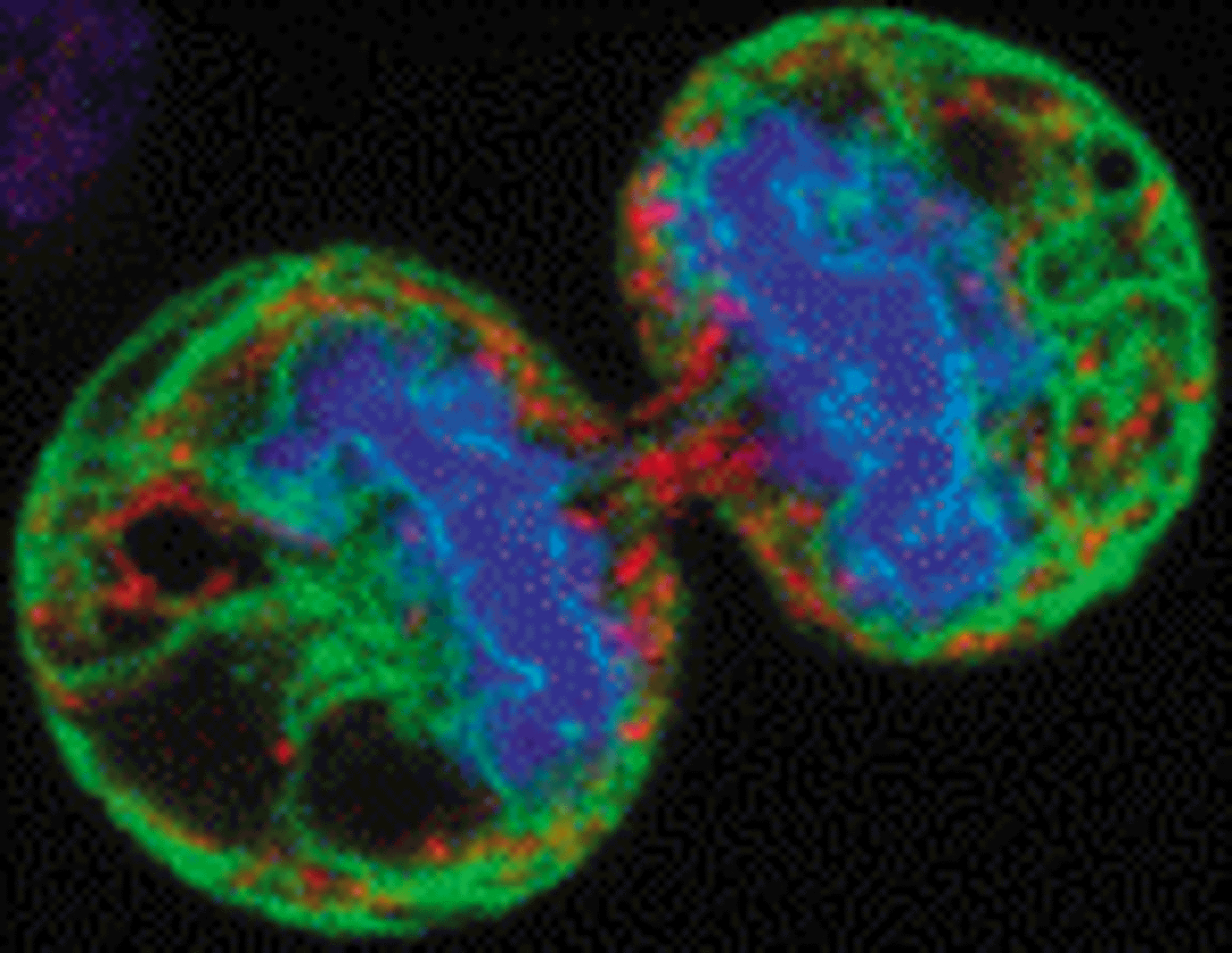
An elegant paper recently published in Toxicological Sciences on mitochondrial dysfunction in the cytotoxic effects of anti-depressants shows great promise for high content biology applied to in vitro toxicology.

As part of the study, the authors, Dykens et al. of Pfizer Inc., developed a novel fluorescence-based imaging assay to report different cytotoxic effects on primary human hepatocytes. Following drug exposure cells were stained with probes to test for mitochondrial membrane potential, presence of reactive oxygen species, glutathione levels, and finally the far-red fluorescent dye DRAQ5 for cell number/nuclear DNA and, notably, intracellular lipids.

This is the first demonstration of the use of DRAQ5 to show drug-induced intracellular accumulation of (phospho)lipid vesicles in addition to providing information, as a live cell DNA reporter, on nuclear morphology and cell numbers.

This seminal work demonstrates a new inherent characteristic in DRAQ5 that lends new opportunities to the area of in vitro toxicology within drug development.

REFERENCE:
Dykens et al. In Vitro Assessment of Mitochondrial Dysfunction and Cytotoxicity of Nefazodone, Trazodone, and Buspirone. Toxicological Sciences 103(2):335-345; 2008

DRAQ5

Biostatus Limited

The proven far-red probe for live or fixed cells, spectrally compatible with UV / Vis-range fluors.

(267)

Links

Tags

Fluorescence SpectroscopyFluorometers and spectrofluorometers (also called fluorescence spectrometers) are used to measure the intensity and wavelength of fluorescent light emitted from a sample after excitation by illumination. Spectrofluorometers utilize monochromators to select the desired wavelengths, whereas filter fluorometers employ a set of filters. Spectrofluorometers for measuring steady-state fluorescence and lifetime fluorescence (or time-resolved fluorescence) are available, as well as fluorescence microscopes and microplate readers. Find the best fluorescence spectroscopy products in our peer-reviewed product directory: compare products, check customer reviews and receive pricing direct from manufacturers.ADME-ToxicologyADME-toxicology (ADME-Tox) studies are used in pharmacology and pharmacokinetics to assess the activity/toxicity of drugs <i>in vivo</i> or <i>in vitro</i>. Find bioassays for absorption, distribution, metabolism, and excretion of drug molecules including cytotoxicity, transporter/permeability, metabolism and activity assays as well as hepatocytes and cell lines for ADME. Find the best ADME-toxicology products in our peer-reviewed product directory: compare products, check customer reviews and receive pricing direct from manufacturers.Cell-Based AssaysCell-based assays are used to monitor the presence, quantity and activities of a desired cellular analyte including drug molecules or biomarkers. This can reveal information on cell health (apoptosis, cytotoxicity, viability and proliferation assays), cell metabolism, cell migration and cell signaling mechanisms. Find the best cell-based assay products, kits and equipment with our peer reviewed product directory: compare products, check customer reviews and receiving pricing direct from manufacturers.High-Content ScreeningHigh-content screening (HCS), also known as high-content analysis (HCA), is a high-throughput technique used in drug discovery to identify substances that alter the phenotype of cells. HCS uses fluorescent microscopic imaging and automated image analysis to investigate cellular events such as apoptosis, cell viability, GPCR activation, oxide production, neurite outgrowth, and cell signaling. Find the best fluorescent labeling reagents, cellular assays, and high-content imaging systems in our peer-reviewed product directory: compare products, check customer reviews and receive pricing direct from manufacturers.