
New Discovery Hints at Japan’s Global Independence for Mineral Resources

23 Jul 2018
Han Yin
Administrator / Office Personnel

Industry news

Researchers have discovered centuries worth of rare-earth elements within Japan’s economic exclusive zone and succeeded in establishing a mineral processing procedure that selectively recovers host minerals of rare-earth elements from deep-sea mud.
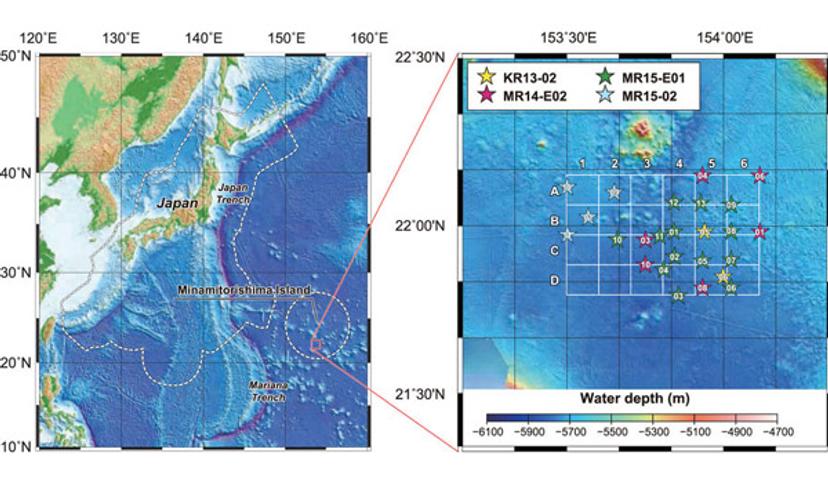
Locality and bathymetric maps of the research area.

“Rare-earth elements and yttrium (REY) are critical in renewable energy technologies and electronics, for example, hybrid vehicles, rechargeable batteries, wind turbines, and light-emitting diodes, as well as medical technologies,” explains Yutaro Takaya, associate professor at Waseda University and leading author of this study. “Our findings may change the nation’s policies and strategies on natural resource management, for we could possibly become self-reliant in terms of rare-earth mineral resource and build a sustainable future.”

Don’t miss out on the latest updates in material science, join our Materials Community >>

Its abundance, paucity for radioactive elements, and easy extraction and recovery have made REY-rich mud a promising rare-earth metal resource, and back in 2013, marine sediments high in REY content were found near Minamitorishima, approximately 1,800km southeast of Tokyo. Since then, Japanese industries, academic institutions, and the government have collaborated to investigate development possibilities and evaluate its economic value.

In this particular study, the team used Geographical Information System software to visualize the REY distribution in the seabed and evaluated its resource potential. In the northwestern part of the island, they found that the resource amount was estimated to be 1.2 million tons of rare-earth oxide, yielding to decades of annual global demand for rare-earth elements.

“When examining the overall target area, the resource amount was estimated to be 16 million tons, accounting for rare earths worth hundreds of years, for example, yttrium being 780 years,” Takaya says. “These metals could be supplied on a semi-infinite basis to the world.”

Additionally, a hydrocyclone separator has enabled selective recovery of biogenic calcium phosphate grains, which are rich in REY content, from deep-sea mud by grain-size separation and has significantly improved the ore grade. In fact, the quality of extracted earth deposits using this technology enhanced 20 times in comparison to those found in Chinese territories.

Takaya’s team is now trying to enhance this quality by 50 times, which will ultimately lead to lower operation cost and increased efficiency. He adds that he is excited by the possibilities of new industries being borne and developed out of the exploitation of this new REY resource.

Receive the latest news in material sciences, become a member for free today.

Links

Tags

Atomic Absorption / Emission SpectroscopyAtomic absorption spectroscopy (AAS) and atomic emission spectroscopy (AES) — also called optical emission spectroscopy (OES) — are used to detect the elemental constituents in samples. Both techniques involve the atomization of a sample. Atomic absorption spectrometers may use a flame or furnace to create an atomic vapor of the sample before irradiation with spectral light. Optical emission spectrometers may use a flame, inductively coupled plasma (ICP), microwave plasma (MP) or spark arcs to atomize and excite the sample. At higher excitation energies, electrons can be emitted instead of photons, which can be useful for samples that can’t be atomized and for surface analysis. Explore electron spectroscopy equipment such as Auger spectrometers and photoelectron spectrometers for surface elemental analysis of samples. Find the best atomic absorption, photoelectron and optical emission spectrometers in our peer-reviewed product directory: compare products, check customer reviews and receive pricing direct from manufacturers.X-Ray Diffraction and SpectroscopyX-Ray diffraction & spectroscopy are used in material characterization to discern the structure and elemental composition of a sample. X-Ray diffractometers (XRD) are superior instruments in elucidating the dimensional atomic structure of crystalline materials, including powders, thin films and single crystals. For large unit cells or ordered macromolecules, consider small-angle X-ray scattering (SAXS). X-ray spectroscopic techniques include X-ray fluorescence (XRF) and X-ray photoelectron spectroscopy (XPS), both providing simple and accurate methods for determining the elemental composition of a material. Energy dispersive (EDXRF) and wavelength dispersive (WDXRF) XRF spectrometers are available, as well as handheld/portable devices. High-resolution, 3D microstructure characterization of materials can be achieved with X-ray microscopes combining sub-micron resolution imaging with 3D computed tomography. Find the best XRD and XRF spectrometers in our peer-reviewed product directory: compare products, check customer reviews and receive pricing direct from manufacturers.ICP-MSInductively Coupled Plasma Mass Spectrometry (ICP-MS) is a powerful analytical technique used to determine the concentrations of elements and their isotopes in a variety of samples, including water, soil, and biological tissues. It involves ionizing elements in the samples with extremely high-temperature Argon (Ar) plasma and then using a mass spectrometer to measure the number of ions based on their mass-to-charge ratio (m/z). Explore ICP-MS systems in our peer-reviewed product directory; compare products, check reviews, and get pricing directly from manufacturers.BatteriesElemental AnalysisElemental analysis involves determining the elemental composition of a sample, often used in environmental, pharmaceutical, and material sciences. Techniques like ICP-MS, X-ray fluorescence, and atomic absorption spectroscopy allow precise quantification of elements such as metals and nonmetals in complex matrices. Browse our peer-reviewed product directory to find the best elemental analysis tools, compare products, check reviews, and get pricing directly from manufacturers.MiningMetalsMetal analysis is critical in various industries, including environmental monitoring, food safety, and pharmaceuticals. Techniques such as ICP-MS and atomic absorption spectrometry are commonly used to detect trace metals. Explore metal analysis tools in our peer-reviewed product directory; compare products, check reviews, and get pricing directly from manufacturers.Rare Earth Elements