
Momentous Science and Discoveries Enabled by Technological Advances in Quantitative Proteomics to be Presented at ASMS 2016
Thermo Scientific Orbitrap Tribrid mass spectrometers employing the Tandem Mass Tags (TMT) enables researchers to better understand the proteome
20 Jun 2016
Isobaric mass tagging for relative quantification of proteins is a high-throughput, accurate method used to study the protein dynamics in a biological system. Cellular biologists, drug discovery and cancer researchers performing high throughput quantitative proteomics, in institutions, including Massachusetts General Hospital, Harvard Medical School, the University of British Columbia and the University of Cambridge, are using multiplexed quantitation utilizing isobaric tags, such as the Thermo Scientific TMT10plex isobaric mass tags and advanced analytical instrumentation, to better understand how time, disease and the environment affect the proteome.
Researchers have adopted the use of the new Tandem Mass Tags (TMT) and Synchronous Precursor Selection (SPS) MS3 workflow to accurately quantify changes in the amounts of large numbers of proteins in order to answer complex biological questions.
- Professors Jeannie T. Lee and Wilhelm Haas and their teams at Massachusetts General Hospital and Harvard Medical School worked together to characterize the Xist interactome. They developed an RNA-centric proteomic approach, which encompasses the use of a TMT-based multiplex quantitation to identify proteins that interact with Xist, a non-coding RNA that is involved in the silencing of one of the X chromosomes.1
“Using 10plex TMT labeling in our research helps close the gap between proteomics and high-throughput genomic methods,” said Haas, Assistant Professor of Medicine at Harvard Medical School. “The Orbitrap Fusion mass spectrometer provides accuracy and a wide dynamic range, while maintaining throughput, allowing us to compare more samples in a single experiment, thereby increasing the statistical power.”
- In another recent study, researchers from the University of British Columbia adopted a TMT Terminal Amine Isotopic Labeling of Substrates (TAILS) workflow to identify new substrates for MALT1, an important drug target for lymphoma. Using B cells from the only known living patient who is homozygous for the MALT1 mutation, the researchers performed comparative proteomic analysis against cells from his healthy family members. Using an SPS MS3 method, the team was able to perform very accurate analysis of TMT reporter ion ratios, enabling them to identify HOIL1 as a new MALT1 substrate. 2
“For the first time, we used proteomics alone to work out the phenotype of a patient with an autoimmune disorder and to identify the defect," said Dr. Chris Overall, principle investigator, Center for Blood Research, University of British Columbia. “With 10plex TMT-labeling, you have 10 chances to amplify the signal (in MS1) and detect low abundance proteins, which might otherwise be missed.”
- Professor Kathryn Lilley, director of the Cambridge Centre for Proteomics at the University of Cambridge, U.K., is using high-throughput quantitative proteomics to generate high-resolution subcellular protein maps. Dr. Lilley applies a method known as LOPIT—Localization Of Proteins using Isobaric Tagging—to identify proteins, and uses organelle markers to define clusters of proteins that co-localize. This provides a steady-state distribution of proteins across organelles and facilitates the identification of novel organelle proteins. Combining this method with TMT10plex labeling, analyzing samples with accurate SPS MS3 analysis, and developing the informatics tools to manage the complex data produced allowed Dr. Lilley to “hyper-plex LOPIT.” She is using this higher multiplexed method to develop a comprehensive cellular map of a self-renewing mouse embryonic stem cell. 3
Productive use of the TMT technology has been made possible by recent, state-of-the art advancements in analytical instrumentation, including the development of the SPS MS3 method on the Thermo Scientific Tribrid mass spectrometers, the Thermo Scientific Orbitrap Fusion and Thermo Scientific Orbitrap Fusion Lumos.
Combining TMT with SPS MS3 to increase reporter ion signal intensity allows for accurate and precise multiplexed quantitation without destructive interference from co-isolated species—a common challenge seen with product ion multiplexing methods. Scientists can quickly monitor up to 10 conditions simultaneously and obtain very high-throughput—tens of thousands of accurately quantified peptides in the span as short as 24 hours.
In the last three years this new technique has enabled high-caliber, biological research and resulted in over 30 published peer-reviewed articles in some of the most prestigious scientific journals.
Additionally, TMTsixplex and TMT10plex are now available in 0.2 mg vials, ideal for labeling samples between 10-25 ug. The vials feature color-coded caps and are supplied in an automation-friendly 96-well format. The new formats allow users to avoid aliquoting tags or throwing away reagents.
References
1 Minajigi, A.; Froberg, J.E.; Wei, C.; Sunwoo, H.; Kesner, B.; Colognori, D.; Lessing, D.; Payer, B.; Boukhali, M.; Haas, W.; Lee, J. T. A comprehensive Xist interactome reveals cohesin repulsion and an RNA-directed chromosome conformation. Science 2015, 349.
2 Klein, T.; Fung, S.; Renner. F.; Blank, M.A.; Dufour, A.; Kang, S.; Bolger-Munro, M.; Scurll, J.M.; Priatel, J.J.; Schweigler, P.; Melkko, S.; Gold, M.R.; Viner, R.I.; Regnier, C.H.; Overall, C.M. The paracaspase MALT1 cleaves HOIL1 reducing linear ubiquitination by LUBAC to dampen lymphocyte NF-kB signalling. Nat. Commun. 2015, 6.
3 Christoforou, A.; Mulvey, C.; Breckels, L.; Geladaki, A.; Hurrell, T.; Hayward, P.C.; Naake, T.; Gatto, L.; Viner, R.; Arias, A.M.; Lilley, K.S. A draft map of the mouse pluripotent stem cell spatial proteome. Nat. Commun. 2016, 7.
Related products
Request Quote for All Products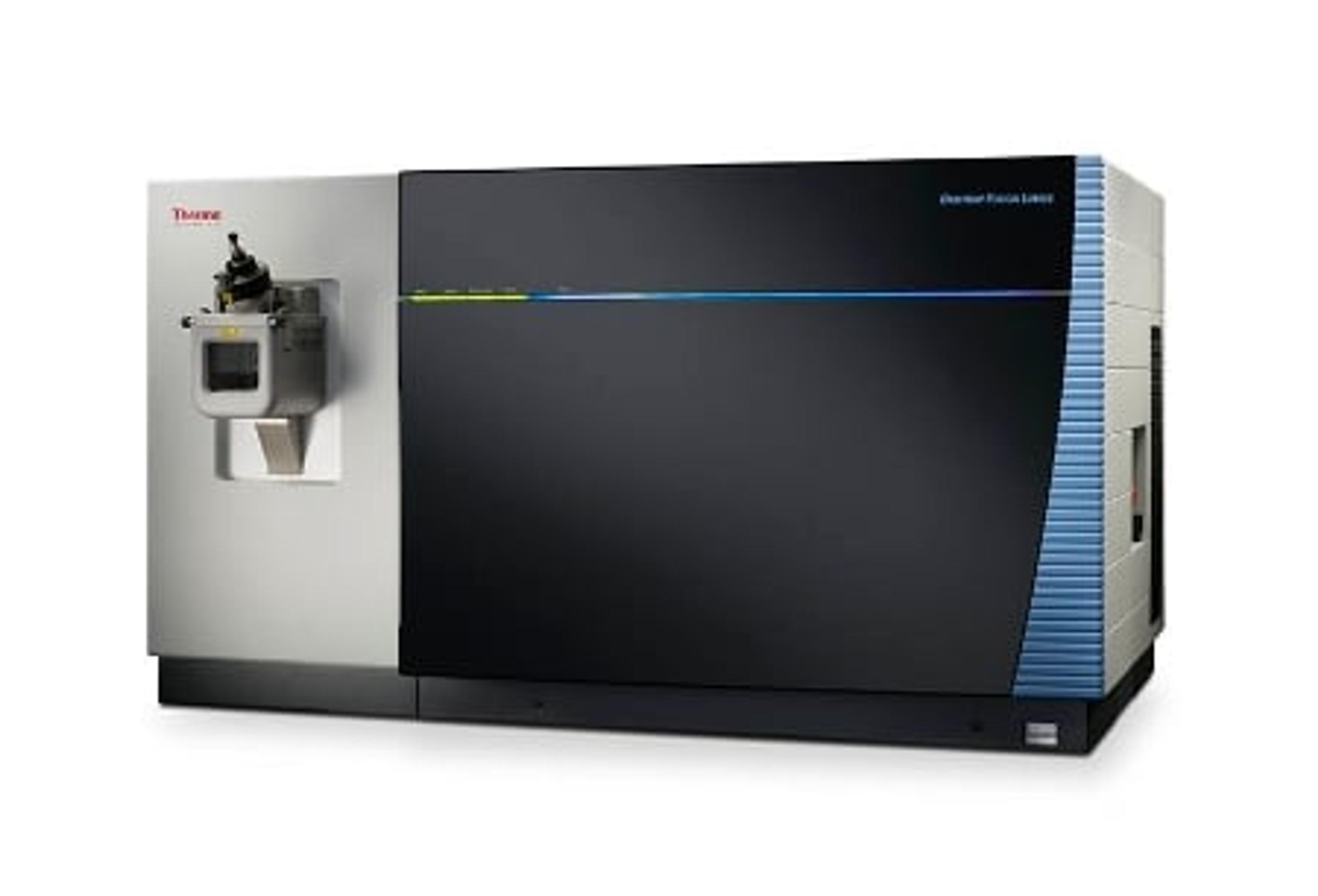
Thermo Scientific™ Orbitrap Fusion™ Lumos™ Tribrid™ Mass Spectrometer
Thermo Fisher ScientificTest new limits of detection, characterization and quantitation with the latest Tribrid™ mass spectrometer. The Thermo Scientific™ Orbitrap Fusion™ Lumos™ Tribrid™ Mass Spectrometer is designed to expand performance in advanced proteomics, biopharma and metabolomics applications, including quantitation using isobaric tags, low level PTM analysis, data independent acquisition (DIA), and top down proteomics. The new instrument features enhanced sensitivity resulting in improved analyte detection, characterization and quantitation, enabling scientists to perform more comprehensive sample analyses faster and with better accuracy than ever before. Novel Orbitrap Fusion Lumos MS Features: Novel high-sensitivity API interface combines a High Capacity Transfer Tube and an Electrodynamic Ion Funnel for increased ion flux and lower limits of detection Advanced Active Beam Guide prevents neutrals and high velocity clusters from entering the resolving quadrupole Advanced Quadrupole Technology combines high selectivity and efficiency of transfer for selected ions symmetrically across the isolation window Advanced Vacuum Technology improves transmission of high molecular weight ions to the Orbitrap analyzer Novel ETD HD—high dynamic range ETD provides significantly increased fragment ion coverage Established Tribrid MS Features: Tribrid architecture — includes quadrupole mass filter, linear ion trap and Orbitrap mass analyzers Ultrahigh resolving power up to 500,000 FWHM, with isotopic fidelity up to 240,000 FWHM at m/z 200 Acquisition rates of up to 20 Hz for both Orbitrap and linear ion trap MSn analyses Full parallelization of MS and MSn analyses with intelligent ADAPT™ (All Dynamically Available Parallelizable Time) technology Synchronous Precursor Selection (SPS) for MS and MSn experiments significantly increases the number of peptides and proteins identified and improves quantitative accuracy when using isobaric mass tags Flexibility of fragmentation — CID, HCD and optional ETD and EThcD available at any stage of MSn with detection in either the Orbitrap or linear ion trap detector enables detailed structure determination of metabolites, glycans and other small molecules Universal Method provides maximal peptide identifications without method optimization for samples of unknown concentration, reducing sample and instrument time requirements for routine peptide identifi cation experiments Intuitive and flexible drag-and-drop user interface simplifies method development and enables unique and complex workflows