
Malvern Panalytical launches Zetasizer Core for high-throughput biologics stability screening
Zetasizer Core is the first instrument to measure DLS, SLS and DSF on a standard well plate, showing biologics teams not just whether a candidate is unstable, but the mechanisms driving it
15 Sept 2026
Malvern Panalytical has launched the Zetasizer Core, a next-generation stability screening instrument for pharmaceutical, biotechnology, contract development, academic and government research laboratories.
Designed for use across biologics discovery, formulation development, and quality control (QC), the instrument simultaneously measures structural stability, colloidal stability and aggregation behavior on a single standard microwell plate.
Zetasizer Core will be available for shipment to customers from January 1, 2027, helping formulation teams generate more comprehensive data, increase throughput and make informed decisions earlier in biologics development.
Three measurements in one biologics screening instrument
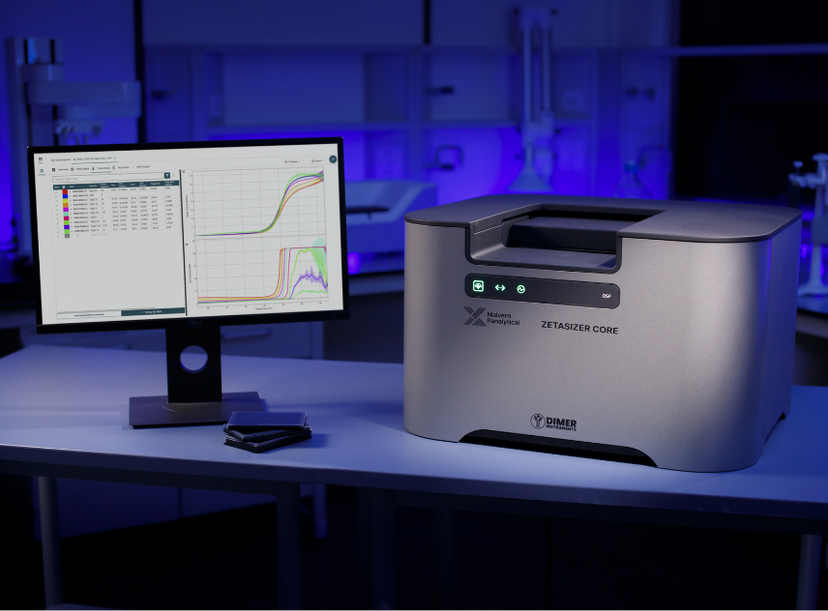
Zetasizer Core
Developed in collaboration with Dimer Instruments and building on more than 30 years of the Zetasizer range, Zetasizer Core measures three indicators of physical instability using one sample under the same conditions:
- Dynamic light scattering (DLS)
- Static light scattering (SLS)
- Intrinsic differential scanning fluorimetry (DSF)
By measuring these indicators together, formulation teams can interpret structural stability, colloidal stability and aggregation behavior in one experiment rather than correlating results from separate experiments.
Christian Sauber, President of Malvern Panalytical, said, “Building on more than 30 years of the trusted Zetasizer range, and developed in collaboration with Dimer Instruments, the Zetasizer Core is the first instrument to simultaneously measure three indicators of physical instability, structural, colloidal and aggregation behavior, on a single standard microwell plate.
“This means formulation teams can make more informed decisions earlier in the process, based on more accurate and more comprehensive data, we firmly believe this ground-breaking instrument our customers have been asking for meets the accuracy and pace biologics discovery now demands.”
Integration with standard microwell plate workflows
Zetasizer Core operates with standard 96-, 384- and 1536-well plates already used across biologics laboratories. It can integrate with existing plate-handling infrastructure, robotics and laboratory information management system (LIMS) workflows.
Existing stability screening workflows often require samples to be transferred into instrument-specific consumables. Using standardized plate formats reduces inter-instrument transfers and offers potential time and resource savings during sample preparation.
The instrument also uses the same DLS algorithms and adaptive correlation as Zetasizer Advance, giving existing users access to the same analysis from discovery through to QC.
Increased throughput for formulation screening
Standard plate formats of up to 1536 wells, combined with the three-in-one measurement format, increase the number of formulations that can be characterized in one experiment.
Zetasizer Core can process up to 192 samples per run at a thermal ramp of 1°C per minute. This is twice the capacity typically achieved by existing stability screening instruments with custom sample holders, which are generally limited to 96 samples.
By consolidating three measurements into one run, the platform provides evidence that can help formulation teams distinguish between a candidate that will not work and one that may perform under different conditions.
Initial trial highlights DSF precision and HTS compatibility
Dr. Viacheslav Trush, Head of High-Throughput Screening & Assay Development at the Translation & Innovation Hub, UK, used Zetasizer Core during initial trials. He enthused, “I’ve been genuinely impressed by the technical performance of the Zetasizer Core.
“What really stands out is the precision of the DSF traces at low protein concentrations, which is a major advantage when working with difficult constructs or early-stage targets. It’s the first time I’ve felt that DSF can scale into drug discovery workflows without the usual compromises.
“The 384-well format, and low working volumes, make it genuinely HTS-compatible. You can run full binding panels or stability screens in a single pass, and the data quality is still higher than what I used to have on other instruments.
“For labs doing small-molecule/protein or DNA/protein work, I think this reader has the potential to become a core piece of infrastructure.”
Supporting faster biologic drug development
John Stenson, Product Manager at Malvern Panalytical, said, “The race to produce effective biologic drugs needs a solution that can do more. The Zetasizer Core is the only instrument on the market that combines DLS, SLS and DSF in one standard well plate format, having unmatched throughput, and repeatability and accuracy engrained within its design.
“Running three measurements at once reduces the chance of data discrepancies, narrowing the margin for error and providing exceptional results, fast.”
Want the latest science news straight to your inbox? Become a SelectScience member for free today>>
Links
Tags
Frequently asked questions
Show frequently asked questions
What does the Malvern Panalytical Zetasizer Core measure?
Zetasizer Core simultaneously uses dynamic light scattering (DLS), static light scattering (SLS) and intrinsic differential scanning fluorimetry (DSF) to assess colloidal stability, aggregation behavior, and structural stability from one sample under the same conditions.
How does Zetasizer Core improve high-throughput biologics stability screening?
Zetasizer Core supports standard 96-, 384- and 1536-well plates and processes up to 192 samples per run at a 1°C-per-minute thermal ramp. Its three-in-one measurement format delivers twice the capacity typically achieved by custom sample-holder instruments limited to 96 samples.
When will Zetasizer Core be available, and which laboratories can use it?
Zetasizer Core will ship from January 1, 2027. It is intended for biologics discovery, formulation development and quality control in pharmaceutical, biotechnology, contract development, academic and government research laboratories.