
FUJIFILM and HORIBA co-develop high-sensitivity inline Raman system to boost antibody yield
Inline Raman system enables real-time monitoring in biopharmaceutical manufacturing
19 Jun 2026
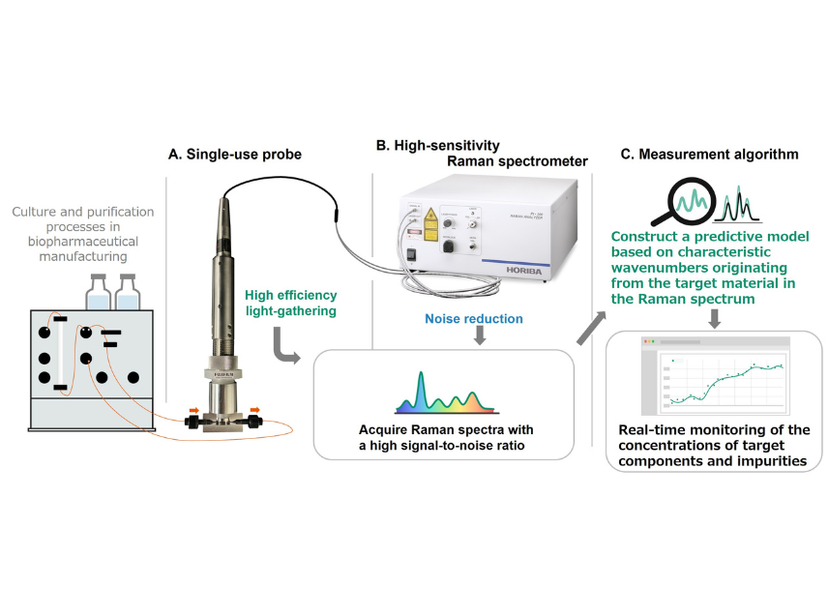
Schematic of the High-Sensitivity Inline Raman Measurement System – a high light-collection-efficiency probe and a Raman spectrometer with a noise-reduction design enable the acquisition of Raman spectra with a high signal-to-noise ratio (S/N)
FUJIFILM Corporation and HORIBA, Ltd have co-developed a high-sensitivity inline Raman measurement system1 that enables continuous, real-time monitoring of component concentrations directly from bioreactors and process equipment during cell culture and purification in biopharmaceutical manufacturing.
When this inline Raman system is used to control purification processes in antibody drug manufacturing, antibody yield improves by approximately 10%2 compared with conventional UV-Vis-based process control methods3. Fujifilm will exhibit this inline Raman system at the BIO International Convention in San Diego, USA, from June 22–25, 2026.
Growing demand for real-time bioprocess monitoring in biopharmaceutical manufacturing
In the manufacturing process of biopharmaceuticals, slight variations in process conditions, such as oxygen concentration in cell culture media and purification processes, can significantly affect product quality and yield. As a result, identification and analysis of various components are conducted during cell culture and purification processes.
Conventional offline analytical methods require samples to be taken from cell culture media and purification solutions during manufacturing, making it difficult to monitor compositional changes in real time. There is therefore an increasing demand for highly sensitive measurement technologies that can analyze the conditions inside bioreactors and process equipment in real time and accurately monitor changes in these conditions.
The system developed by HORIBA and Fujifilm combines a high-sensitivity Raman spectrometer from HORIBA and Fujifilm’s single-use probe and proprietary measurement algorithms, enabling efficient acquisition of weak Raman signals and highly accurate analysis.
By integrating Fujifilm’s optical design technologies with HORIBA’s Raman spectroscopy technologies, the companies have developed an inline Raman measurement system that achieves industry-leading sensitivity4. This enables high-precision, real-time monitoring of changes in the composition of cell culture media and purification solutions.
Going forward, the two companies will work together to verify the system towards real-world use. By improving manufacturing process monitoring and advanced data analysis technologies, the system is intended to contribute to the stable manufacturing of high-quality biopharmaceuticals, including antibody drugs, and the reduction of manufacturing costs.
Key features of the high-sensitivity inline Raman measurement system
The system achieves high sensitivity through a proprietary noise-reduction design that minimizes signal fluctuations caused by rising temperatures. It also enables highly accurate continuous measurement through automatic calibration that mitigates spectral drift caused by temperature fluctuations and other factors.
By combining the Raman spectrometer with a high light-collection-efficiency probe optimized in material and structure for biopharmaceutical manufacturing using Fujifilm’s proprietary optical design technologies, the system can detect weak signals that were difficult to identify using conventional methods and attains a high signal-to-noise ratio (S/N) in the industry. Sufficient accuracy can be ensured even with a short acquisition time, contributing to improved measurement throughput.
Fujifilm’s proprietary measurement algorithm extracts characteristic wavenumbers associated with target substances and impurities in the acquired Raman spectra5 and constructs a predictive model. This enables highly accurate measurement of time-dependent changes in cell culture media components and concentrations of target substances and impurities in purification solutions.
Application value and future development
Stabilization of antibody quality in cell culture processes
In cell culture processes, the inline Raman system can identify and continuously measure multiple amino acids contained in the cell culture media, enabling real-time monitoring of changes in cell culture media composition inside the bioreactor. This makes it possible to identify sources of variation among batches and within the same batch process, allowing precise control of manufacturing processes and contributing to stable manufacturing of high-quality biopharmaceuticals.
Acceleration of process development for biopharmaceutical manufacturing
By enabling continuous real-time inline analysis, the system reduces the time required for conventional offline analysis involving sampling during the process. As a result, the cycle of trial processes, from condition optimization to verification, can be repeated in a shorter time frame.
References
1. Inline measurement technology that applies Raman spectroscopy (a technology based on the interaction of light with a molecule that provides detailed information about its chemical structure) to manufacturing processes, enabling continuous, real-time, non-destructive analysis of chemical composition and reaction states without sampling.
2. Verified through demonstration tests conducted using Fujifilm’s model experimental systems.
3. An analytical method that measures the amount of ultraviolet or visible light absorbed by molecules for the characterization and quantification of samples.
4. Measured in terms of signal-to-noise ratio (S/N) in a measurement system combining commercially available Raman spectrometers and probes for inline Raman applications. As of June 2026, based on Fujifilm research. The S/N is an indicator representing the ratio of measured signal to noise. A system with higher S/N is capable of detecting weaker signals, making it suitable for low concentration analytes detection.
5. Raman spectra are graphs showing the intensity of Raman scattered light as a function of wavenumber, which corresponds to the vibrational energy levels of molecules.
Want the latest science news straight to your inbox? Become a SelectScience member for free today>>
Links
Tags
Frequently asked questions
Show frequently asked questions
How does the FUJIFILM and HORIBA inline Raman system improve antibody drug manufacturing yield?
The co-developed high-sensitivity inline Raman measurement system enables continuous, real-time monitoring of antibody and impurity concentrations during purification. By extracting characteristic wavenumbers and using predictive models, it allows antibodies to be collected at the optimal timing while impurities remain within acceptable limits.
Demonstration tests using Fujifilm’s model systems confirmed an approximately 10% improvement in antibody yield compared with conventional UV-Vis-based process control methods.
What are the key features of the FUJIFILM–HORIBA high-sensitivity inline Raman measurement system for biopharmaceutical manufacturing?
The system combines HORIBA’s rugged, high-precision Raman spectrometer with Fujifilm’s high light-collection-efficiency single-use probe and proprietary measurement algorithms. It uses a noise-reduction design and automatic calibration to achieve industry-leading signal-to-noise ratio, enabling accurate, real-time monitoring of cell culture media and purification solutions. The predictive models built from Raman spectra support stable, high-quality biopharmaceutical manufacturing and reduced production costs.
How does inline Raman spectroscopy support real-time bioprocess monitoring in biopharmaceutical production?
Inline Raman spectroscopy enables continuous, non-destructive analysis of chemical composition and reaction states inside bioreactors and process equipment without sampling. The FUJIFILM–HORIBA system identifies characteristic wavenumbers of target substances and impurities, then constructs predictive models to track time-dependent changes in cell culture media and purification solutions. This real-time monitoring helps control process variations, stabilize antibody quality, accelerate process development, and improve yield across diverse biopharmaceuticals.