
Feinstein Institutes' ROSE study continues to advance critical endometriosis diagnostic test
National Institutes of Health awards The Research OutSmarts Endometriosis team an $850,000 prize over one year to accelerate the development of a non-invasive diagnostic test
20 Apr 2026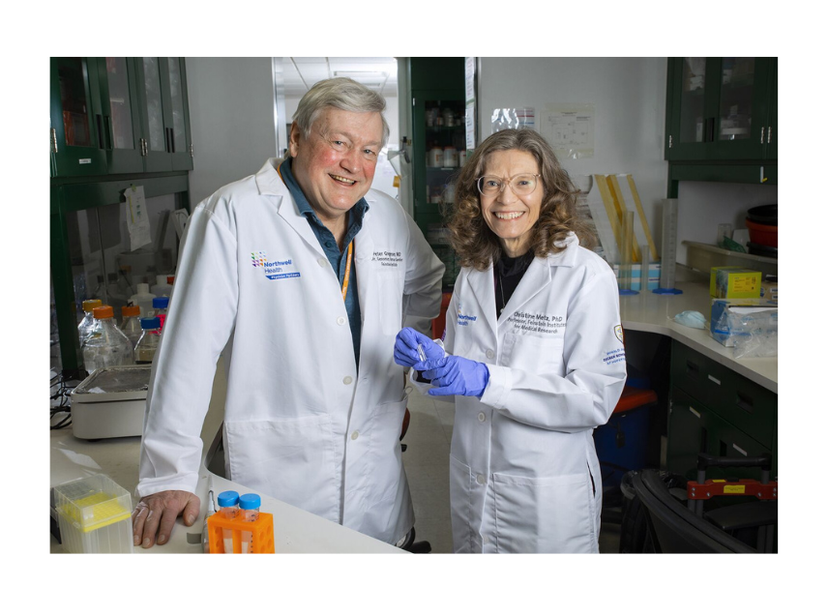
Dr. Peter K. Gregersen and Dr. Christine N. Metz lead the Research OutSmarts Endometriosis (ROSE) study
Investigators at Northwell Health’s Feinstein Institutes for Medical Research have, for more than a decade, been at the forefront of addressing the endometriosis diagnostic gap. Dr. Christine N. Metz, and Dr. Peter K. Gregersen, lead the Research OutSmarts Endometriosis (ROSE) study and have been working on developing a fast, easy and non-invasive test using a person’s menstrual blood to identify the disorder.
The ROSE study, which began in 2013, compares the menstrual discharge, or effluent, of women with and without endometriosis, searching for distinct biological markers that could be used to diagnose the disease, without the need for invasive surgery. Menstrual flow contains tissue from the endometrium (uterine lining), and it is well-documented that women with endometriosis have altered cells in their uterine lining. The study, which has already enrolled more than 3,700 participants, is one of the first attempts to translate these cellular differences into a diagnostic test.
“Many women tell us they’ve been dismissed by doctors, friends, coworkers, and even parents,” said Dr. Metz, professor in the Institute of Molecular Medicine at the Feinstein Institutes. “Our goal with the ROSE study is to provide a reliable, early diagnostic tool that validates their experiences and enables timely treatment.”
Endometriosis lesions commonly adhere to various organs in the pelvic cavity, such as the uterus, ovaries, bladder, and rectum, often causing severe pain during hormonal fluctuations. The symptoms are complex and can be easily missed or misinterpreted by health care providers. On average, women visit six different health care providers over several years before receiving a diagnosis.
Building on laboratory discoveries and clinical research data, Drs. Metz and Gregersen launched the ROSE II clinical trial in 2022. This study is actively recruiting women across the country, between 18 and 40 years old, who suspect they may have endometriosis and are scheduled for diagnostic endometriosis surgery. Researchers analyze the trial participants’ menstrual blood (collected by participants at home) to compare the results with their laparoscopic surgery findings to validate the accuracy of the menstrual blood diagnostic test.
Both the ROSE and ROSE II studies are working towards the same goal: Food and Drug Administration approval for this one-of-a-kind diagnostic test for endometriosis with the hope that one day analyzing menstrual effluent will become a routine aspect of a gynecological visit.
To further their research, the ROSE team received a $500,000 prize from the National Institutes of Health’s Rapid Acceleration of Diagnostics Technology (RADx Tech) program; this tops the $350,000 the team won over the past year from RADx making the entire prize $850,000.
The RADx Tech initiative, originally established to speed the development of innovative diagnostic tests, expands its focus to critical health challenges, including conditions like endometriosis, by supporting advanced technology platforms and rapid development pathways.
“Receiving this RADx Tech prize is a tremendous endorsement of the critical work we’ve been doing since 2013,” said Dr. Gregersen, professor in the Institute of Molecular Medicine at the Feinstein Institutes. “This federal support acknowledges the vital need and promise of our research in transforming endometriosis diagnosis from a long, arduous process into a simple, effective screening. This funding is crucial for moving our innovations from the lab to patients’ lives.”
The ROSE study team was also the recipient of a $1 million award at the 2018 Northwell Innovation Challenge, a Northwell 'Shark Tank'-style competition, for their research. Northwell Innovations continues to support the team’s development of this important diagnostic.