
Expanding Solutions for Elemental Impurity Analysis in Pharmaceutical Products
Shimadzu releases the ICPMS-2030 inductively coupled plasma mass spectrometer
14 Mar 2016
The new ICPMS-2030 is designed to meet the requirements of the ICH (International Council for Harmonisation of Technical Requirements for Pharmaceuticals for Human Use) Q3D guidelines for elemental impurities in pharmaceutical products. The ICH Q3D specifies allowable limits of daily intake of 24 elements of toxicological concern, and requires highly sensitive and high-precision measurement of such elements.
The ICPMS-2030 satisfies these requirements with ppt level high sensitivity. This is achieved by the newly developed collision cell and the optimized internal structure, offering FDA 21 CFR Part 11 compliance, automated analytical method development function, and unique measurement result evaluation function to provide analytical results with exceptionally high reliability.
The US pharmacopoeia indicates limits of elemental impurities (USP) and detection techniques using ICP-MS (USP), which will be in effect in January 2018. In USP, X-ray Fluorescence Spectrometry is adopted as general analytical method. For those demands, Shimadzu offers total solution for elemental impurities analysis from screening without sample preparation using the EDX-7000/8000, FDA 21 CFR Part 11 compliant Energy Dispersive X-ray Fluorescence Spectrometers, to highly sensitive and high-precision analysis using the ICPMS-2030.
“Critical Mass Tour” – The ICPMS-2030 European Launch Tour
Newly released during the Pittcon Expo in March 2016, the ICPMS-2030 will be launched in Europe as of March. During the “Critical Mass Tour” Shimadzu will travel to several countries such as Belgium, Hungary, France, and others. In Germany, the ICPMS-2030 will be introduced during the analytica trade fair in Munich, May 10-13.
Features:
The ICPMS-2030 combines benefits covering performance features such as sensitivity and reliability, as well as operational, handling and economic aspects.
1. Designed for high sensitivity and easy maintenance
The optimized internal structure including the newly developed collision cell enables analysis at ppt level sensitivity; depending on the elements even sub-ppt levels can be reached. This outstanding sensitivity is achieved by minimized spectral interference and improved transmission efficiency of atomic ions, so that precise quantitation results in elemental impurity analysis become more reliable. The sample injection unit and interface unit, where ionized atoms go through can be easily removed for maintenance so that stable analysis for longer period can be ensured.
2. Simplified analysis and higher data reliability by assistant functions and LabSolutions software
In ICP-MS analysis, conventionally users needed to be skilful and often spent a long time to find the ions that interfere with spectra, select the optimum mass number of the elements to be measured, and determine the calibration curve sample concentration.
Using the “Development Assistant" function, users can now simply perform qualitative analysis by selecting the elements to be measured. The software then automatically sets the suitable analysis conditions. When performing routine analysis, the “Diagnosis Assistant” automatically checks if there is spectral interference and indicates problems if there are any. Shimadzu’s FDA 21 CFR Part 11 compliant LabSolutions software provides ensured analytical data management.
3. Reduction of argon gas consumption and lower running costs via the mini-torch and Eco mode
Shimadzu’s unique mini-torch plasma unit significantly reduces the consumption of argon gas. The Eco mode automatically reduces the argon gas flow during standby. In addition, the use of 99.95 % purity argon gas is guaranteed. Therefore, analysis can be performed using the relatively lower cost argon gas, instead of 99.999 % or higher purity argon gas generally used. These features greatly reduce costs in laboratory operations.
For research use only. Not for use in diagnostic procedures.
Related products
Request Quote for All Products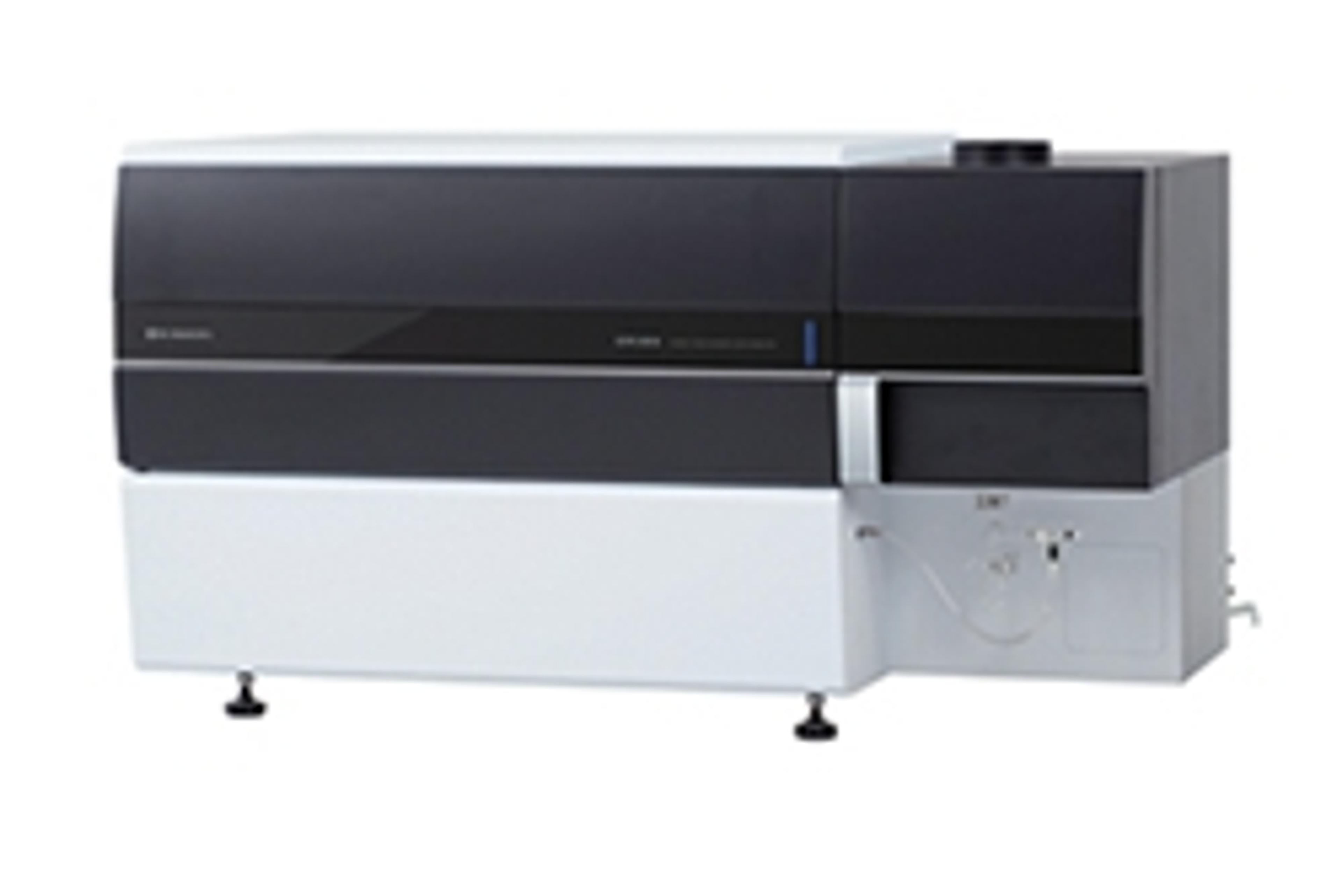
ICPE-9800 Series: Simultaneous ICP Emission Spectrometers
Shimadzu CorporationFeaturing user-friendly software and a proprietary design, the simultaneous ICPE-9800 series instruments enable sensitive, high-speed simultaneous analysis of multiple elements regardless of concentration levels while significantly reducing operating costs. Key features include a vertically oriented plasma torch with dual view (axial/radial) capabilities that achieves the ideal combination of sensitivity and dynamic range, and a leading-edge CCD (charge-coupled device) detector with one million pixels. Eco Mode and a mini-torch system significantly minimize argon gas consumption, resulting in substantial cost savings. Easy-to-use, 21 CFR compliant software helps users optimize methods and enables a smooth analysis process. The Assistant functions help users optimize methods by automatically acquiring wavelength data, selecting optimal wavelengths, diagnosing methods and providing inter-element correction for an all-around smooth analysis process. In addition to the standard accessories, additional torches, chambers, nebulizers, drains and other parts are available for the ICPE-9800 series so users can customize their systems for their specific application needs.
ICPE-9000
ICPE-9000 is a simultaneous ICP-OES spectrometer utilizing a vacuum type Echelle optical system in combination with a large scale CCD detector designed for stable performance over extended periods. The ICPE-9000’s innovative Mini Torch minimizes cost by reducing consumption of argon gas to half that of conventional torches. The ICPE-9000 features easy-to-use, innovative ICPEsolution Software, which offers such features as a Method Development Assistant and a Diagnosis Assistant and easily handles automatic wavelength optimization as well as interference corrections.