
Drinking Water Analysis using Ion Chromatography at Anglian

Chris Pegg, Senior Scientist Chemistry at Anglian Water, UK, explains why his team uses ion chromatography to monitor target ions in drinking water

25 Aug 2016
Alex Waite
Editorial Assistant

Editorial article

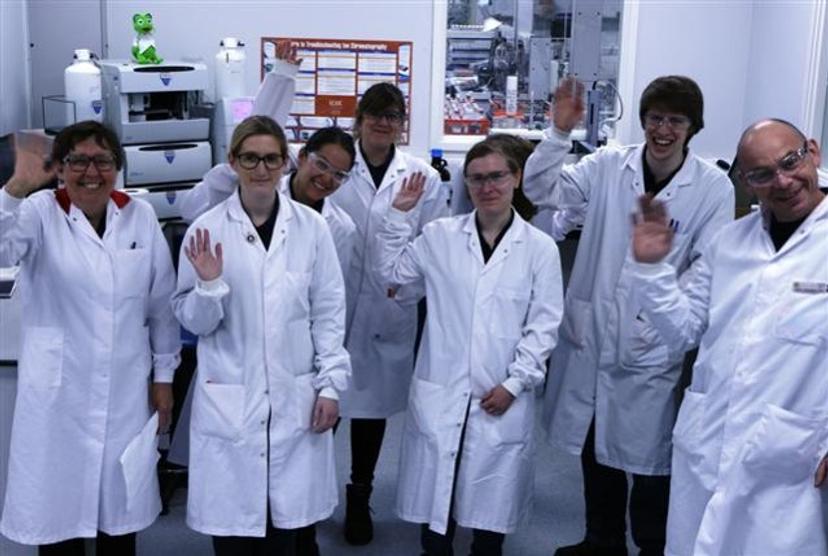
The Anglian Water Analysts - Image courtesy of Chris Pegg
Anglian Water supplies water and water recycling services to more than six million domestic and business customers in the east of England and Hartlepool.

SelectScience® spoke to Chris Pegg, Senior Scientist Chemistry at Anglian Water to learn how his team uses ion chromatography to perform effective analysis of disinfection by-products in water.

What analytes are monitored in the water?

At Anglian Water, Chris's team is monitoring disinfection by-products, in particular bromate, chlorate and iodide. “These are dealt with by Regulation 26 of the Water Supply – known as the disinfection by-products rule” says Chris, “It obliges water companies to design, operate and maintain disinfection processes to keep by-products as low as possible, while not compromising effectiveness of disinfection. We do this by producing a risk assessment. You populate it with your water quality results and what treatment you’ve got on site and it gives a level of risk. It allows others on site to be aware of what’s going on”.

Why use Ion Chromatography (IC) for water analysis?

Chris explained; “Since the late 90s we’ve used IC to test for bromate and chlorate. Previously, we used liquid chromatography (LC), but we had problems with certain samples”.

The lab at Anglian Water currently uses the Dionex ICS-5000+ Reagent-Free HPIC system and the ICS-2100 Integrated Reagent-Free IC System, both from Thermo Fisher Scientific. Chris explained, “we’re currently on our third or fourth IC system, and a big reason is performance”.

According to Chris, “IC fits nicely into our operation - we can run bromate and chlorate effectively on the same run". However, when analyzing iodide, "we replace the column, so we have a day dedicated to iodide analysis. Due to long stability of the samples it doesn’t affect our operation. Time per sample isn’t an issue, with little downtime, as it is left to run over night. In the morning, peaks are quantified and downloaded to Laboratory Information Management System (LIMS) for the business to use, so the analyst can do other things during the day. Also, because it’s so easy to use, it’s very easy to train on - we can fully train an analyst in 3-4 months”.

Chris added, “Servicing is only required once a year, which takes all day. With maintenance, it doesn’t need stripping down, although we change piston seals about every 6 months as we find it runs a bit better”.

The future of IC in the water analysis lab

According to Chris, “if we bolt a mass spec onto our IC, we can analyze down to parts per trillion, but it’s working fine for now”. “Our next IC project is chromium-6 in drinking water,” revealed Chris, “which is something I’m quite excited about”.

Watch Chris’ full presentation here, or more exclusive interviews on the Analyzing Contaminants in UK Waters Special Feature.

Do you use any of the products mentioned in this article? Is there a product you couldn’t live without? Share your experiences with our worldwide community and write a review today.

Links

Tags

AutosamplersAutosamplers are automated sample loaders used with a number of separation and analytical techniques. HPLC autosamplers use automated partial or full-loop injection systems and place samples in vials or microplates for analysis. Autosamplers can also be used for elemental analysis. Features to consider include repeatability, syringe capacity, footprint and temperature controls.  Ion ChromatographyIon chromatography, also known as ion exchange chromatography, is a high-performance liquid chromatographic technique used for the separation and identification of ions or polar molecules in a sample, including proteins, nucleotides and amino acids. Equipment includes ion exchange columns, ion exclusion columns, ion chromatography systems, pumps, and detectors. Find the best ion chromatography equipment in our peer-reviewed product directory: compare products, check customer reviews and receive pricing direct from manufacturers.Sample PreparationSample preparation can improve the quality and speed of separation techniques. Products to assist sample preparation include filtration equipment, evaporators, membranes and sieves.Mass SpectrometryMass spectrometry (MS) is a powerful analytical technique used to identify and quantify molecules based on the mass-to-charge ratio of gas-phase ions. It provides detailed information about the structure, composition, and properties of compounds and is widely used across fields such as environmental monitoring, materials science, drug discovery and development, food and beverage testing, and wider chemical research. Key MS techniques include tandem mass spectrometry (MS/MS), liquid chromatography–mass spectrometry (LS-MS) and inductively coupled plasma (ICP-MS). Choosing from these wide range of techniques and technologies can be a daunting task, so keep up to date with scientific applications, performance expectations, and customer reviews here all in one place. Visit our product directory to receive quotes direct from the manufacturer. Data AnalysisData analysis hardware and software is available to make data processing straight-forward yet powerful. Data software can be used for math and stats, technical graphing and image analysis. In addition, software is available for specific data analysis of electrophoresis, densitometry, ELISA and DNA sequencing.LIMSLIMS (Laboratory Information Management System) is an informatics software system used to improve the quality assurance and quality control (QA / QC) of data management. LIMS can be a standard for common lab workflows, such as commercial off the shelf systems (COTS), or customized for more specialized lab use. Systems are available for mainframe computers or PC.Sample ManagementSample management systems include sample storage devices such as freezers and plate storers, sample environment enclosures and sample organization, retrieval and sorter systems. Useful system features include high-throughput, automation, robotic arms, automated liquid handling and associated database systems. Accessories in sample management include barcode scanners, heat sealers and tubes.Environmental Monitoring and TestingEnvironmental monitoring and testing uses handheld portable analyzers, kits, spectrometers or chromatography systems for air, water, soil, food and other sample testing. Useful features of analyzers such as BOD and COD include portability, easy calibration, automation and sensitivity.  Environmental test kits for pH, water, moisture, etc, should be accurate, sensitive, reliable, fast and easy to use.Robotic InstrumentsRobotic instruments can be used for high-throughput automation of many lab processes. Such processes use instruments for assays like cell based assays and ELISA, for sample preparation like shakers, centrifuges and incubators, and for analysis such as sequencing and western blot analyzers. Useful features of robotic instruments include speed, reproducibility, barcode readers, software and automation.Software PlatformsSoftware platforms are useful for various stages of laboratory experiments from data collection to data storage and processing. For instance lab software is available for system control, data management, data analysis and qualification / validation.Water PurificationThere are a number of water purification methods available to remove contamination from laboratory water. These systems include demineralization, reverse osmosis, filtration and ultrafiltration. A combination of methods is sometimes necessary to achieve purified water suitable for use in experiments.ChromatographyChromatography is a powerful technique used to separate and analyze components of mixtures based on their chemical properties. It is widely used in fields like biochemistry, pharmaceuticals, and environmental analysis. By exploiting differences in the interaction of substances with a stationary phase and a mobile phase, chromatography enables precise purification and quantification of compounds. Whether you're working with complex biological samples or industrial chemicals, chromatography is essential for obtaining high-quality results. Browse our peer-reviewed product directory to find the best chromatography systems, compare products, read customer reviews, and get pricing directly from manufacturers.Water Security MonitoringWater AnalysisAnalytical methods used to test the purity of drinking water include determining the level of contaminants abides to the level set by the Environmental Protection Agency (EPA).Capillary Ion Chromatography