
Dana-Farber Liquid Biopsy Trial Highlights the Value of Droplet Digital™ PCR Technology in Clinical Settings
First Prospective Clinical Trial of Liquid Biopsy with Real-World Clinical Application
30 May 2016
The first prospective clinical trial of a blood-based DNA test conducted by researchers at the Dana-Farber Cancer Institute (DFCI) in Boston has validated the use of cell-free (cfDNA) as a predictive diagnostic tool.

Dr Geoffrey Oxnard, senior author of the JAMA Oncology study
The test, more commonly known as a liquid biopsy, was developed by the multidisciplinary team at DFCI using Bio-Rad’s Droplet Digital PCR (ddPCR™) platform to rapidly detect key driver mutations in non–small-cell lung cancer (NSCLC) patients. Liquid biopsy analysis of cfDNA using ddPCR technology performed so well in this setting that the Dana-Farber/Brigham and Women’s Cancer Center (DF/BWCC) plans to offer the lab-developed test to eligible patients outside of the trial. Trial results were published last month in JAMA Oncology.
While the use of ddPCR for analyzing liquid biopsy samples is relatively well established in research settings, the Dana-Farber study represents the first prospective real-world assessment of the clinical performance of ddPCR-detected cfDNA as a molecular biomarker for cancer driver and resistance mutations. Unlike earlier studies, the DFCI trial did not use retrospective samples; liquid biopsy samples were prospectively collected.
The investigators’ ddPCR assay pinpointed NSCLC driver mutations with a 100% positive predictive value and zero false positives. For resistance mutations, ddPCR-based plasma genotyping at times identified apparent false positives, which are thought to represent heterogeneous resistance mutations missed on a biopsy of a resistant tumor site.“The Dana-Farber study is the first to include a mixed real-world population,” said George Karlin-Neumann, Director of Scientific Affairs at Bio-Rad's Digital Biology Group. “The study included common day-to-day logistical considerations and variations in sample processing, with an understanding of how they may influence results.”
The results for the liquid biopsy were obtained in three days on average, demonstrating an important advantage over traditional biopsies, which can take between 12 days (for newly diagnosed patients) to several weeks (for drug-resistant patients) to complete.
The study authors also underscored that the sensitivity of the cfDNA assays was not as high as its specificity. In cases where the liquid biopsy results were negative, a tissue biopsy is recommended to look for mutations that might have been missed in the cfDNA.
cfDNA — An Emerging Alternative to Invasive Tissue Biopsy
Precision medicine approaches are rapidly advancing oncology care. Genetic profiles of individual tumors are being used to determine the best possible treatment options for an individual patient. Genetic variation is typically determined from tissue samples biopsied directly from the patient’s tumor. Although this approach has enabled more targeted care, the method is invasive and not always conclusive. In addition, successful tissue biopsies can take several weeks or longer to generate results and then may have only limited clinical sensitivity due to incomplete sampling of the tumor, which is often a heterogeneous and rapidly evolving population of cells.
“In some patients with the EGFR resistance mutation, ddPCR detected mutations missed by standard tissue biopsy,” said Geoffrey Oxnard, MD, a thoracic oncologist and lung cancer researcher at Dana-Farber and Brigham and Women’s Hospital, and senior author of the study.
“A resistant tumor is inherently made up of multiple subsets of cells, some of which carry different patterns of genetic mutations,” Dr. Oxnard said. “A single biopsy is only analyzing a single part of the tumor, and it may miss a mutation present elsewhere in the body. A liquid biopsy, in contrast, may better reflect the distribution of mutations in the tumor as a whole,” he added.
The DFCI study involved 180 individuals with NSCLC and included both newly diagnosed patients and those who had become resistant to a previous treatment. Using both liquid and tissue biopsies, researchers looked for cancer-driving mutations in the EGFR and KRAS genes, as well as a separate mutation in the EGFR gene that often confers resistance to front-line therapies.
DFCI researchers used Bio-Rad’s ddPCR technology to analyze cfDNA in the liquid biopsy samples. The method detects and quantifies mutations by partitioning cfDNA extracted from the plasma sample into thousands of nanoliter-sized droplets. In droplets containing the target mutations, the PCR reaction amplifies the cfDNA of interest, with minimal background noise from extraneous normal DNA. This generates an absolute count of mutant DNA molecules in the sample: information that is both precise and actionable in the hands of clinicians seeking to personalize patient care. Serial measurements of tumor cfDNA levels after therapy initiation in 50 of the 180 patients demonstrated patterns of change suggestive of patient response to therapy.
The validation study demonstrated that Dana-Farber’s liquid biopsy approach is an invaluable supplement to traditional tissue sampling, with a rapid turnaround time and a high positive predictive value. A positive cfDNA result appears actionable, while patients with a negative result can proceed to a more invasive biopsy. The test demonstrated between 64 and 82% clinical sensitivity, with zero false positives for lung cancer driver mutations.
For more information, please visit www.bio-rad.com.
Related products
Request Quote for All Products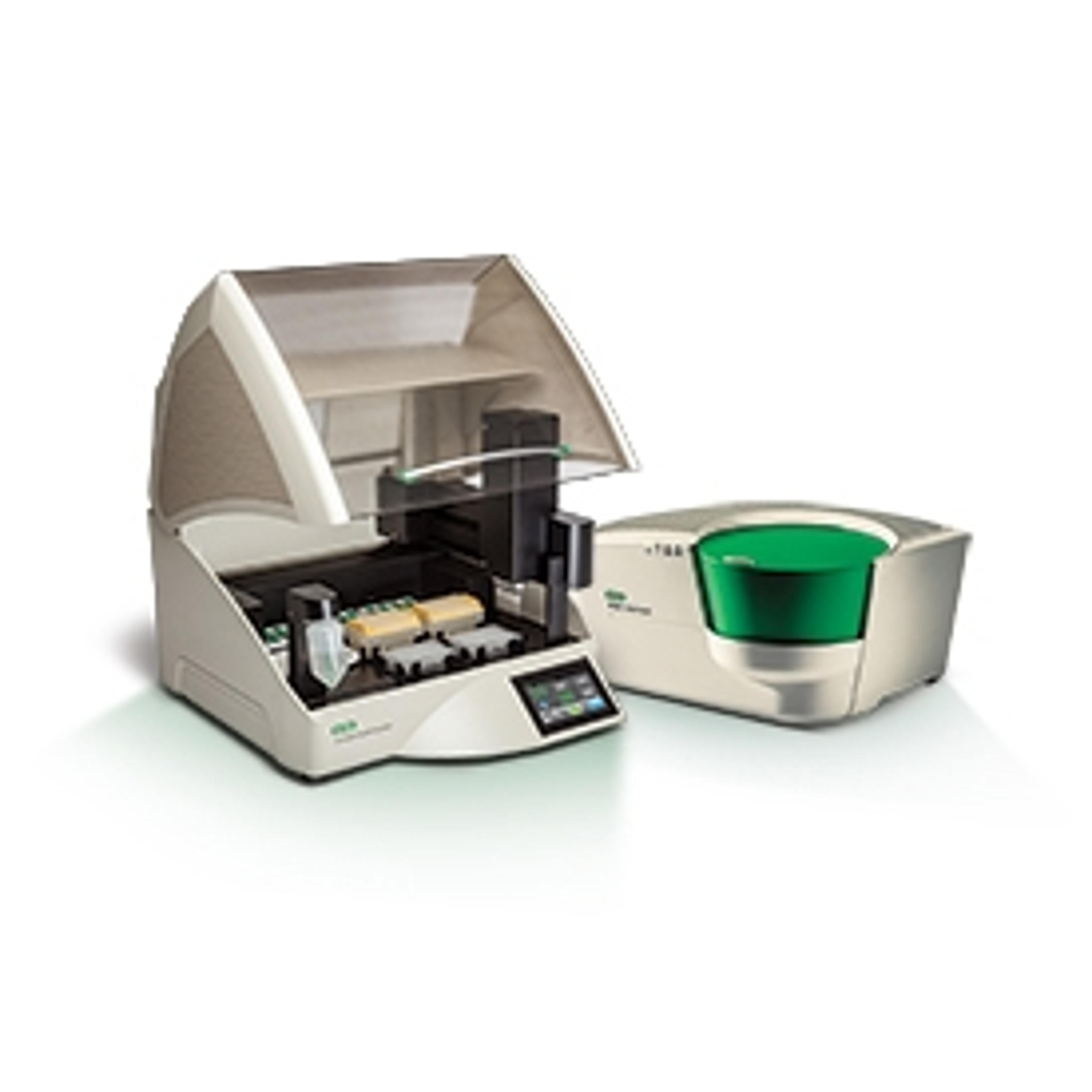
QX200™ AutoDG™ Droplet Digital™ PCR System (1864100)
Bio-RadAutoDG Droplet Digital PCR System for EvaGreen or probe-based digital PCR applications, includes Automated Droplet Generator, QX200 Droplet Reader, laptop computer, and QuantaSoft™ Software