
Cresset’s drug discovery tool unlocks the creative potential of molecule design
Generate innovative ideas with custom workflows and task automation
18 Jul 2024Cresset releases Flare V9 with integrated Spark™ for advanced ligand and structure-based drug design
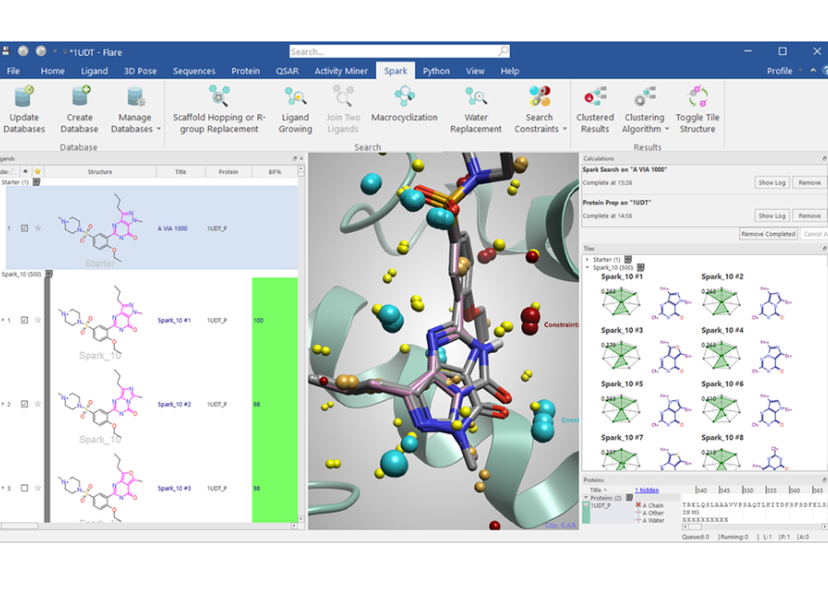
Figure 1: The Spark tab in Flare
Cresset has released version 9 of its Flare platform for ligand-based and structure-based design, integrating the Spark™ bioisostere replacement solution directly into Flare. This release provides medicinal and computational chemists with a unified environment for optimizing and progressing new small molecules, enabling more efficient drug discovery workflows and the creation of novel intellectual property.
Integrated Spark bioisostere replacement in Flare
The latest Flare release includes the full integration of Spark, Cresset’s bioisostere replacement solution which works in electrostatic and shape space. This enables better matching of the nature of molecules and supports the design of novel IP. Flare users can now access Spark’s capabilities directly within the Flare interface, benefiting from a seamless workflow for ligand-based design.
Spark’s key features include:
- Scaffold hopping and R-group replacement
- Ligand macrocyclization
- Growing and docking
- Joining two ligands
- Water replacement
- Access to the new Linkers databases for linker degrader design
These capabilities support highly innovative design ideas, help escape ADMET issues, and enable prioritization of the best compounds, streamlining the small molecule discovery process.
Enhanced workflows and automation with Flare Python API
By integrating Spark into Flare, users can take advantage of custom workflows and task automation via the Flare Python API. Spark now has an API within Flare, enabling access to all Spark features programmatically. This makes it straightforward to set up automated workflows, such as running a Spark search and automatically re-docking results or scoring them with MM/GBSA, and to integrate Spark into existing company workflows.
New scientific methods and customer-driven enhancements
Flare V9 introduces new and enhanced features and methods based on the latest science and important customer feedback. These include:
- Ensemble MM/GBSA on dynamics trajectories for binding free energy predictions
- Homology modeling
- New features for Dynamics and Flare FEP calculations
- JupyterLab integration to work with the Flare Python API
- An enhanced Extension Manager to enable seamless installation and update of Cresset or customer-generated Python extensions
These additions expand Flare’s capabilities for structure-based design, enabling more accurate modeling, analysis, and prediction of molecular interactions.
Customer-focused innovation in computational chemistry
Giovanna Tedesco, VP of Products at Cresset, commented on the release of Flare V9 and the integration of Spark: “We are delighted to bring the latest version of Flare, for the first time incorporating the integration with Spark. Our customers say Spark is the best scaffold hopping software they have ever used, and it is favored by both medicinal and computational chemists for the great results it generates and its simplicity of use. Having Spark in Flare, gives Spark an API, which enables access to all the cutting-edge Spark features. It makes it very easy to set up custom workflows, (for example, to run a Spark search and automatically re-dock results, or score them with MM/GBSA) and integrate Spark in your own company’s workflow.”
Want the latest science news straight to your inbox? Become a SelectScience member for free today>>
Links
Tags
Frequently asked questions
Show frequently asked questions
What new capabilities does Cresset Flare V9 offer for ligand-based and structure-based drug design?
Flare V9 integrates the Spark bioisostere replacement solution directly into the Flare platform, creating a unified environment for ligand-based and structure-based design. Medicinal and computational chemists can perform scaffold hopping, R-group replacement, ligand macrocyclization, growing and docking, joining two ligands, and water replacement, as well as use new Linkers databases for linker degrader design, all within Flare.
How does the integrated Spark API in Flare V9 improve small molecule discovery workflows?
With Spark fully integrated into Flare and exposed via the Flare Python API, users can programmatically access all Spark features. This enables automated workflows such as running Spark searches, automatically re-docking results, and scoring them with MM/GBSA. Companies can integrate Spark into existing pipelines, streamline small molecule optimization, and efficiently prioritize compounds while addressing ADMET issues.
What new scientific methods and integrations are included in Cresset Flare V9 for structure-based design?
Flare V9 introduces ensemble MM/GBSA on dynamics trajectories for binding free energy predictions, homology modeling, and new features for Dynamics and Flare FEP calculations. It also adds JupyterLab integration for working with the Flare Python API and an enhanced Extension Manager for installing and updating Cresset or customer-generated Python extensions, expanding Flare’s structure-based modeling and analysis capabilities.