
Cresset releases the latest update to its agile ligand and structure-based drug design platform
"accelerate innovation, improve accuracy, and drive smarter decision-making"
24 Feb 2025Cresset launches Flare™ V10 with advanced FEP, protein-protein docking, and PLIF capabilities
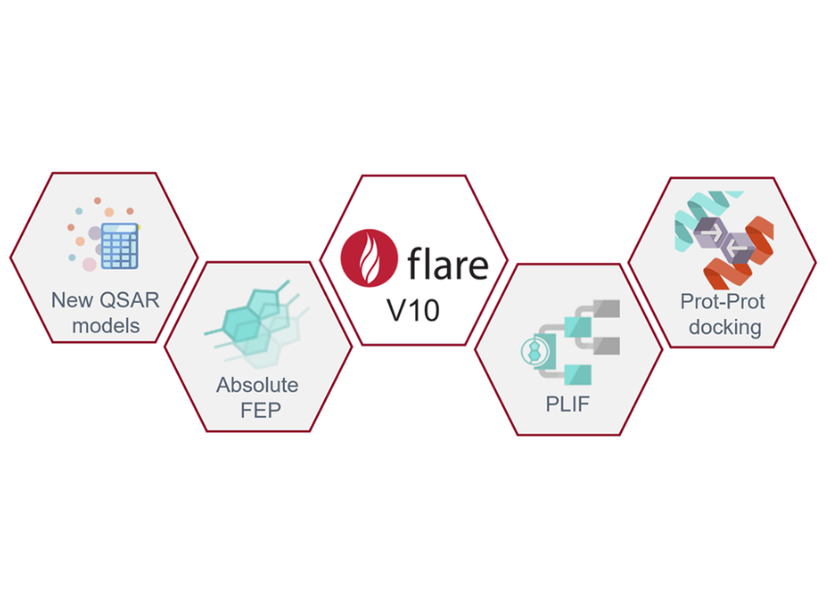
Flare V10 offers a range of new functionalities for every computational or medicinal chemist
Cresset has released Flare™ platform V10, a major update to its computational chemistry software designed for drug discovery teams worldwide. The new version delivers enhanced Free Energy Perturbation (FEP) calculations, including Absolute FEP, protein-protein docking, and Protein-Ligand Interaction Fingerprints (PLIF), enabling computational and medicinal chemists to predict ligand binding affinities more accurately, model complex protein interactions, and streamline structure-based design workflows.
Enhanced Absolute Free Energy Perturbation for accurate binding affinity prediction
Flare V10 introduces Absolute Free Energy Perturbation Calculations, enabling precise prediction of ligand binding affinities without the need for structurally related reference molecules. This Absolute FEP implementation uses the SOMD engine to deliver fast, GPU-accelerated simulations, supporting high-throughput and industrial-scale drug discovery projects.
Protein-Ligand Interaction Fingerprints for ligand clustering and SAR insight
Protein-Ligand Interaction Fingerprints (PLIF) in Flare V10 help scientists analyze and cluster ligands based on their interaction patterns with protein targets. By summarizing key contacts between ligands and binding sites, PLIF provides insights into structure–activity relationships and binding affinities, supporting lead optimization and rational design.
Protein-protein docking powered by JabberDock and PSO
The new protein-protein docking functionality predicts how two proteins interact to form a stable complex. Flare V10 leverages the JabberDock algorithm combined with Particle Swarm Optimization (PSO) to refine docking accuracy. This approach is particularly useful for modeling dimers, peptide–protein interactions, and multimeric assemblies, helping researchers explore complex biological mechanisms and interaction networks.
Advanced QSAR modeling with Gradient Boosting
Flare V10 expands its quantitative structure–activity relationship (QSAR) modeling capabilities with advanced methods, including Gradient Boosting, to improve predictive accuracy. These enhanced QSAR tools support data-driven decision-making and help medicinal chemists prioritize compounds more effectively.
Match3D for accurate protein superposition
The Match3D feature for protein superposition has been enhanced to ensure accurate alignment of proteins, even when sequence similarity is low. This supports comparative modeling, binding site analysis, and the transfer of structural insights across related protein families.
Quantum mechanics tools for detailed molecular analysis
Flare V10 includes upgraded Quantum Mechanics (QM) tools, such as torsion scans, solution-phase minimization, and carbanion input support. These QM methods enable detailed exploration of conformational preferences, reaction intermediates, and electronic effects that influence molecular behavior and binding.
Spark™ enhancements for bioisosteric replacement
Enhancements to Spark™ in Flare V10 streamline bioisosteric replacement workflows and result tracking. These improvements help chemists explore new chemical space efficiently, identify suitable bioisosteres, and manage design iterations more effectively within lead optimization campaigns.
Improved FEP graph visualization and quality scoring
FEP Graph Enhancements in Flare V10 include improved connectivity handling and quality scoring, providing clearer visualization of FEP networks. These tools help users interpret FEP results, assess calculation reliability, and optimize project strategies.
Molecular dynamics upgrades for flexible simulations
Molecular Dynamics (MD) capabilities in Flare V10 have been upgraded to support restrained simulations, improved trajectory exports, and more flexible restart options. These enhancements enable more controlled and reproducible MD studies, supporting detailed analysis of protein–ligand dynamics and conformational changes.
Supporting digital transformation in drug discovery
Sofia Bariami, Flare Product Manager at Cresset, commented, “We are excited to introduce the latest release of Flare, which makes the integration of advanced methods into research workflows even easier. As digital transformation continues to reshape drug discovery, Flare empowers researchers with cutting-edge computational tools to accelerate innovation, improve accuracy, and drive smarter decision-making.”
Want the latest science news straight to your inbox? Become a SelectScience member for free today>>
Links
Tags
Frequently asked questions
Show frequently asked questions
How does Cresset Flare V10 improve Free Energy Perturbation (FEP) for drug discovery teams?
Flare V10 introduces Absolute Free Energy Perturbation calculations using the SOMD engine for fast, GPU-accelerated simulations. This enables precise prediction of ligand binding affinities without requiring structurally related reference molecules. These enhanced FEP capabilities support high-throughput, industrial-scale drug discovery projects and help computational and medicinal chemists optimize structure-based design workflows.
What new protein-protein docking and PLIF features are available in Cresset Flare V10?
Flare V10 adds protein-protein docking powered by the JabberDock algorithm combined with Particle Swarm Optimization (PSO) to refine docking accuracy. It also introduces Protein-Ligand Interaction Fingerprints (PLIF) to summarize key contacts between ligands and protein binding sites. These tools help model dimers, peptide–protein interactions, and multimeric assemblies, and provide structure–activity relationship insights for lead optimization.
Which advanced modeling and analysis tools in Flare V10 support modern drug discovery workflows?
Flare V10 includes Gradient Boosting for advanced QSAR modeling, enhanced Match3D for accurate protein superposition, upgraded Quantum Mechanics tools, and Spark enhancements for bioisosteric replacement. It also offers improved FEP graph visualization and upgraded molecular dynamics capabilities. Together, these features support digital transformation in drug discovery by improving predictive accuracy, design efficiency, and data-driven decision-making.