
Comprehensive Trace-Element Characterization with NANOHUNTER II

New brochure highlights instrument’s high-sensitivity analysis of ultra-trace elements in liquids and on solid surfaces

30 Jan 2017

Emily Adam
Publishing / Media

Product news

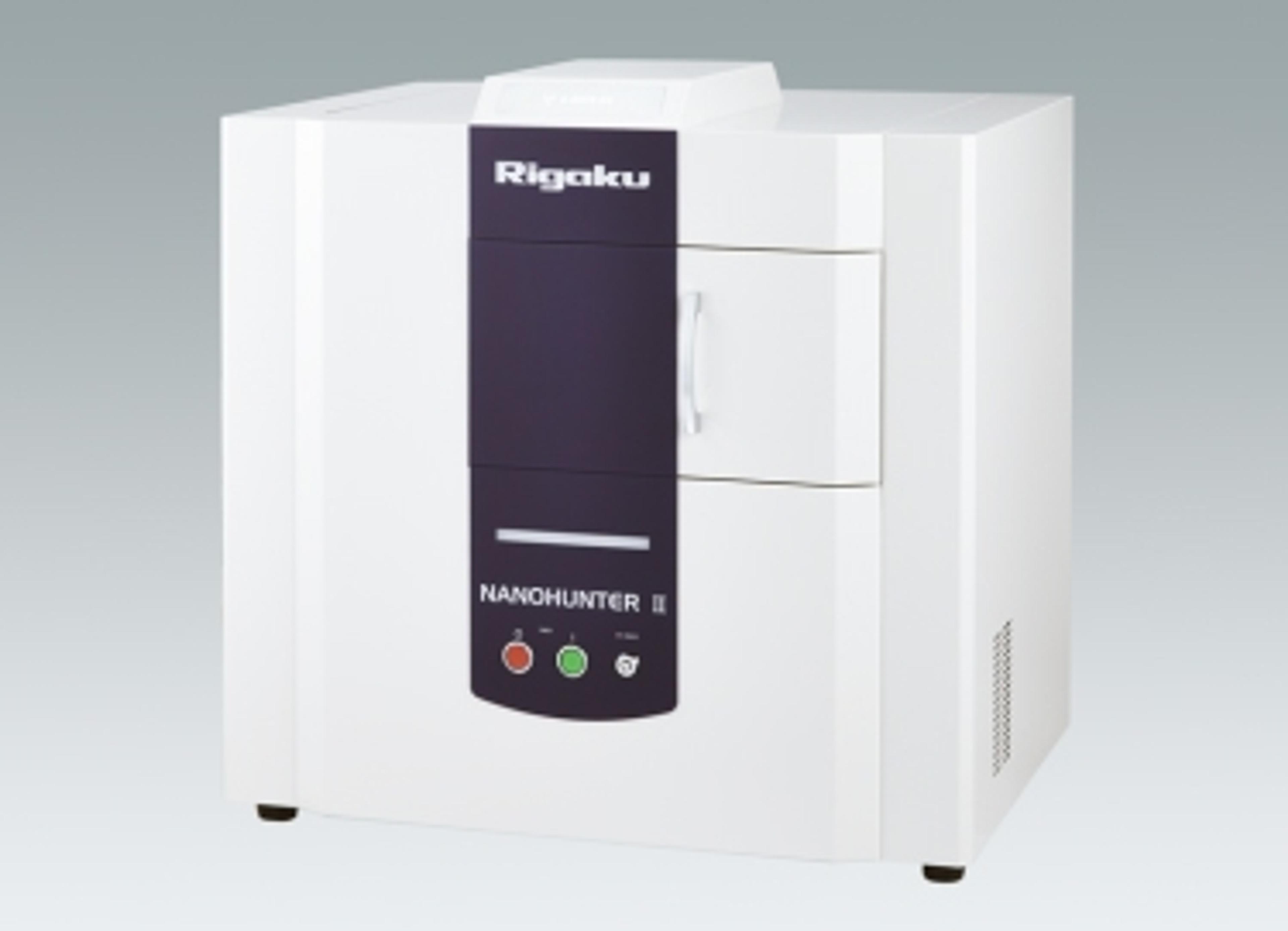
Rigaku Corporation has published of a brochure that describes the newly introduced Rigaku NANOHUNTER II benchtop total reflection X-ray fluorescence (TXRF) spectrometer. This eight-page document provides an overview of capabilities, basic specifications and application options.

Titled NANOHUNTER II - Total reflection X-ray fluorescence spectrometer, the document provides guidance for geologists, chemists, biochemists, biologists, materials scientists and engineers seeking state-of-the-art non-destructive ultra-trace elemental analysis solutions.

The original Rigaku NANOHUNTER benchtop spectrometer offered comprehensive trace element and materials characterization analysis capabilities to a broad range of research disciplines. The completely redesigned, next generation NANOHUNTER® II spectrometer features a number of advancements, including a high-power 600 W X-ray source, molybdenum (Mo) excitation for improved sensitivity, a newly developed mirror (optic) and a large-area silicon drift detector (SDD). It enables high-sensitivity ultra-trace elemental analysis, in liquids or on solid surfaces to the parts-per-billion (ppb) level, and offers over an order of magnitude (12X) greater X-ray tube power, along with a high-precision goniometer, enabling unparalleled high-sensitivity ultra-trace elemental analysis in both TXRF and grazing incidence X-ray fluorescence (GI-XRF) modes.

The new brochure features an overview of X-ray fluorescence and the principles of TXRF, and describes the unique capabilities of the system, including the detection of a wide range of elements - from Al (aluminum, atomic no. 13) to U (uranium, atomic no. 92) - and measurement of extremely small samples, along with its automated measurement functionality. An overview of applications for a range of sample types, along with essential product specifications, completes the brochure.

For more information about the the NANOHUNTER II TXRF spectrometer download the brochure here.
Links

Tags

X-Ray Diffraction and SpectroscopyX-Ray diffraction & spectroscopy are used in material characterization to discern the structure and elemental composition of a sample. X-Ray diffractometers (XRD) are superior instruments in elucidating the dimensional atomic structure of crystalline materials, including powders, thin films and single crystals. For large unit cells or ordered macromolecules, consider small-angle X-ray scattering (SAXS). X-ray spectroscopic techniques include X-ray fluorescence (XRF) and X-ray photoelectron spectroscopy (XPS), both providing simple and accurate methods for determining the elemental composition of a material. Energy dispersive (EDXRF) and wavelength dispersive (WDXRF) XRF spectrometers are available, as well as handheld/portable devices. High-resolution, 3D microstructure characterization of materials can be achieved with X-ray microscopes combining sub-micron resolution imaging with 3D computed tomography. Find the best XRD and XRF spectrometers in our peer-reviewed product directory: compare products, check customer reviews and receive pricing direct from manufacturers.X-Ray FluorescenceX-ray fluorescence (XRF) is an analytical technique used to determine the elemental composition of materials. It is widely used in geology, materials science, and environmental testing for detecting heavy metals and other elements. Browse our peer-reviewed product directory to find the best XRF systems, compare products, check reviews, and get pricing directly from manufacturers.Elemental AnalysisElemental analysis involves determining the elemental composition of a sample, often used in environmental, pharmaceutical, and material sciences. Techniques like ICP-MS, X-ray fluorescence, and atomic absorption spectroscopy allow precise quantification of elements such as metals and nonmetals in complex matrices. Browse our peer-reviewed product directory to find the best elemental analysis tools, compare products, check reviews, and get pricing directly from manufacturers.SpectrometrySpectrometry is a technique used to measure the mass-to-charge ratio of ions. It provides valuable information about the composition, structure, and molecular weight of compounds. Used across a variety of fields, including chemistry, biology, and environmental science, spectrometry is essential for identifying substances, analyzing mixtures, and developing new products. Explore the best spectrometry tools in our peer-reviewed product directory; compare products, check reviews, and get pricing directly from manufacturers.