
Ceres Nanosciences receives $8.2M NIH Award to improve wastewater-based COVID-19 surveillance
22 Apr 2021
Ceres Nanosciences, a privately held company that makes innovative products to improve diagnostic testing, has announced that it has been awarded a contract from the National Institutes of Health (NIH) Rapid Acceleration of Diagnostics (RADxSM) Initiative for $8.2 million to support the development and implementation of wastewater-based surveillance systems for COVID-19 powered by the Nanotrap® particle technology in a network of sites with an emphasis on underserved and vulnerable populations.
Wastewater surveillance can help communities monitor spatial and temporal trends in SARS-CoV-2 infection at a population level, but widespread implementation has been stymied by the lack of a sensitive, rapid, high-throughput viral concentration method. Nanotrap® Magnetic Virus Particles address this need by capturing and concentrating virus directly from raw sewage prior to RNA extraction and detection and can be readily adapted for small-scale as well as large-scale surveillance systems.
Ceres will work closely with a multidisciplinary team of scientists at Emory University to develop and implement a wastewater-based COVID-19 surveillance framework in the metro-Atlanta area with a focus on use cases for underserved and vulnerable populations, such as correctional facilities, low-income neighborhoods, and long-term care facilities.
“This collaboration between Ceres and Emory will generate robust evidence to support the CDC’s objective of developing a national wastewater surveillance system that meets the information needs of city, county, and state decision makers to effectively respond to the COVID-19 pandemic across multiple use cases in underserved community settings,” said Christine Moe, Eugene J. Gangarosa Chair in Safe Water and Sanitation at the Rollins School of Public Health at Emory University.
In parallel, Ceres will be identifying and launching a network of centers of excellence for high-throughput wastewater-based COVID-19 surveillance.
“Researchers from the University of California San Diego (UCSD) recently demonstrated a Nanotrap® particle high-throughput method for wastewater surveillance that can process more than 100 samples in a day with an ability to detect 1 asymptomatic infected individual in a building with 415 residents,” said Ben Lepene, CTO of Ceres Nanosciences. “We are very excited to identify additional sites around the country to implement similar approaches.”
This award builds on the $6.57 million RADxSM initiative award that Ceres received in 2020 to increase the manufacturing capacity of Ceres’ Nanotrap® Magnetic Virus Particles. Nanotrap® Magnetic Virus Particles improve diagnostic testing for respiratory viruses by eliminating the need for RNA extraction kits, reducing sample processing time, and improving the sensitivity of the downstream diagnostic assays in point-of-care settings and high-throughput laboratories.
This project has been funded in part by the NIH Rapid Acceleration of Diagnostics (RADxSM) initiative with federal funds from the National Institute of Biomedical Imaging and Bioengineering, National Institutes of Health. The current contract is funded from the Public Health and Social Services Emergency Fund through the Biomedical Advanced Research and Development Authority, HHS Office of the Assistant Secretary for Preparedness and Response, Department of Health and Human Services, under Contract No. 75N92020C00034.
For more of the latest science news, straight to your inbox, become a member of SelectScience for free today>>
Related products
Request Quote for All Products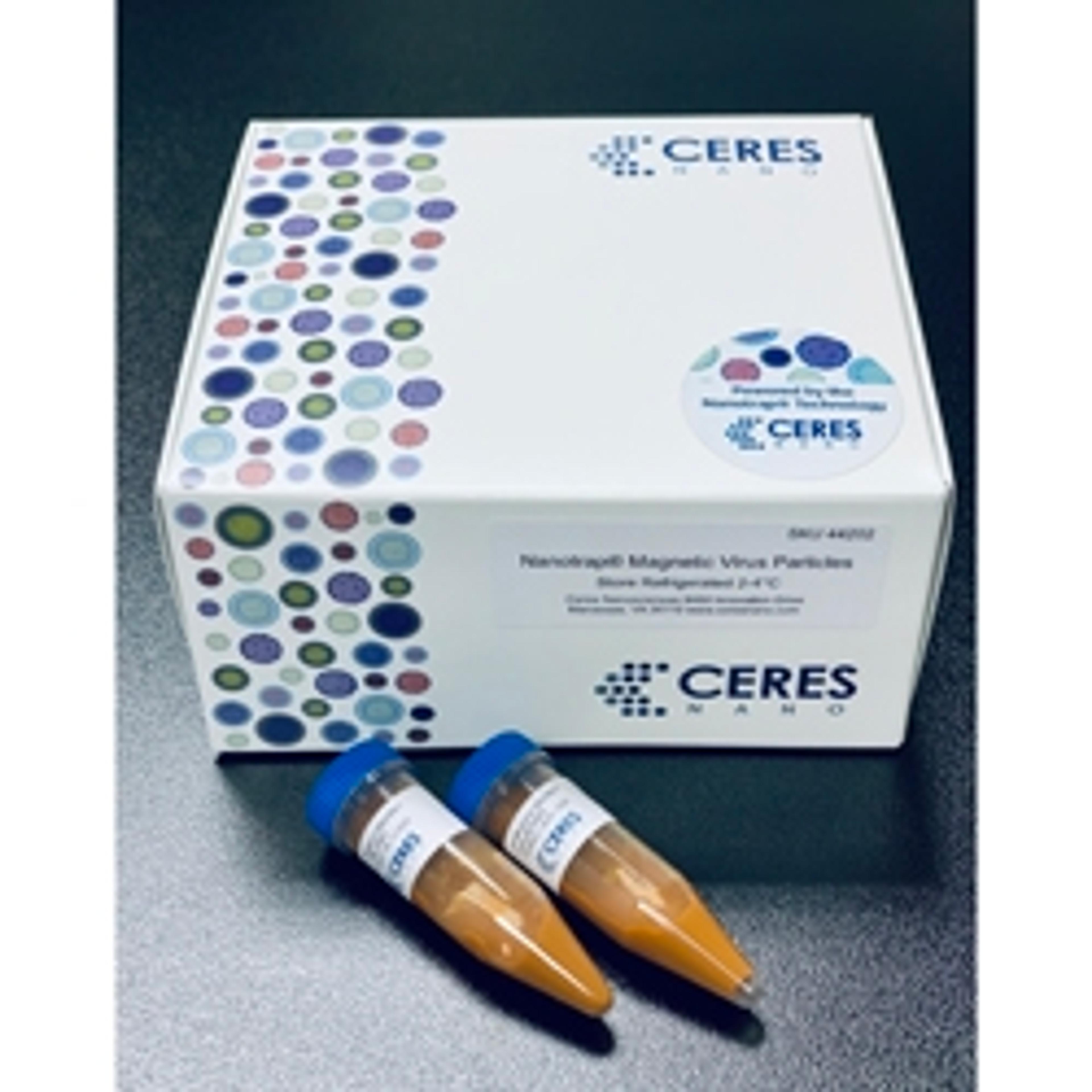
Nanotrap® Virus Particles
Ceres Nanosciences, Inc.2mL of Nanotrap ® Non-Magnetic Virus Particles (10 x 0.2 mL)