
Cancer Researchers Highlight Clinical Potential of Liquid Biopsy Using Droplet Digital PCR Technology
Bio-Rad’s Droplet Digital PCR (ddPCR)-powered liquid biopsy was presented during the 2019 American Association for Cancer Research (AACR) Annual Meeting in Atlanta
17 Apr 2019
New research demonstrating the clinical utility of Bio-Rad’s Droplet Digital PCR (ddPCR) powered liquid biopsy was presented during the 2019 American Association for Cancer Research (AACR) Annual Meeting in Atlanta, March 29–April 3. Many of the studies rely on the sensitivity, speed, and cost-effectiveness of ddPCR technology to measure blood-based tumor biomarkers in a reproducible way.
Cited in more than 900 liquid biopsy publications, ddPCR technology is often employed by cancer researchers and oncologists to track disease progression and determine therapy response, but it is yet to be ascertained whether changing therapies based on this timely information translates to improved patient outcomes. A large phase 3 study currently underway is addressing that question by analyzing circulating tumor DNA (ctDNA) in plasma using ddPCR technology. Below we highlight this study and other notable research that will be presented during this year’s AACR Annual Meeting.
Liquid biopsy could be superior to tissue biopsy in predicting breast cancer therapy response.
Sara Tolaney, MD, MPH, of the Dana-Farber Cancer Institute, and her collaborators used ddPCR technology in their investigation of the benefits of tracking drug-resistance mutations in the ctDNA of patients with hormone receptor–positive metastatic breast cancer.
In the phase 3 study, researchers measured mutations in two genes (PIK3CA and ESR1) implicated in drug resistance. Their study included 334 plasma samples and 434 archival tissue samples from 669 patients treated with either fulvestrant alone or fulvestrant plus abemaciclib. The researchers found a correlation between the presence of PIK3CA and ESR1 mutations and response to abemaciclib in ctDNA, but not in tissue samples. They also found that while the addition of abemaciclib was beneficial for all patients, those with PIK3CA and ESR1 mutations benefited more.
“These findings lend support to the use of ctDNA and liquid biopsies to identify molecular alterations that could help inform treatment choices,” Tolaney said.
The next step is validating these data in prospective clinical trials.
ctDNA could be a predictor of surgery success for malignant pleural mesothelioma
Malignant pleural mesothelioma (MPM) is an aggressive, but relatively rare, tumor associated with asbestos exposure. Most patients with MPM are over 70 years old, so surgery can be risky and may not improve outcomes. Luke Martinson, PhD, of the University of Leicester, and his colleagues conducted a proof-of-principle study to understand the potential use of ctDNA as a prognostic biomarker for surgical success for these patients.
The scientists compared genetic differences between tumor and normal tissue in 11 patients with MPM and developed a ddPCR assay that could detect MPM-specific ctDNA. Next, they tested patient blood samples collected before surgery. Results showed that patients with MPM-specific ctDNA had a worse prognosis after surgery.
“Detection of ctDNA requires highly sensitive methods and ddPCR technology was ideally suited to help us answer the question of whether or not the ctDNA status was informative of patient survival,” said Martinson.
The researchers hope to confirm the preliminary findings with a larger cohort. If validated, ctDNA would represent one of the few known prognostic markers for MPM.
Detecting therapy resistance in HER2-negative breast cancer
Continuing work presented at last year’s American Society of Clinical Oncology annual meeting, researchers are examining whether changing therapies may be effective for patients with advanced breast cancer when mutations are detected in their ctDNA. This is the first large-scale effort to monitor resistance mutations and personalize breast cancer therapy in real time, according to François-Clément Bidard, MD, PhD, of the Institut Curie, Paris, the study’s author.
This phase 3 clinical trial, run in more than 80 French cancer centers, has enrolled 1,000 patients with estrogen receptor–positive, HER2-negative metastatic breast cancer who were treated with endocrine therapy. Using ddPCR based liquid biopsy tests — done both before and during treatment — the researchers are tracking the emergence of ESR1 mutations linked to endocrine therapy resistance. While the study is still ongoing, preliminary results indicate that ddPCR technology can rapidly detect the presence of ESR1 mutations.
“Droplet Digital PCR is the only cost-effective solution that enables us to track the onset in real time of ESR1 mutations in thousands of serial ctDNA samples,” said Bidard.
If this study determines that switching patients with ESR1 mutations to a new treatment is more effective, ddPCR could potentially be applied in the clinical setting to continually monitor patients and help physicians know when to make that switch.
Related products
Request Quote for All Products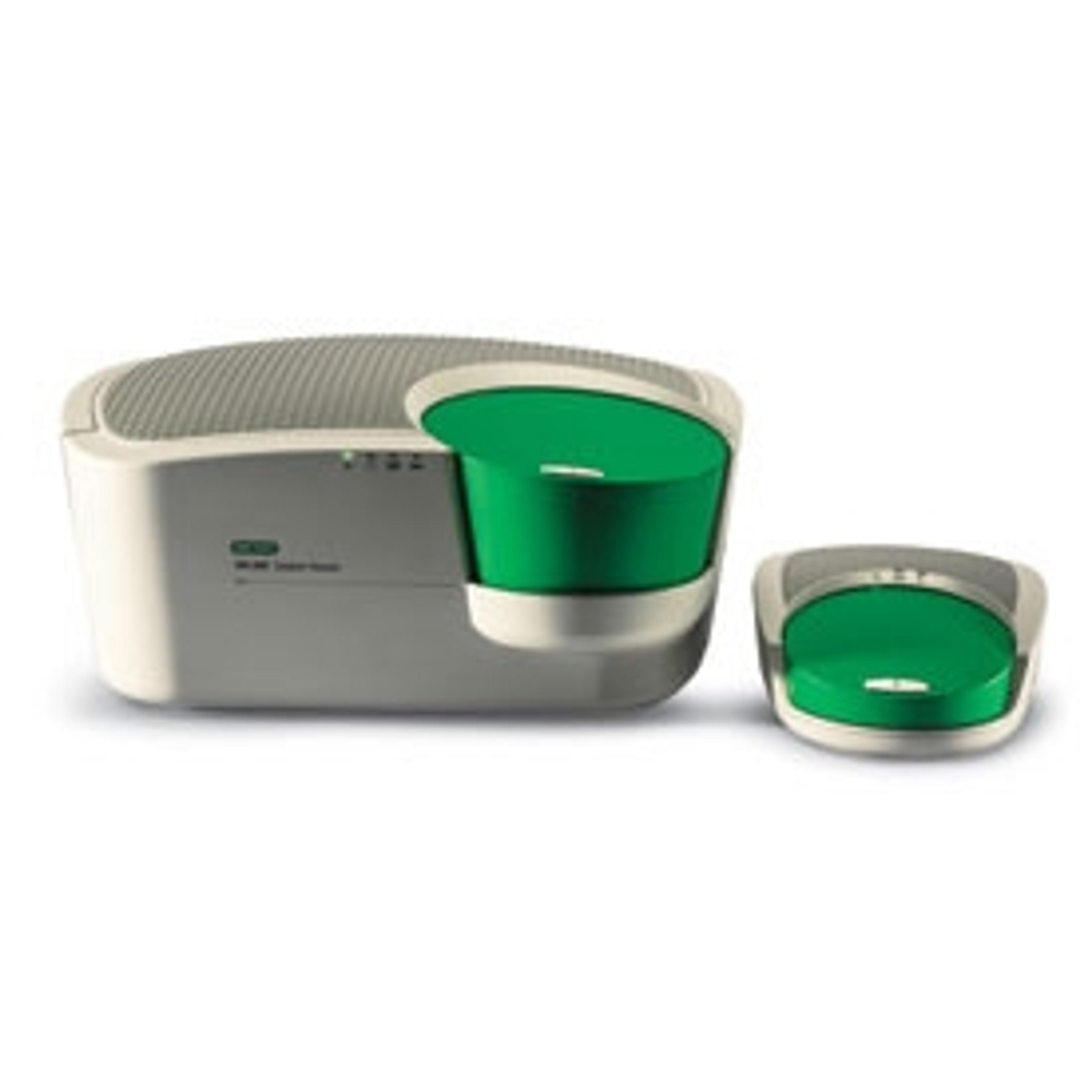
QX200™ Droplet Digital PCR System
Bio-RadDroplet Digital PCR System, includes droplet generator, droplet reader, laptop computer, software, associated component consumables, for EvaGreen or probe-based digital PCR applications