BioTek Announces New Epoch™ 2 Microplate Spectrophotometer

3 Jan 2019

Finn Price
Administrator / Office Personnel

Product news

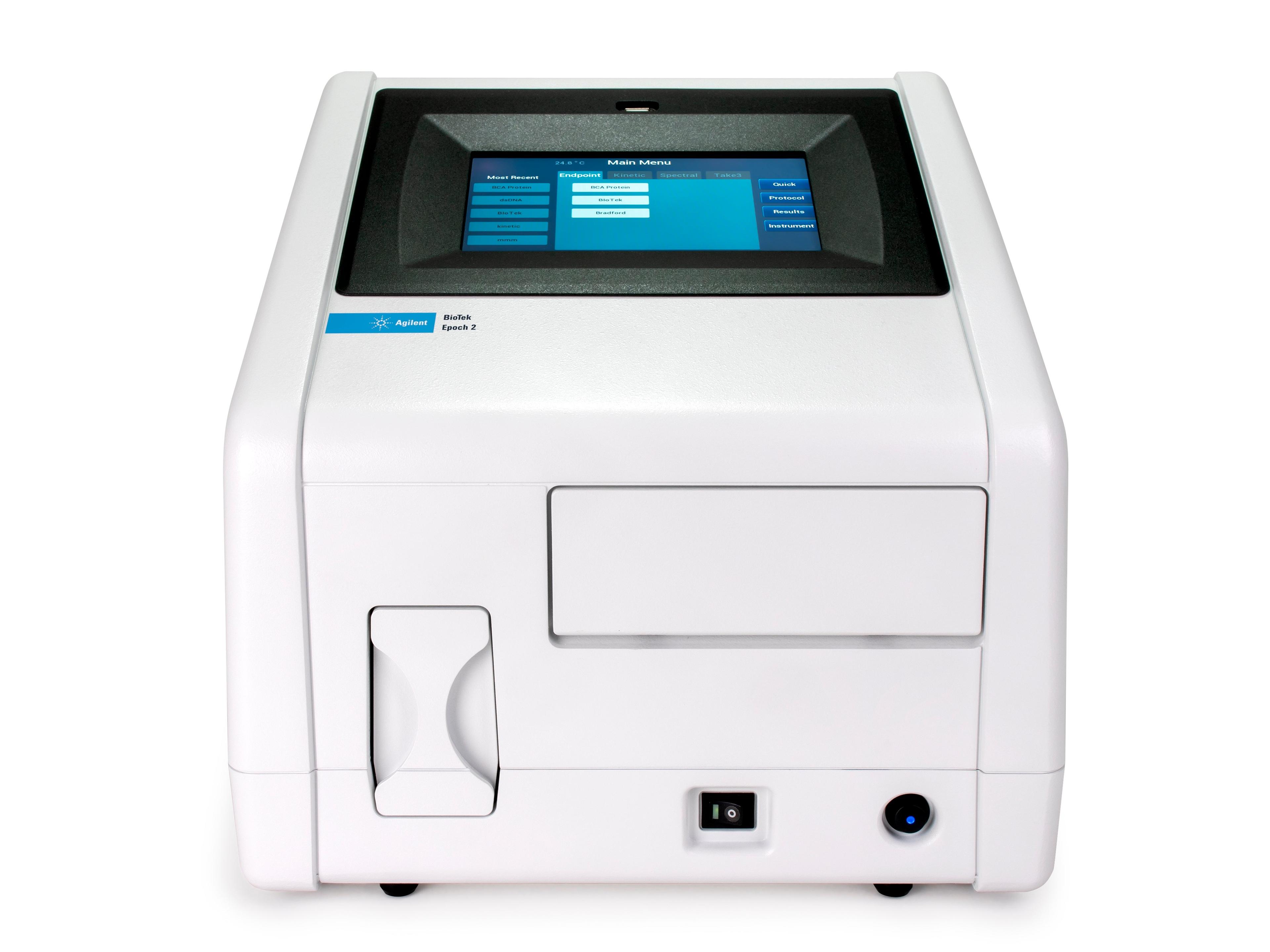
BioTek Instruments introduces their next generation Epoch™ 2 Microplate Spectrophotometer; with added features that enable multiple conveniences for performing absorbance measurements. Epoch 2 now includes monochromator-based individual wavelength selection or wavelength scanning from 200-999 nm to accommodate an extensive range of assays, including nucleic acid and protein quantification, ELISA, microbial growth, endotoxin, ROS assays and enzyme kinetics.

The new onboard software in Epoch 2 eliminates the need for a separate computer and includes predefined common protocols for rapid assay setup and recall. Custom protocol definition, storage and selection are easily accomplished via the optional color touchscreen interface. Endpoint, kinetic and spectral scanning applications are all available from the touchscreen; data can be output to a USB flash drive or printer.

Epoch 2 is compatible with 6- to 384-well microplates and cuvettes as well as BioTek’s Take3™ Micro-Volume Plate for dilution-free nucleic acid quantification in volumes as low as 2 µL. Advanced shaking profiles include linear, orbital and double orbital, and 4-Zone™ incubation to 65 ºC and Condensation Control™ facilitate temperature-sensitive assays. Epoch 2 is compatible with BioTek’s BioStack™ Microplate Stacker and BioSpa 8™ Automated Incubator as well as third-party systems for complete workflow automation.

Do you use any of the above technology from BioTek Instruments? Tell us what you think in a review for your chance to win a $400 Amazon.com Gift Card

Links

Tags

Microplate Readers / DetectorsMicroplate readers are used to automate the detection and analysis of labeled or label-free components in microplates during assays or live-cell monitoring. Microplate readers are generally distinguished by their mode of detection. Types include absorbance, luminescence, fluorescence intensity, fluorescence polarization, TRF / FRET and multimode microplate readers. Microplate readers deliver a high throughput of samples by reading multiple wells simultaneously, with the 96-well format the most commonly used. As a result, microplate readers are often used in the drug discovery, bioassays, research and pharmaceutical industries for screening applications. Microplate loading can also be automated, with robotic microplate stackers to increase throughput. Find the best microplate readers in our peer-reviewed product directory: compare products, check customer reviews and receive pricing direct from manufacturers.SpectroscopySpectroscopy is a technique that analyzes the interaction of light with matter to study molecular properties, concentrations, and structural information. Widely used in chemical, pharmaceutical, and environmental analysis, spectroscopy offers insights into molecular composition and helps identify unknown compounds. It plays a key role in quality control, research, and diagnostics. Browse our peer-reviewed product directory to compare spectroscopy tools, read reviews, and get prices directly from manufacturers.Cell Based AssaysCell-based assays use living cells to measure biological responses to various treatments or stimuli. They are essential for drug discovery, toxicology testing, and understanding cellular mechanisms. These assays are used to assess cell viability, proliferation, gene expression, and other cellular activities. Browse our peer-reviewed product directory to find the best cell-based assay tools and reagents, compare products, read customer reviews, and get pricing directly from manufacturers.Cell CultureCell culture involves growing cells under controlled conditions, typically outside of their natural environment, to study cellular behavior, drug response, and disease models. Cell culture is crucial in biotechnology and biomedical research. Explore cell culture products in our peer-reviewed product directory; compare products, check reviews, and get pricing directly from manufacturers.SpectrophotometrySpectrophotometry is a technique used to measure the absorption or transmission of light through a sample. It is commonly used in chemical analysis, environmental monitoring, and quality control. Explore spectrophotometry tools in our peer-reviewed product directory; compare products, check reviews, and get pricing directly from manufacturers.ELISA