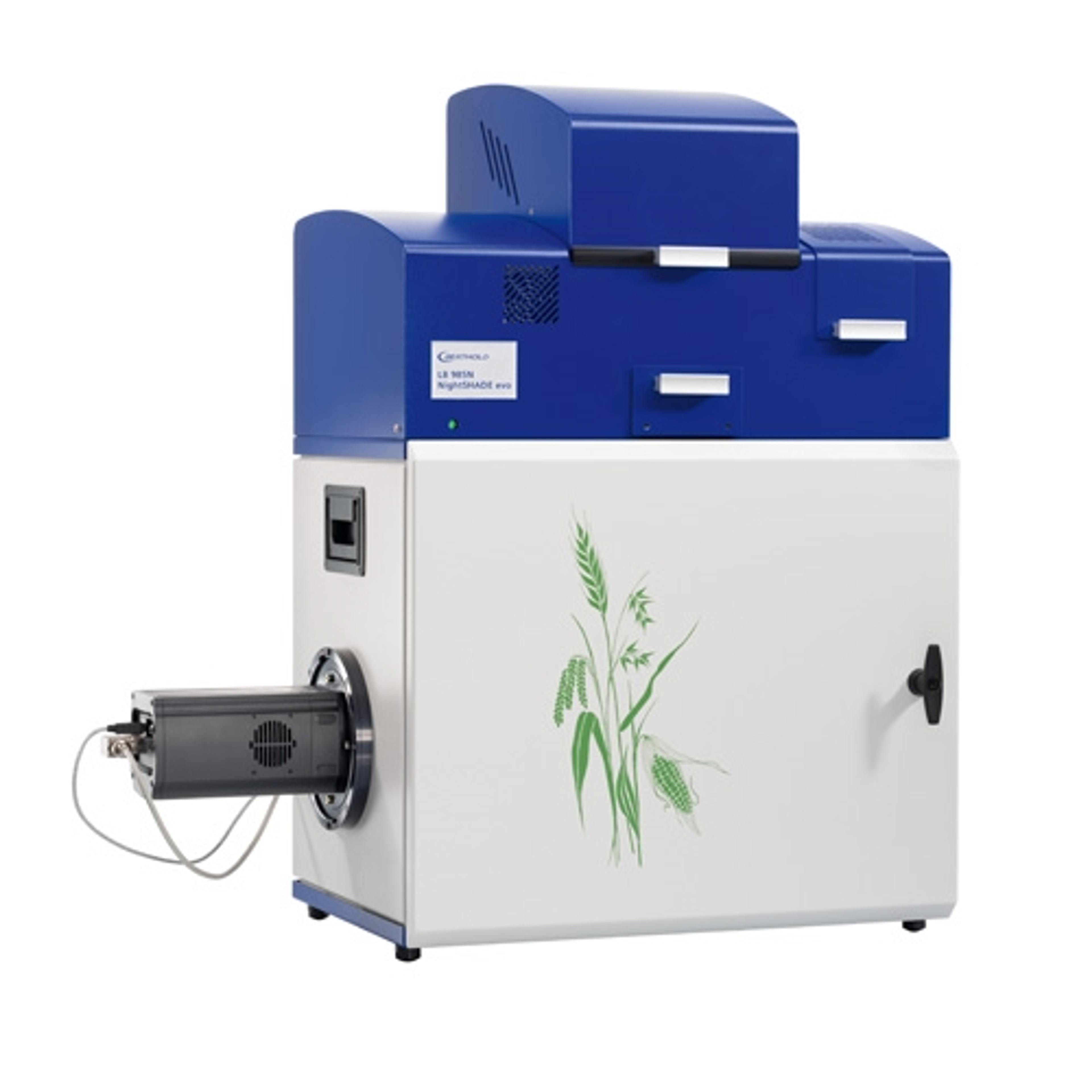
BERTHOLD Introduces the Improved NightSHADE Imaging System

30 Jun 2013

Sarah Thomas
Associate Editor

Product news

The NightSHADE has been released with new features and improvements based on feedback from users throughout the world.

BERTHOLD’s NightSHADE is a modular plant imaging system for monitoring luminescence and fluorescence in tissues, seedlings and whole plants. Housed in an absolutely light-tight darkroom its heart is a cooled CCD camera which can be mounted on top or at the side.

Low level luciferase bioluminescence and chemiluminescence from luminol enhanced reactive oxygen species can be monitored as well as GFP and other fluorescent dyes. With the NightSHADE BERTHOLD offer a plant imaging system ideally suited for today´s and tomorrow´s applications such as monitoring gene expression and circadian rhythm with reporter genes, observation of plant growth, examination of stress tolerance, measuring of delayed fluorescence and drug screening in plants.

New features and improvements

- Motorized emission filter wheel (and motorized excitation slider) – quicker and more flexible filter change, e.g. for dual reporter gene expressing samples

- 1.4 megapixel camera with high sensitivity for basic luminescence and sensitive fluorescence measurements – an extremely economic but powerful solution for fluorescence and luminescence imaging

- Modular lens system for quick lens change together with a new 50mm macro lens for high quality close ups while maintaining sensitivity

- Focusing device outside the dark box – higher level of usability when working with changing sample sizes for focusing levels

- Dual photo illumination using white or infrared LEDs located at an improved illumination position for clearer photographic images

New indiGO software features

- Batch TIFF export to allow using the image data with external software (including meta data)

- Optimized LED panel handling with status display in task bar

- Improved speed when working with live preview. X-Y table support for multi position measurements

Links

Tags

High-Throughput ScreeningHigh-throughput screening (HTS) is an automated drug discovery technique for identification of active compounds against a compound library. Use HTS readers and integrated assay preparation / analysis workstations to screen your compounds. Identify active compounds against various HTS libraries, including membranes, proteins and peptides and HTS cell lines. Find the best high-throughput screening products in our peer-reviewed product directory: compare products, check customer reviews and receive pricing direct from manufacturers.Gel Doc / Image AnalysisGel documentation (gel doc) or gel imaging systems are used for the analysis of proteins, antibodies and nucleic acid immobilized in polyacrylamide or agarose gels, membranes or microarrays. Explore a range of a gel imaging systems, densitometers, scanners, transilluminators or UV lamp + CCD cameras for your image analysis solutions. Colorimetric, fluorescent and/or radioisotopic samples can be visualized and documented for further analysis. See gel doc / Image analysis software for quantitative 1D and 2D analysis of your samples. Find the best gel doc / image analysis products in our peer-reviewed product directory: compare products, check customer reviews and receive pricing direct from manufacturers.In Vivo Imaging Systems<i>In vivo</i> imaging systems, including pre-clinical imaging systems and medical imaging systems are used to non-invasively visualize and capture images of live animals and plants. Monitor the natural processes or diseases of your subjects using small-animal pre-clinical imaging systems, including single photon positron emission tomography (SPECT), positron emission tomography (PET), computed tomography (micro-CT), magnetic resonance imaging (MRI), X-ray radiography, ultrasound, fluorescence and bioluminescence imagers. Multimodal systems and software solutions are also available for correlative analysis of organ, tissue, cell, or molecular-level processes. Find the best in vivo imaging products in our peer-reviewed product directory: compare products, check customer reviews and receive pricing direct from manufacturers.ImagingImaging techniques are essential for obtaining visual representations of samples to understand structures, processes, and function in biological, chemical, and physical research. These tools range from traditional light microscopy to advanced imaging modalities like MRI and electron microscopy, providing researchers with valuable data for diagnostics, drug discovery, and material analysis. Explore imaging solutions in our peer-reviewed product directory to compare products, check reviews, and get pricing directly from manufacturers.Plant SciencePlant science studies the biology of plants, including genetics, physiology, ecology, and biotechnology. Research in this field is essential for improving crop yields, disease resistance, and sustainability. Explore plant science tools in our peer-reviewed product directory; compare products, check reviews, and get pricing directly from manufacturers.LuminescenceLuminescence techniques detect and measure light emitted by substances during chemical reactions or biological processes. Widely used in assays for diagnostics, environmental monitoring, and drug screening, luminescence-based methods offer high sensitivity. Explore leading systems and products in our directory.