
Beckman Coulter and Scopio Labs partner to accelerate adoption of hematology digital cell morphology platform
Beckman Coulter, a global leader in clinical diagnostics, and Scopio Labs, a medtech company that develops AI-powered workflow solutions, has announced a worldwide partnership to accelerate adoption of Scopio’s next generation peripheral blood smear platforms
27 Jul 2022
Scopio’s technology employs Full-Field imaging and AI decision support to truly eliminate manual microscopy, while providing laboratory professionals and clinicians a true workflow benefit. With simple-to-use remote viewing, the Scopio solutions simplify lab operations and improve workflow in a distributed network. High resolution full-field images can now be shared in real time over a secure hospital network – no more slides being shipped between locations.
“In today’s busy laboratory environment, manual operations are a strain on precious resources,” said Dr. Peter Soltani, senior vice president & general manager at Beckman Coulter. “Scopio enables fast digital capture of a wide field of view of a smear, from the feathered edge to the monolayer. By leveraging computational photography, Scopio generates a high resolution, full-field image of the sample including a large scan area and the smallest details. This is a leap in digital morphology capabilities, and with easy and secure remote viewing, can help laboratories significantly reduce manual labor burden, while improving turnaround time. A powerful AI-driven decision support solution also speeds interpretation and reporting of results. We are excited to partner with Scopio Labs to bring cutting edge digital peripheral blood smear analysis and the use of AI decision support to our customers, continuing our push to innovate and solve everyday problems for the lab.”
“As 70% of all medical decisions depend on laboratory test results , it’s crucial that diagnostic excellence and innovation are placed at the forefront of healthcare,” said Itai Hayut, CEO and cofounder of Scopio Labs. “It is an honor to partner with Beckman Coulter, the pioneers of automated hematology testing and a known industry innovator, to accelerate the digital transformation of hematology laboratories worldwide. By introducing digitalization to Peripheral Blood Smear review at scale, Scopio completes a crucial piece of the puzzle. This partnership is a vote of confidence in our Full-Field cell morphology imaging and AI-powered analysis platform as the market’s new standard – we’re moving away from snapshots of individual cells and into end-to-end digitalization.”
With the increasing worldwide attention of hematological disorders and malignancies, the accuracy and timeliness of Peripheral Blood Smear (PBS) results are critically important for early diagnosis and effective treatment initiation. The peripheral blood smear review is a powerful diagnostic tool that provides clinicians information about a variety of disorders such as blood related cancers, anemia, infections, and many other life-threatening medical conditions. The majority of these tests are performed manually, but Scopio's disruptive Full-Field Peripheral Blood Smear™ morphology solution completely eliminates the need for additional manual microscopic examination.
In manual microscopy, users must choose between a large field of view or high resolution. Scopio's devices eliminate that tradeoff completely, capturing large scan areas at 100X magnification. Holding 30 slides and processing up to 40 samples an hour, Scopio's X100HT can meet the high throughput requirements of large hospitals and labs, while fully supporting remote review capabilities, enabling a new subfield of tele-hematology. Hospital and lab networks can now operate seamlessly across multiple facilities of all sizes, with workload balancing, remote consultations, addressing personnel shortages, and more.
In May, Scopio Labs received U.S. Food and Drug Administration 510(k) clearance of its X100HT device with PBS Application coupling high throughput capabilities with high resolution scanning for hematological analysis. Catering to large medical facilities and labs across the world, the X100HT complements the previously cleared X100 instrument designed with a 3-slide tray and a throughput of up to 15 slides an hour for a 200 WBC Diff, making it an optimal solution for small to medium size laboratories.
Want the latest science news straight to your inbox? Become a SelectScience member for free today>>
Related products
Request Quote for All Products
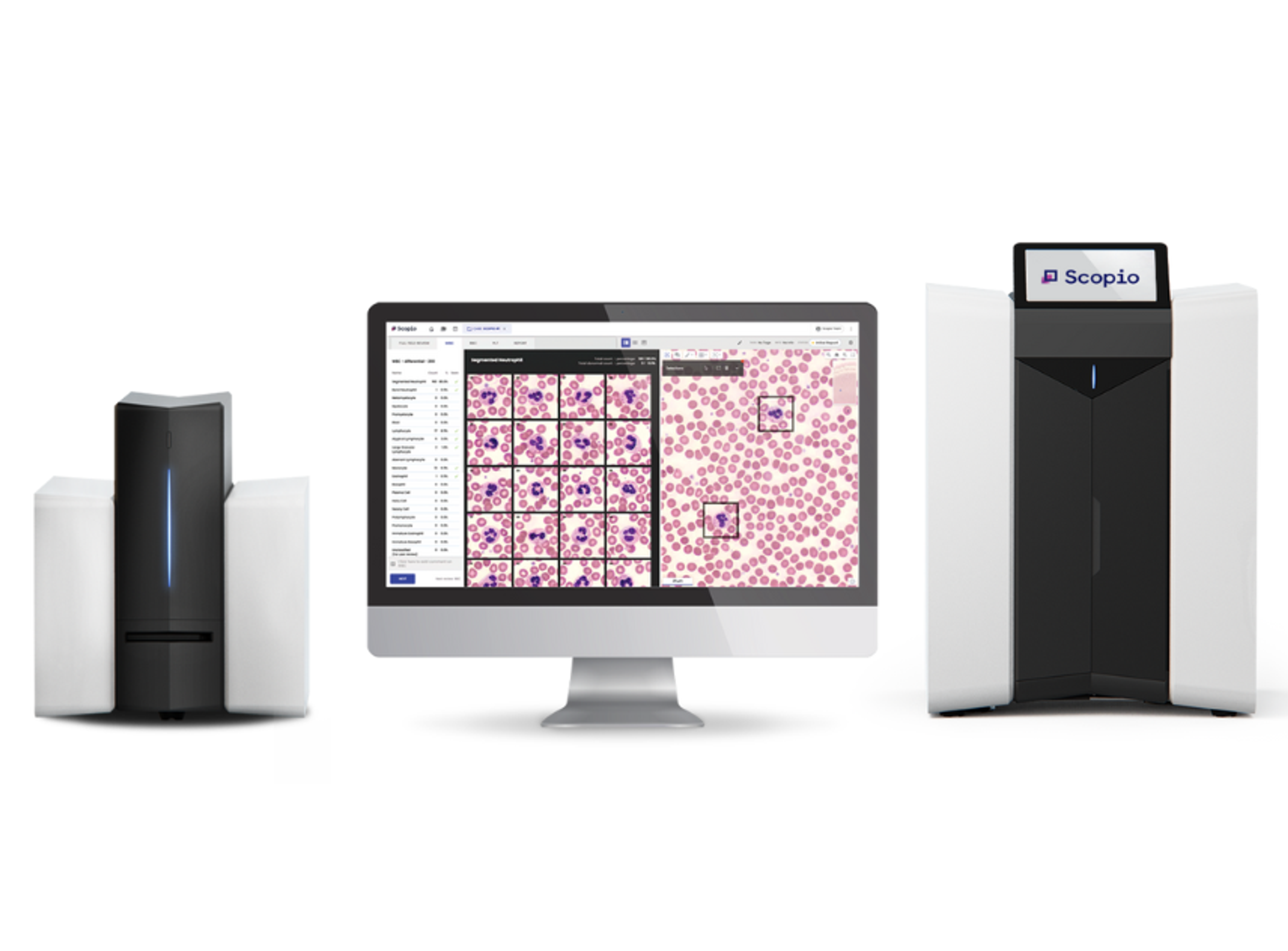
Scopio Labs X100 & X100HT Digital Morphology Solution
Beckman Coulter DiagnosticsFull-Field Digital Cell Morphology