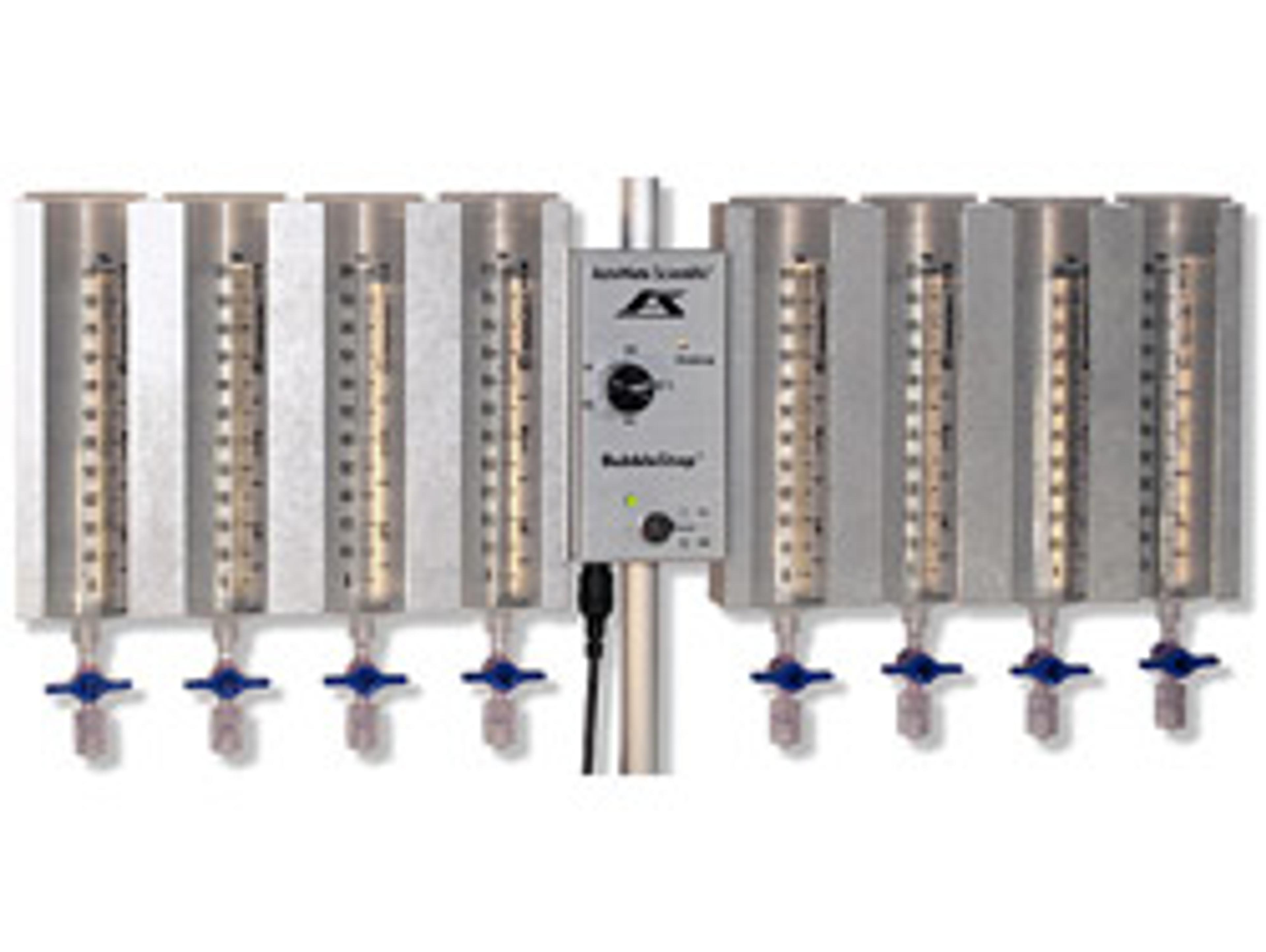
AutoMate Scientific Introduces the New BubbleStop™ Syringe Heater

8 Mar 2011
bridget bridget
Laboratory Director

Product news

Stop bubbles in your tubing - AutoMate Scientific introduces the new BubbleStop™ Syringe Heater

Bubbles in perfusion systems are caused by solution temperature changes. As solutions warm, they cannot hold as much gas, so they off-gas. This forms bubbles in perfusion tubing. It is especially true in inline heaters where the temperature rises dramatically.

The best cure for bubbles is to pre-warm your solutions. AutoMate Scientific introduces the BubbleStop™ Syringe Heater with integrated temperature feedback. Set the temperature on the BubbleStop a few degrees higher than room temperature or your inline heater, and the warmed solutions will off-gas in the reservoirs – not in your tubing.

Available in gravity and pressurized configurations with 35 ml or 60 ml syringe reservoirs.

Low noise for electrophysiology. Don't let another bubble slow you down.

For more information visit the company article page.

BubbleStop4 60ml Syringe Heater - Gravity

AutoMate Scientific Inc.

Bubbles in perfusion systems are caused by solution temperature changes. As solutions warm, they cannot hold as much gas, so they off-gas. This forms bubbles in perfusion tubing. It is especially true in inline heaters where the temperature rises dramatically. The best cure for bubbles is to pre-warm your solutions. AutoMate Scientific introduces the BubbleStop™ Syringe Heater with integrated temperature sensor and feedback. Set the temperature on the BubbleStop a few degrees higher than room temperature or your inline heater, and the warmed solutions will off-gas in the syringe reservoirs to the maximum gas concentration for that temperature. Even if they cool and re-heat again inside the perfusion tubing, they will not off-gas.• Easy to remove full syringes • Analog heating power - low noise for electrophysiology • Completely shielded electronics plus external power supply • Spill-proof design • Range: ambient to 50°C liquid temperature• Mounts to standard 1/2" rod• Includes syringes and stopcocks
(0)

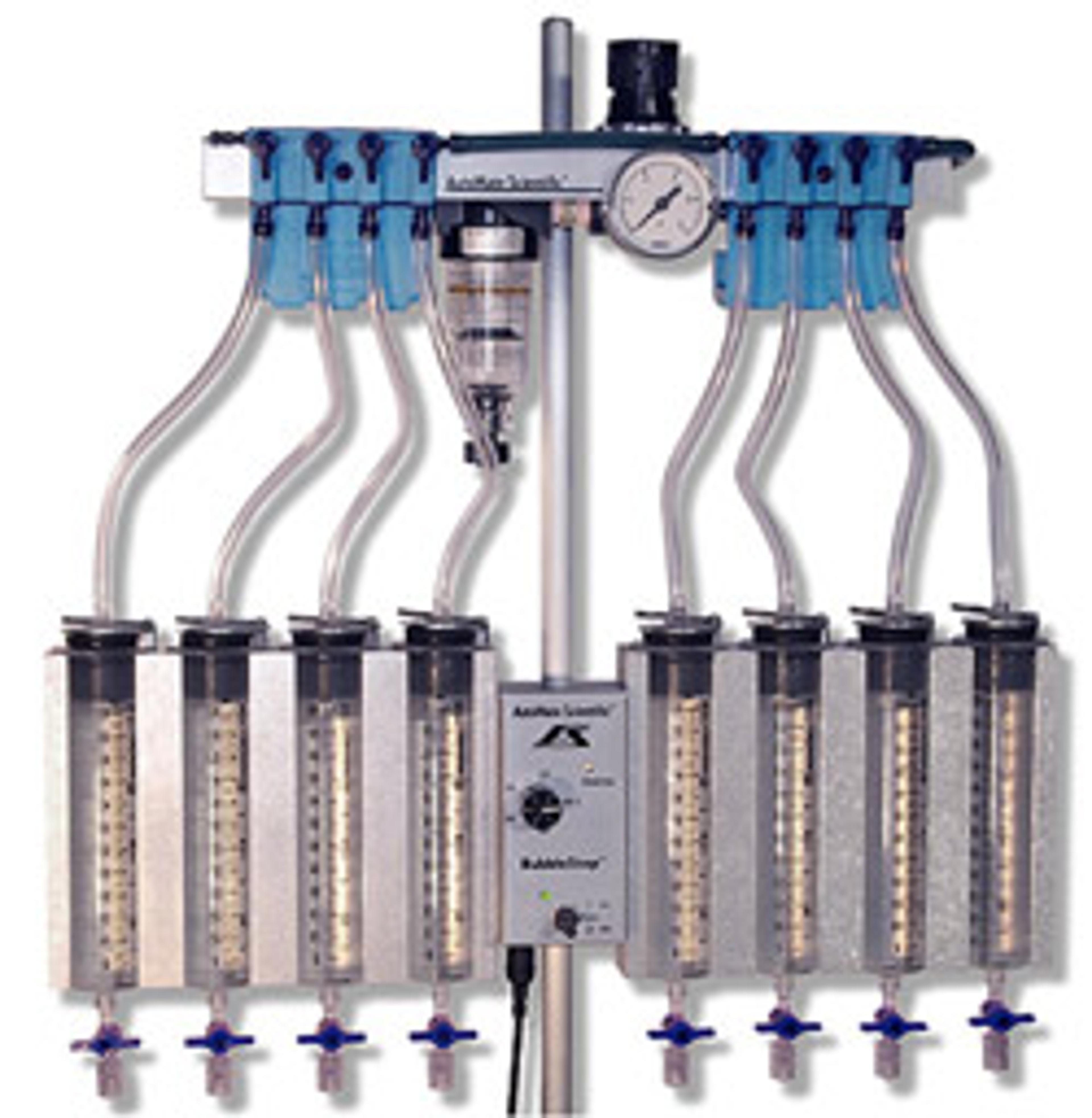
BubbleStop8 60ml Syringe Heater - Pressurized

AutoMate Scientific Inc.

Bubbles in perfusion systems are caused by solution temperature changes. As solutions warm, they cannot hold as much gas, so they off-gas. This forms bubbles in perfusion tubing. It is especially true in inline heaters where the temperature rises dramatically. The best cure for bubbles is to pre-warm your solutions. AutoMate Scientific introduces the BubbleStop™ Syringe Heater with integrated temperature sensor and feedback. Set the temperature on the BubbleStop a few degrees higher than room temperature or your inline heater, and the warmed solutions will off-gas in the syringe reservoirs to the maximum gas concentration for that temperature. Even if they cool and re-heat again inside the perfusion tubing, they will not off-gas.• Easy to remove full syringes • Analog heating power - low noise for electrophysiology • Completely shielded electronics plus external power supply • Spill-proof design • Range: ambient to 50°C liquid temperature• Mounts to standard 1/2" rod• Includes syringes and stopcocks

(0)

Links

Tags

Cell / Tissue CultureCell culture or tissue culture is used to study the biology of cells or tissues and to isolate cellular products in an environment which can be manipulated and well defined. Accurately control your culture environment with bioreactors or culture incubators, bind your cells to a surface or together with an extracellular matrix. Distinguish cell types with differential media or proliferate cells with certain characteristics using selective media. Enrich your media with supplements such as growth factors, sera and vitamins. Find the best cell and tissue culture products, kits and equipment in our peer-reviewed product directory: compare products, check customer reviews and receive pricing direct from manufacturers.Genome AnalysisGenomics, the study of genomes, includes functional genomics, evolutionary genomics and comparative genomics. There are many genomic technologies such as DNA sequencing of whole genomes, computational biology and bioinformatics. DNA and nucleic acids must be isolated and concentrated from cells for analysis with kits, automated analyzers and software. Other useful technologies for studying genomics include PCR, microarrays and electrophoresis.ProteomicsProteomics is the systemic bioinformatics study of proteins and amino acids, including their structure, size, function and identification. Tools used in proteomics include chromatography, blotting and gels, protein arrays, mass spectrometry and ELISA and associated analysis software. Analyzers and proteomic systems should be sensitive, high resolution, fast and may be automated for high-throughput.High-Throughput ScreeningHigh-throughput screening (HTS) is an automated drug discovery technique for identification of active compounds against a compound library. Use HTS readers and integrated assay preparation / analysis workstations to screen your compounds. Identify active compounds against various HTS libraries, including membranes, proteins and peptides and HTS cell lines. Find the best high-throughput screening products in our peer-reviewed product directory: compare products, check customer reviews and receive pricing direct from manufacturers.Cell Lines Stem Cells and Primary CellsPrimary cell cultures, established cell lines and stem cells are vital for <i>in vitro</i> and <i>ex vivo</i> experimentation. High-quality cells, optimized for your applications, alongside optimized cell substrates, growth medium and supplements, are critical for experimental success. Explore a range of cells suitable for your applications, including isogenic cell lines, competent cells, induced pluripotent stem cell (iPSC)-derived cell lines, fungal/bacterial/mammalian cell lines, stem cells and cancer cell lines. Find the best cells for your research in our peer-reviewed product directory: compare products, check customer reviews and receive pricing direct from manufacturers.Cell-Based AssaysCell-based assays are used to monitor the presence, quantity and activities of a desired cellular analyte including drug molecules or biomarkers. This can reveal information on cell health (apoptosis, cytotoxicity, viability and proliferation assays), cell metabolism, cell migration and cell signaling mechanisms. Find the best cell-based assay products, kits and equipment with our peer reviewed product directory: compare products, check customer reviews and receiving pricing direct from manufacturers.High-Content ScreeningHigh-content screening (HCS), also known as high-content analysis (HCA), is a high-throughput technique used in drug discovery to identify substances that alter the phenotype of cells. HCS uses fluorescent microscopic imaging and automated image analysis to investigate cellular events such as apoptosis, cell viability, GPCR activation, oxide production, neurite outgrowth, and cell signaling. Find the best fluorescent labeling reagents, cellular assays, and high-content imaging systems in our peer-reviewed product directory: compare products, check customer reviews and receive pricing direct from manufacturers.Gene Expression and Molecular CloningMolecular cloning is a set of techniques that utilizes vectors to transfer recombinant DNA into host cells and is an essential tool for investigating the expression of genes and proteins in bacterial or mammalian cells. A variety of vectors optimized for gene cloning and expression in a range of host organisms are available, alongside competent cells for genetic replication. Here, you can explore a range of molecular tools, high-quality genomic and cDNA libraries, premade clones, transformation and transfection reagents and mutagenesis or gene expression detection assays and expression arrays. Find the best gene expression and molecular cloning products in our peer-reviewed product directory: compare products, check customer reviews and receive pricing direct from manufacturers.ElectrophysiologyElectrophysiology is the study of biological voltage changes, from a single ion channel through to a whole organ scale. Voltages can be measured using patch clamping, automated workstations, electrophysiology rigs or cell based assays. Specific cell lines, manipulators and microinjectors are also available for electrophysiology research.
AutoMate Scientific Introduces the New BubbleStop™ Syringe Heater