
Andor Launches the World’s First Super-Resolution Microscopy Camera
6 Jul 2017Andor Technology, an Oxford Instruments company and leader in scientific imaging and spectroscopy solutions, has announced the launch of a new super-resolution microscopy technology, available on single photon sensitive iXon EMCCD cameras.
‘SRRF-Stream’ unlocks real time super resolution fluorescence microscopy on most modern microscopes, using conventional fluorophores at low illumination intensities, thus making it highly compatible with live cell imaging. A resolution improvement from 2- to 6-fold (50-150nm final resolution) can be expected for most datasets.
Adopting the recently developed SRRF (pronounced ‘Surf’) technology from the lab of Dr Ricardo Henriques, Quantitative Imaging and Nanobiophysics Group, University College London (UCL), and working in close collaboration with Dr Henriques, Andor have enhanced the technology to run optimally on iXon EMCCD cameras. Andor is also expert in advanced GPU processing optimization techniques, employed in this instance to execute the SRRF algorithm up to 30x faster than the existing ImageJ-based post processing implementation of SRRF. This significant acceleration enables workflow enhancement, by allowing data acquisition and SRRF processing to operate in parallel. Since processing is faster than the camera can acquire data, SRRF-Stream now accomplishes real time super-resolution, with large field of view super-resolution images. An EMCCD full field of view super-resolved image can be readily generated at a rate of > 1 Hz, easily pushing up to > 10 Hz through use of smaller ROI sizes. Regarding image acquisition software, SRRF-Stream is readily available to SDK users and has also been made compatible with the MicroManager (Open Imaging) open source microscopy software platform.
Dr Colin Coates, Andor’s Imaging Product Manager, said; “Andor has a shared vision with that of the Henriques lab, which is to make super-resolution microscopy widely and easily accessible to all. SRRF-Stream makes a significant leap in that direction, working extremely well with standard widefield, TIRF and spinning disk confocal modalities. The combination of SRRF-Stream and Andor’s recently release iXon Life EMCCD represents a highly cost-effective way to unlock powerful super-resolution from existing conventional fluorescence microscopes.”
Dr Ricardo Henriques commented; “We are delighted to partner with Andor in the SRRF-Stream development. We have received a lot of very positive comments about SRRF due to the fact that it can achieve remarkable resolution without requiring specialized photo-switchable fluorophores, and with light levels of approximately 106 times lower than that required by standard localisation-based super-resolution techniques. We are extremely excited to see SRRF-Stream operating in real time, rather than as post-processing. Having thoroughly tested SRRF-Stream in our own lab, we are very impressed by both the workflow and also the ability to now utilise larger fields of view for live cell super-resolution. By seamlessly combining the SRRF algorithm with the high-performance of the iXon, we have accomplished the world’s first super-resolution camera for fluorescence microscopy.”
Find more information on iXon EMCCD cameras and Andor here.
Related Products
Request Quote for All Products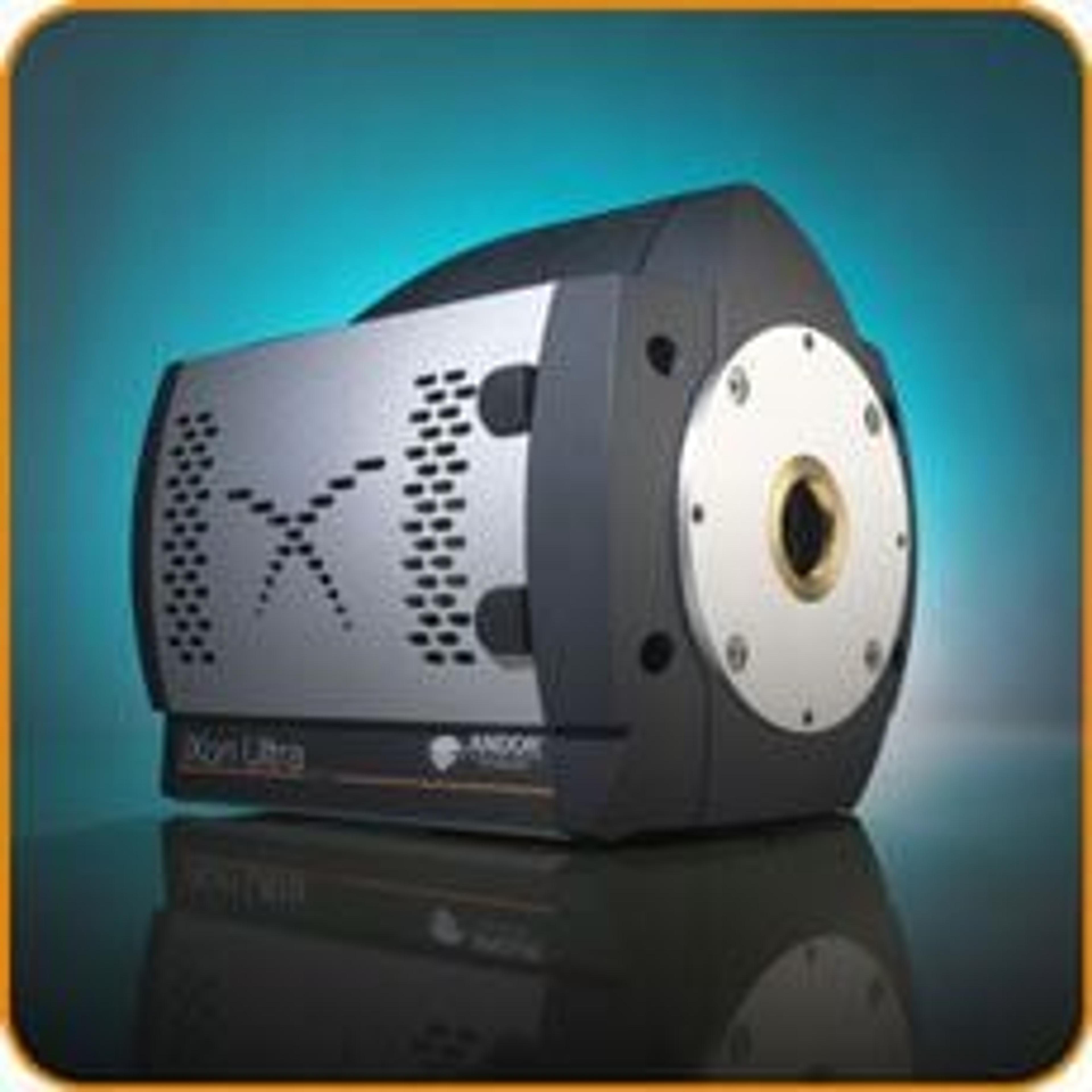
iXon Ultra 897 EMCCD Camera
Oxford Instruments AndorFacilitated by a fundamental redesign, the NEW iXon Ultra platform takes the popular back-illuminated 512 x 512 frame transfer sensor and overclocks readout to 17 MHz, pushing speed performance to an outstanding 56 fps (full frame), whilst maintaining quantitative stability throughout. The status of ‘Ultimate Sensitivity’ is also preserved in this model, offering thermoelectric cooling down to -100°C and industry-lowest clock induced charge noise. Additional unique features of the iXon Ultra include USB connectivity and direct raw data access for on the fly processing. EMCCD and conventional CCD readout modes provide heightened application flexibility, with a new ‘low and slow’ noise performance in CCD mode.
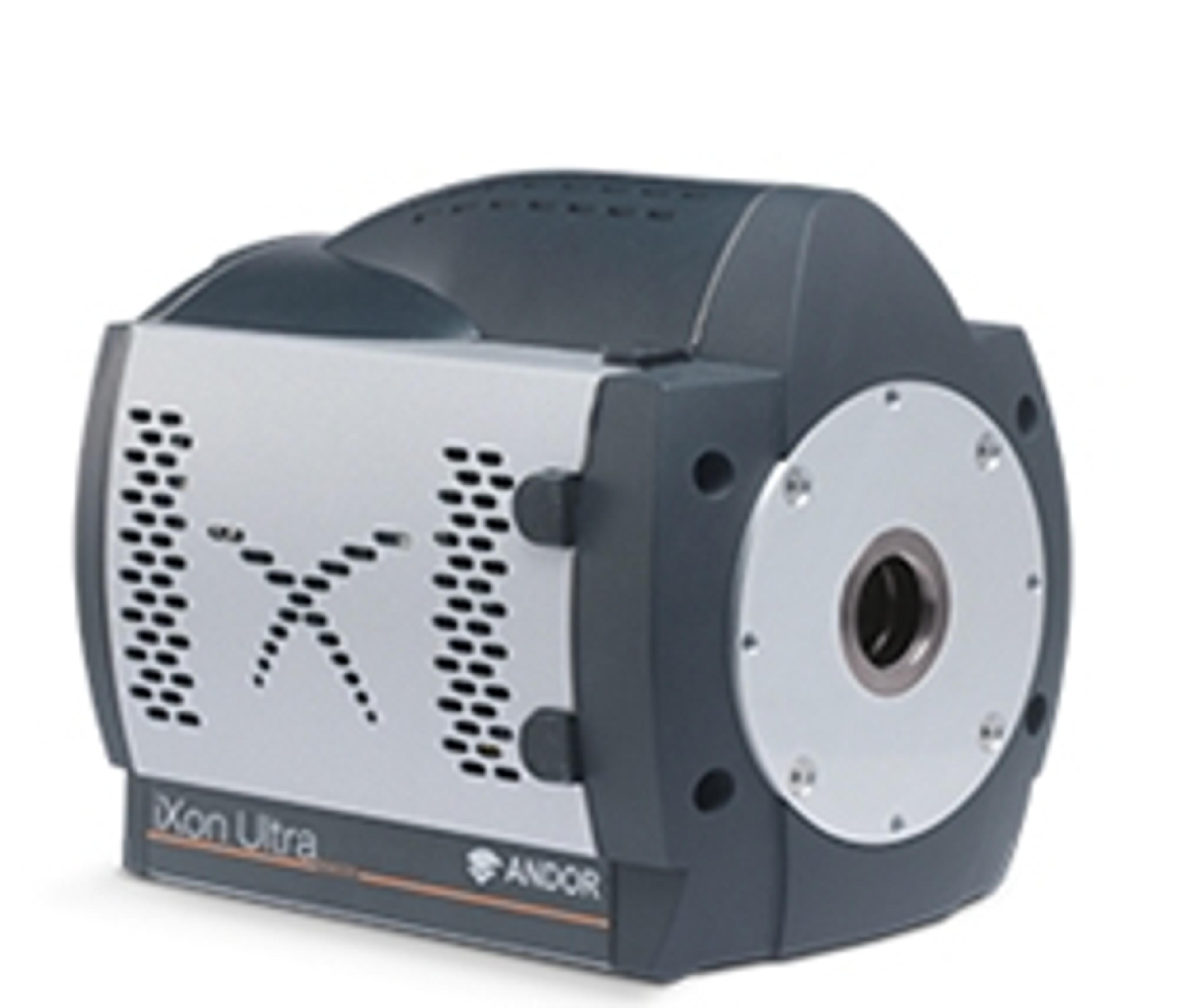
iXon Ultra 888 EMCCD Camera
Oxford Instruments AndorThe highly innovative iXon Ultra 888 is the world’s fastest Megapixel, Back-illuminated EMCCD camera, offering exceptional frame rates and single photon sensitivity across a large field of view. Building on a rich history of first to market innovation, the ‘supercharged’ iXon Ultra 888, represents a massive performance boost for the largest available EMCCD sensor, as well as the first USB3 enabled EMCCD camera. The iXon Ultra 888 has been fundamentally re-engineered to facilitate 3x overclocking of the pixel readout speed to an unprecedented 30 MHz, whilst maintaining quantitative stability, accelerating the full frame rate performance to video rate. Furthermore, Andor’s unique ‘Crop Mode’ can be employed to further boost frame rates from a user defined sub-region, for example pushing a 512 x 512 sub-array to 93 fps and a 128 x 128 area to 697 fps. With a 1024 x 1024 sensor format and 13 µm pixel size, the resolving power, field of view and unparalleled speed of the iXon Ultra 888 render it the most attractive and versatile EMCCD option for demanding applications such as single molecule detection, super-resolution microscopy, live cell imaging and high time resolution astronomy.Features: 30 MHz readout delivering 26 fps at 1024 x 1024 > 2.6x larger Field of View than ‘897’ model Optically Centered Crop Mode – Live Cell Super Resolution at 697fps Single Photon Sensitive EX2 Technology for wider QE response TE Cooling to -95°C