
AAIC 2026 highlights a turning point for Alzheimer’s disease diagnosis
SelectScience interviews leading experts at pivotal conference in London, UK
15 Jul 2026
During the AAIC 2026 conference today, one of the experts I interviewed, Dr. Ashton Harper, Global Medical Director of Neurosciences at Roche Diagnostics, told me that 75% of people with dementia, including Alzheimer’s disease, do not have a definitive diagnosis.
I later learned that this statistic is widely cited, but it was still shocking to hear in the moment. Underdiagnosis means many people may miss out on timely evaluation, treatment, planning, and support. This affects patients, of course, but also families, clinicians, and healthcare systems.
A delayed or missed dementia diagnosis can result in:
- Delayed treatment to slow or manage symptoms
- Missed opportunity to identify other potentially reversible causes
- Reduced opportunity for proactive care planning
- Increased safety risks when living arrangements and support needs remain unaddressed
- Greater caregiver burden
- Worse healthcare outcomes
- Greater pressure on already stretched healthcare systems
At the Alzheimer’s Association International Conference® 2026 in London, I spoke to some of the leading minds in the field. I expected to be impressed by the scientific advances, and I was. What I had not fully anticipated was the passion shared by everyone I spoke to, all working toward a common goal: improving outcomes for people with Alzheimer’s disease and their families. Almost everyone I interviewed, chatted to, or even queued for coffee with had a personal story connected to dementia. My own family is part of that story too; my grandmother lived with dementia in the final years of her life, although she was never formally diagnosed.
From that shared commitment comes remarkable science. I interviewed experts in the field to learn more about the technologies, initiatives, and diagnostic approaches that could help transform Alzheimer’s disease care. Below are some of the technology highlights from the day.
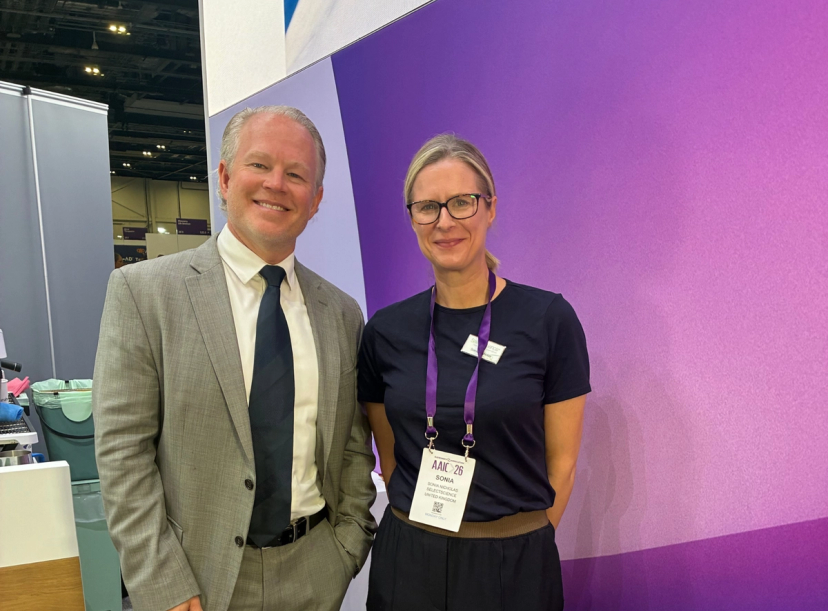
Sonia Nicholas interviews Dr. Chris Bird, Beckman Coulter Diagnostics at AAIC 2026
I spoke to Dr. Chris Bird, Chief Medical Officer and Vice President at Beckman Coulter Diagnostics, to learn more about the newly announced CE-marked Access p-Tau217 blood assay, powered by the DxI 9000 Immunoassay Analyzer. Read the official press announcement and look out for my full interview with Dr. Bird, coming soon.
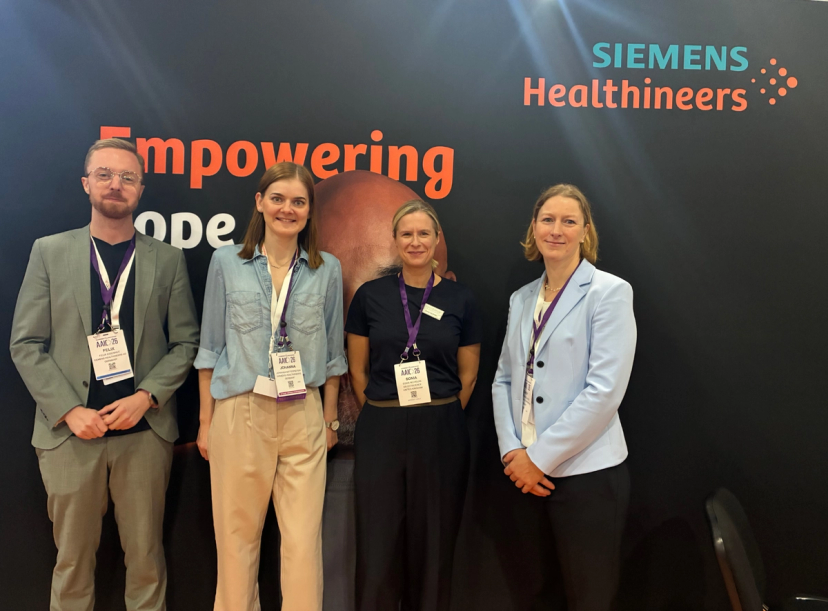
Dr. Felix Eisenhut, Johanna Mitterreiter, and Gaby Marquardt from Siemens Healthineers, with Sonia Nicholas at AAIC 2026
At the Siemens Healthineers booth, I interviewed Gaby Marquardt, Global Head of Clinical Technology and Innovation, and Prof. Charlotte Teunissen, Professor in Neurochemistry at Amsterdam UMC Alzheimer Center. I also had the privilege of speaking with Johanna Mitterreiter, Research Scientist and Project Lead. We discussed the PREDICTOM initiative, which is optimizing clinical pathways, and the ACCESS-AD project, which is focused on improving access to personalized Alzheimer’s disease care and generating real-world clinical evidence. The full interview will be available at the launch of CLINICAL24, which will highlight advances in Alzheimer’s Disease diagnostics and brain health, on October 1.
I met with the innovative team at Spear Bio and had an excellent discussion with Dr. Thomas Karikari, Director of the Biomarker and Neurogenetics Core at the University of Pittsburgh Alzheimer’s Disease Research Center, and Oliver Tassinari, Vice President of Business Development and Sales. We discussed Spear Bio’s announcement of the first commercially available singleplex eMTBR-Tau immunoassay, a novel epTau 217 assay, and a fully automated instrument platform designed to streamline SPEAR workflows. Look out for the full interview on the potential advantages these developments could offer researchers, clinicians, and, ultimately, patients.
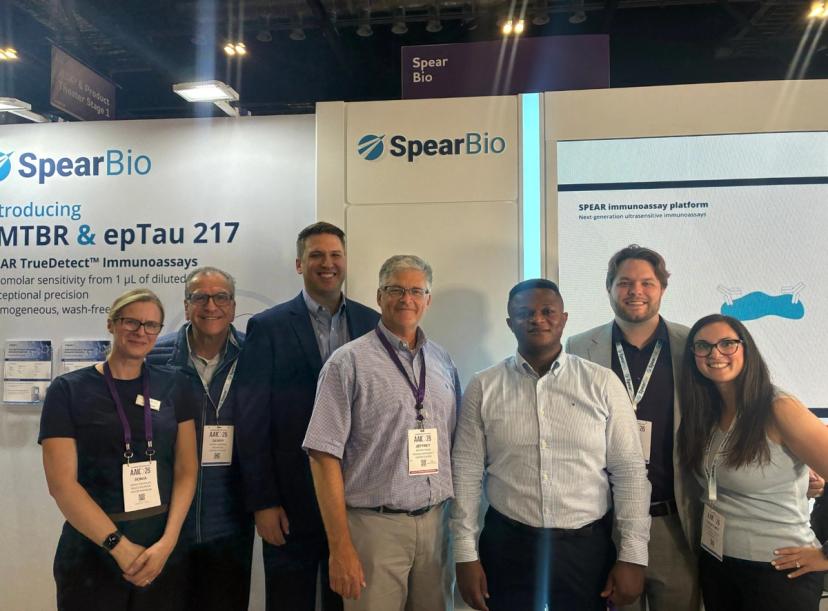
Sonia Nicholas with Gerry Andros, Oliver Tassinari, Jeffrey Dage, Dr. Thomas Karikari, Sam Olson, and Courtney Shirley at the Spear Bio booth during AAIC 2026
I was also fortunate to speak with Dr. Ashton Harper, Global Medical Director of Neurosciences at Roche Diagnostics. Dr. Harper shared sobering insights into the current state of Alzheimer’s diagnostics and discussed the growing momentum around pTau217. I learned how blood-based assays, alongside Roche Diagnostics’ broader testing portfolio, are helping reshape the patient pathway by supporting earlier, more accessible disease diagnosis. Read about the unveiling of new Alzheimer's disease data at AAIC 2026.
I visited the Fujirebio booth to see the LUMIPULSE® G System. Fujirebio recently secured CE marking for the Lumipulse® G pTau 217 Plasma assay under Regulation (EU) 2017/746 on in vitro diagnostic medical devices (IVDR). With the CE marking of Lumipulse® G pTau 217 Plasma on the LUMIPULSE® G platform, alongside Lumipulse® G NfL Blood, Fujirebio is expanding its portfolio of blood-based neurology diagnostics.
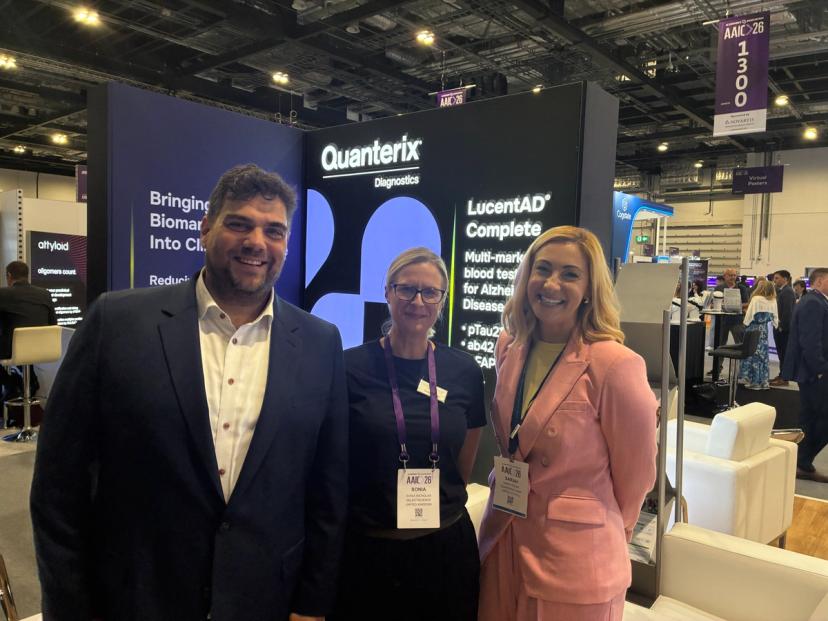
Sonia Nicholas speaks to Sarah Dolny, VP Marketing and Jorge Marques Signes, VP, Accelerator and Clinical Services from Quanterix.
I was happy to spend time on the Quanterix booth, speaking to Sarah Dolny, VP Marketing and Jorge Marques Signes, VP, Accelerator and Clinical Services, learning about Simoa technology, novel p-Tau assays, multi-analyte risk scores, and spatial phenotyping. I asked questions like will multi-analyte testing outperform single-marker approaches as the field progresses? And have we become too focused on pTau217? You'll have to wait for the final interview to learn the answers!
To round off the day, I called in at the Meso Scale Discovery (MSD) booth to see the new ProteinXI platform. This new offering enables MSD to provide one of the broadest neuroscience immunoassay menus available for biomarker research across the translational continuum.
As AAIC 2026 made clear, the future of Alzheimer’s disease diagnosis is moving rapidly toward earlier, more accessible, and more personalized approaches, with blood-based biomarkers, advanced immunoassays, and collaborative clinical initiatives all playing a vital role. The challenge now is to translate this scientific momentum into real-world impact for patients, families, and healthcare systems.
This October, CLINICAL24 will continue that conversation with a dedicated focus on Alzheimer’s disease diagnostics and brain health, exploring the technologies, evidence, and expert insights shaping the next era of neurological care. You can also visit our new feature: Alzheimer’s disease and dementia diagnostics. If you are working in this field, I’d love to hear from you at editor@selectscience.net.
Article written by Sonia Nicholas, SelectScience, reporting from AAIC 2026, London, UK
Tags
Frequently asked questions
Show frequently asked questions
Why is earlier diagnosis important in Alzheimer’s disease?
Earlier diagnosis can help people with Alzheimer’s disease and other forms of dementia access timely clinical evaluation, treatment options, support services, and care planning. It may also help clinicians identify other causes of cognitive symptoms and guide patients toward the most appropriate pathway.
What are blood-based biomarkers for Alzheimer’s disease?
Blood-based biomarkers are measurable biological indicators found in blood that may help detect or monitor disease processes associated with Alzheimer’s disease. Biomarkers such as phosphorylated tau, including pTau217, are attracting significant attention because they could support more accessible and scalable approaches to diagnosis and clinical research.
What is pTau217 and why is it important?
pTau217 is a phosphorylated form of tau protein that is being studied and developed as a biomarker for Alzheimer’s disease. Its growing role in blood-based testing reflects wider efforts to make Alzheimer’s disease assessment more accessible, less invasive, and better integrated into clinical decision-making.
How could new Alzheimer’s diagnostics change the patient pathway?
Emerging diagnostic technologies could help move Alzheimer’s disease assessment toward earlier, more efficient, and more personalized pathways. Blood-based assays, automated immunoassay platforms, and real-world evidence initiatives may help clinicians identify patients who need further investigation, monitor disease biology, and improve access to specialist care.
What will CLINICAL24 cover in relation to Alzheimer’s disease and brain health?
Launching in October, CLINICAL24 will explore advances in Alzheimer’s disease diagnostics and brain health, including blood-based biomarkers, clinical laboratory innovation, emerging evidence, and expert perspectives on how new technologies could support earlier diagnosis and better neurological care.